US Retail Sales rise by 0.2% in September vs. 0.4% expected
- Retail Sales in the US rose less than expected in September.
- The US Dollar Index stays in negative territory, slightly below 100.00.

Retail Sales in the United States (US) rose by 0.2% on a monthly basis in September to $733.3 billion, the US Census Bureau reported on Tuesday. This print followed the 0.6% increase recorded in August and came in below the market's expectation of 0.4%.
"Total sales for the July 2025 through September 2025 period were up 4.5 percent (±0.4 percent) from the same period a year ago," the press release read.
"The July 2025 to August 2025 percent change was unrevised from up 0.6 percent (±0.2 percent). Retail trade sales were up 0.1 percent (±0.5 percent) from August 2025, and up 3.9 percent (±0.5 percent) from last year."
Market reaction
The US Dollar (USD) remains under pressure in the early American session on Tuesday. At the time of press, the USD Index is down 0.2% on the day, at 99.97.
US Dollar Price Today
The table below shows the percentage change of US Dollar (USD) against listed major currencies today. US Dollar was the weakest against the Japanese Yen.
| USD | EUR | GBP | JPY | CAD | AUD | NZD | CHF | |
|---|---|---|---|---|---|---|---|---|
| USD | -0.20% | -0.28% | -0.34% | 0.04% | 0.09% | 0.17% | 0.13% | |
| EUR | 0.20% | -0.07% | -0.14% | 0.25% | 0.28% | 0.36% | 0.32% | |
| GBP | 0.28% | 0.07% | -0.04% | 0.32% | 0.36% | 0.44% | 0.40% | |
| JPY | 0.34% | 0.14% | 0.04% | 0.37% | 0.42% | 0.48% | 0.46% | |
| CAD | -0.04% | -0.25% | -0.32% | -0.37% | 0.05% | 0.11% | 0.08% | |
| AUD | -0.09% | -0.28% | -0.36% | -0.42% | -0.05% | 0.08% | 0.03% | |
| NZD | -0.17% | -0.36% | -0.44% | -0.48% | -0.11% | -0.08% | -0.04% | |
| CHF | -0.13% | -0.32% | -0.40% | -0.46% | -0.08% | -0.03% | 0.04% |
The heat map shows percentage changes of major currencies against each other. The base currency is picked from the left column, while the quote currency is picked from the top row. For example, if you pick the US Dollar from the left column and move along the horizontal line to the Japanese Yen, the percentage change displayed in the box will represent USD (base)/JPY (quote).
This section below was published as a preview of the US Retail Sales data at 10:57 GMT.
- US Retail Sales are expected to have grown 0.4% in September after a 0.6% rise in August.
- Excluding autos, sales of all other products are seen easing to 0.4% after a 0.7% rise in August.
- A sharp decline in consumption might boost hopes of further Fed cuts and weigh on the USD.
With the US Government open again after a 43-day shutdown, federal agencies are scrambling through a backlog of data to deliver a stream of delayed macroeconomic releases. The focus today is on September’s US Retail Sales report.
The latest reference, released more than two months ago, showed a strong increase in retail consumption, with a 0.6% monthly gain beating market expectations and easing concerns about the deterioration of the labour market. Likewise, the core Retail Sales grew at a larger-than-expected 0.7% rate.
US Dollar Price This week
The table below shows the percentage change of US Dollar (USD) against listed major currencies this week. US Dollar was the strongest against the Swiss Franc.
| USD | EUR | GBP | JPY | CAD | AUD | NZD | CHF | |
|---|---|---|---|---|---|---|---|---|
| USD | -0.20% | -0.22% | -0.14% | 0.08% | -0.01% | 0.13% | 0.15% | |
| EUR | 0.20% | -0.03% | 0.07% | 0.28% | 0.18% | 0.29% | 0.35% | |
| GBP | 0.22% | 0.03% | 0.08% | 0.31% | 0.21% | 0.35% | 0.38% | |
| JPY | 0.14% | -0.07% | -0.08% | 0.23% | 0.07% | 0.13% | 0.30% | |
| CAD | -0.08% | -0.28% | -0.31% | -0.23% | -0.09% | 0.05% | 0.07% | |
| AUD | 0.01% | -0.18% | -0.21% | -0.07% | 0.09% | 0.15% | 0.17% | |
| NZD | -0.13% | -0.29% | -0.35% | -0.13% | -0.05% | -0.15% | 0.03% | |
| CHF | -0.15% | -0.35% | -0.38% | -0.30% | -0.07% | -0.17% | -0.03% |
The heat map shows percentage changes of major currencies against each other. The base currency is picked from the left column, while the quote currency is picked from the top row. For example, if you pick the US Dollar from the left column and move along the horizontal line to the Japanese Yen, the percentage change displayed in the box will represent USD (base)/JPY (quote).
US Retail Sales data overview
The US Census Bureau will release the United States (US) Retail Sales for September on Tuesday, at 13:30 GMT. Retail consumption, a key measure of consumer spending, is expected to have moderated its growth to 0.4%, following August’s 0.6% increase. In the same line, Retail Sales excluding autos are seen growing at a 0.4% monthly pace, down from 0.7% in the previous month.
Tuesday’s Retail Sales data might have a significant impact on currency markets, as it will test the strength of US consumption, a leading contributor to the country’s Gross Domestic Product (GDP). Retail Sales are also a key element of the Federal Reserve’s (Fed) monetary policy decisions, as they hint at future inflation trends. In that sense, today’s readings will be closely observed by the market to assess the chances of an interest rate cut in December.
Rising consumer spending signals strong demand, pushing consumer inflation higher and encouraging business owners to raise prices at the factory gate. All in all, an inflationary scenario that forces the Fed to adopt a hawkish stance on interest rates. Weaker consumption, by contrast, would allow the Fed to turn dovish on policy rates to boost demand and support economic growth.
How could the US Retail Sales data affect EUR/USD?
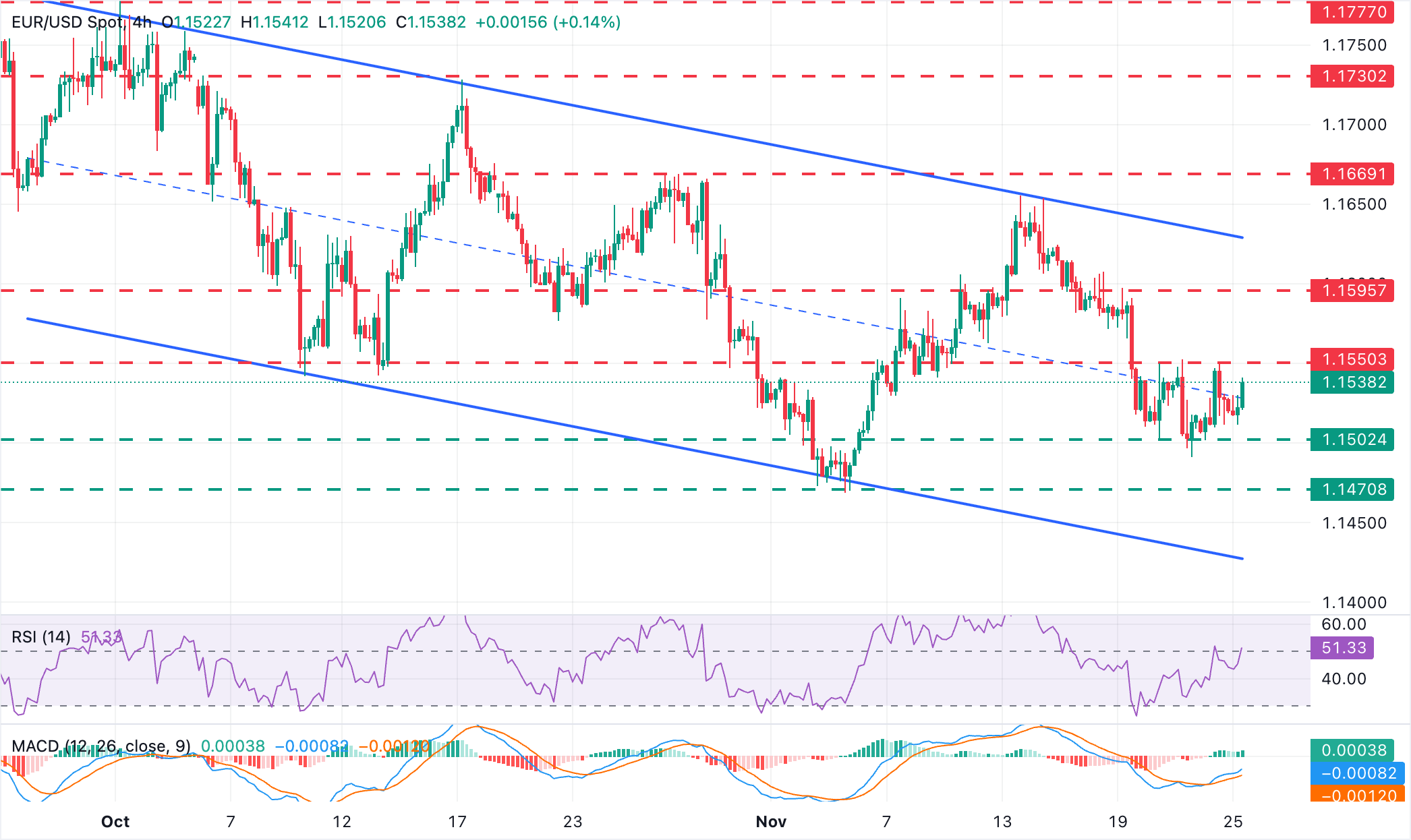
EUR/USD is posting moderate gains but remains trapped within a narrow range, right above two-week lows at 1.1500, with upside attempts limited to 1.1550 so far, after a nearly 1% decline last week.
Recent dovish comments by Fed officials have revived hopes of further monetary easing after the December meeting, but market expectations are volatile. Investors are awaiting additional US macroeconomic data to better assess the monetary policy path. In that sense, September’s Retail Sales might be a key release.
A sharper-than-expected slowdown in consumption would give further reasons for Fed doves to lower borrowing costs by 25 basis points in December, and might feed hopes of further monetary easing in the first quarter of 2026.
This would add pressure on the US Dollar and help the Euro to extend its recovery beyond the 1.1550 resistance area, aiming to 1.1600 and the late October highs, at the 1.1670 area.
A positive surprise, on the contrary, might curb hopes of a December rate cut and buoy the US Dollar higher. A EUR/USD break below 1.1500, in that case, would open the path towards the key Support at 1.1470, which guards the path to the August low, near 1.1400.
Economic Indicator
Retail Sales (MoM)
The Retail Sales data, released by the US Census Bureau on a monthly basis, measures the value in total receipts of retail and food stores in the United States. Monthly percent changes reflect the rate of changes in such sales. A stratified random sampling method is used to select approximately 4,800 retail and food services firms whose sales are then weighted and benchmarked to represent the complete universe of over three million retail and food services firms across the country. The data is adjusted for seasonal variations as well as holiday and trading-day differences, but not for price changes. Retail Sales data is widely followed as an indicator of consumer spending, which is a major driver of the US economy. Generally, a high reading is seen as bullish for the US Dollar (USD), while a low reading is seen as bearish.
Read more.Next release: Tue Nov 25, 2025 13:30
Frequency: Monthly
Consensus: 0.4%
Previous: 0.6%
Source: US Census Bureau
Retail Sales data published by the US Census Bureau is a leading indicator that gives important information about consumer spending, which has a significant impact on the GDP. Although strong sales figures are likely to boost the USD, external factors, such as weather conditions, could distort the data and paint a misleading picture. In addition to the headline data, changes in the Retail Sales Control Group could trigger a market reaction as it is used to prepare the estimates of Personal Consumption Expenditures for most goods.
Economic Indicator
Retail Sales ex Autos (MoM)
The Retail Sales ex Autos data, released by the US Census Bureau on a monthly basis, measures the value in total receipts of retail and food stores in the United States excluding the key sector of motor vehicles and parts. A stratified random sampling method is used to select approximately 4,800 retail and food services firms whose sales are then weighted and benchmarked to represent the complete universe of over three million retail and food services firms across the country. The data is adjusted for seasonal variations as well as holiday and trading-day differences, but not for price changes. Retail sales data is widely followed as an indicator of consumer spending, which is a major driver of the US economy. Generally, a high reading is seen as bullish for the US Dollar (USD), while a low reading is seen as bearish.
Read more.Last release: Tue Sep 16, 2025 12:30
Frequency: Monthly
Actual: 0.7%
Consensus: 0.4%
Previous: 0.3%
Source: US Census Bureau
Author

Guillermo Alcala
FXStreet
Graduated in Communication Sciences at the Universidad del Pais Vasco and Universiteit van Amsterdam, Guillermo has been working as financial news editor and copywriter in diverse Forex-related firms, like FXStreet and Kantox.