When is the US ISM Services PMI data for December and how could it affect EUR/USD?

US ISM Services PMI Preview
The United States (US) Institute of Supply Management (ISM) Services Purchasing Managers’ Index (PMI) data for December is scheduled to be published today at 15:00 GMT.
The ISM is expected to show that activities in the services sector grew again, but at a moderate pace. The Services PMI is seen at 52.3, lower than 52.6 in November. Investors will pay close attention to the Services PMI data as the related sector accounts for two-thirds of the US economy.
Apart from the Services PMI, investors will also focus on subcomponents of data, such as the Employment Index, the New Orders Index, and Prices Paid.
Weaker-than-projected US ISM Services PMI data would prompt expectations for interest rate cuts by the Federal Reserve (Fed) as policymakers have remained concerned about the economic outlook. However, better figures would be a relief for Fed officials, but will unlikely act as a major drag on Fed dovish expectations.
How could US ISM Services PMI data will affect EUR/USD?
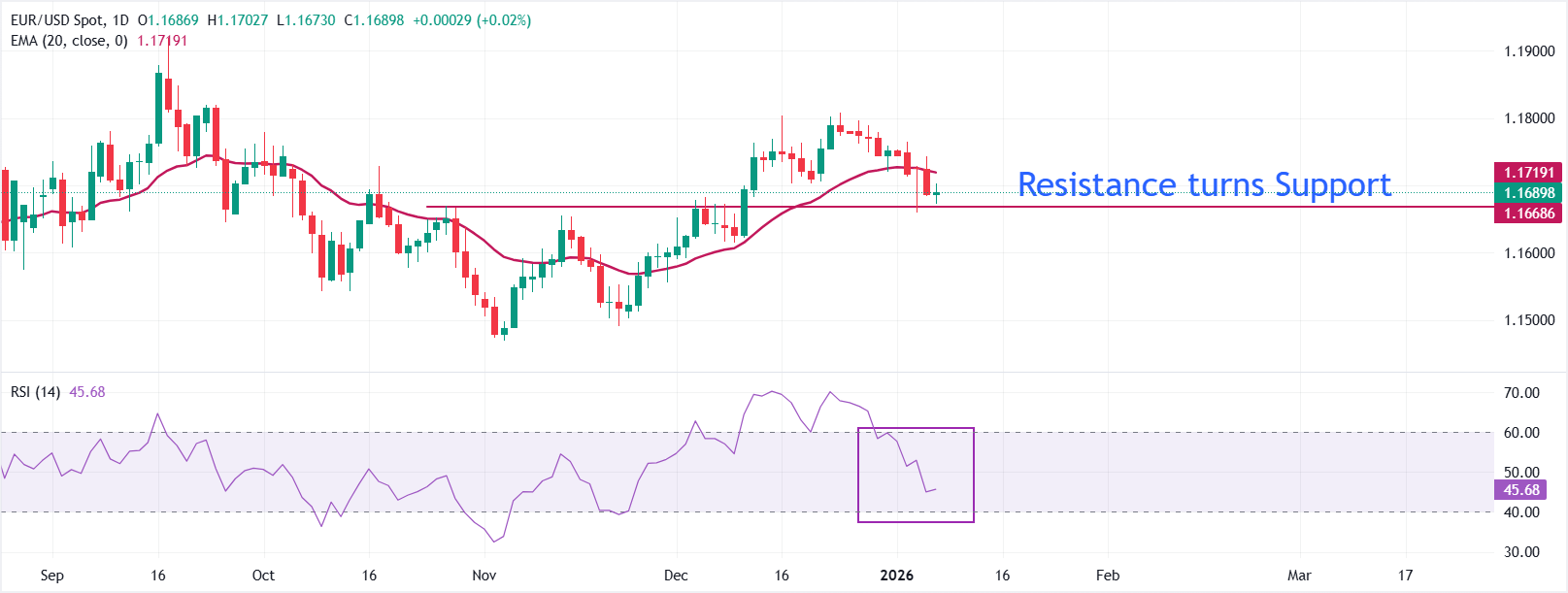
EUR/USD trades flat at 1.1690 at the time of writing. The pair sits below the 20-day Exponential Moving Average at 1.1719, which has begun to turn lower and caps rebounds.
The 14-day Relative Strength Index (RSI) at 45.7 (neutral) is descending, confirming weakening momentum and a heavier near-term tone.
Though indicators show that the short-term structure is bearish, the odds of a bullish reversal are high as the price is close to its key support near the December 4 high around 1.1670, which used to act as a key barrier for the pair. The major currency pair could face fresh downside towards the November 28 low of 1.1555 if it breaks below the December 4 high of 1.1670.
On the contrary, the pair could revisit an over three-month high of 1.1800 if it recovers above the January 6 high of 1.1743.
(The technical analysis of this story was written with the help of an AI tool.)
Economic Indicator
ISM Services PMI
The Institute for Supply Management (ISM) Services Purchasing Managers Index (PMI), released on a monthly basis, is a leading indicator gauging business activity in the US services sector, which makes up most of the economy. The indicator is obtained from a survey of supply executives across the US based on information they have collected within their respective organizations. Survey responses reflect the change, if any, in the current month compared to the previous month. A reading above 50 indicates that the services economy is generally expanding, a bullish sign for the US Dollar (USD). A reading below 50 signals that services sector activity is generally declining, which is seen as bearish for USD.
Read more.Next release: Wed Jan 07, 2026 15:00
Frequency: Monthly
Consensus: 52.3
Previous: 52.6
Source: Institute for Supply Management
The Institute for Supply Management’s (ISM) Services Purchasing Managers Index (PMI) reveals the current conditions in the US service sector, which has historically been a large GDP contributor. A print above 50 shows expansion in the service sector’s economic activity. Stronger-than-expected readings usually help the USD gather strength against its rivals. In addition to the headline PMI, the Employment Index and the Prices Paid Index numbers are also watched closely by investors as they provide useful insights regarding the state of the labour market and inflation.
Author

Sagar Dua
FXStreet
Sagar Dua is associated with the financial markets from his college days. Along with pursuing post-graduation in Commerce in 2014, he started his markets training with chart analysis.