Breaking: China’s CPI inflation arrives at -0.3% YoY in September vs. -0.1% expected

China’s Consumer Price Index (CPI) declined 0.3% in September from a year ago after arriving a fall of 0.4% in August, the National Bureau of Statistics of China reported on Wednesday. The market consensus was for -0.1% in the reported period.
Chinese CPI inflation rose 0.1% MoM in September versus 0% prior. This figure came in softer than the expectation of 0.2%.
China’s Producer Price Index (PPI) dropped 2.3% YoY in September, following a 2.9% fall in August. The data came in line with the market consensus.
Market reaction to China’s inflation data
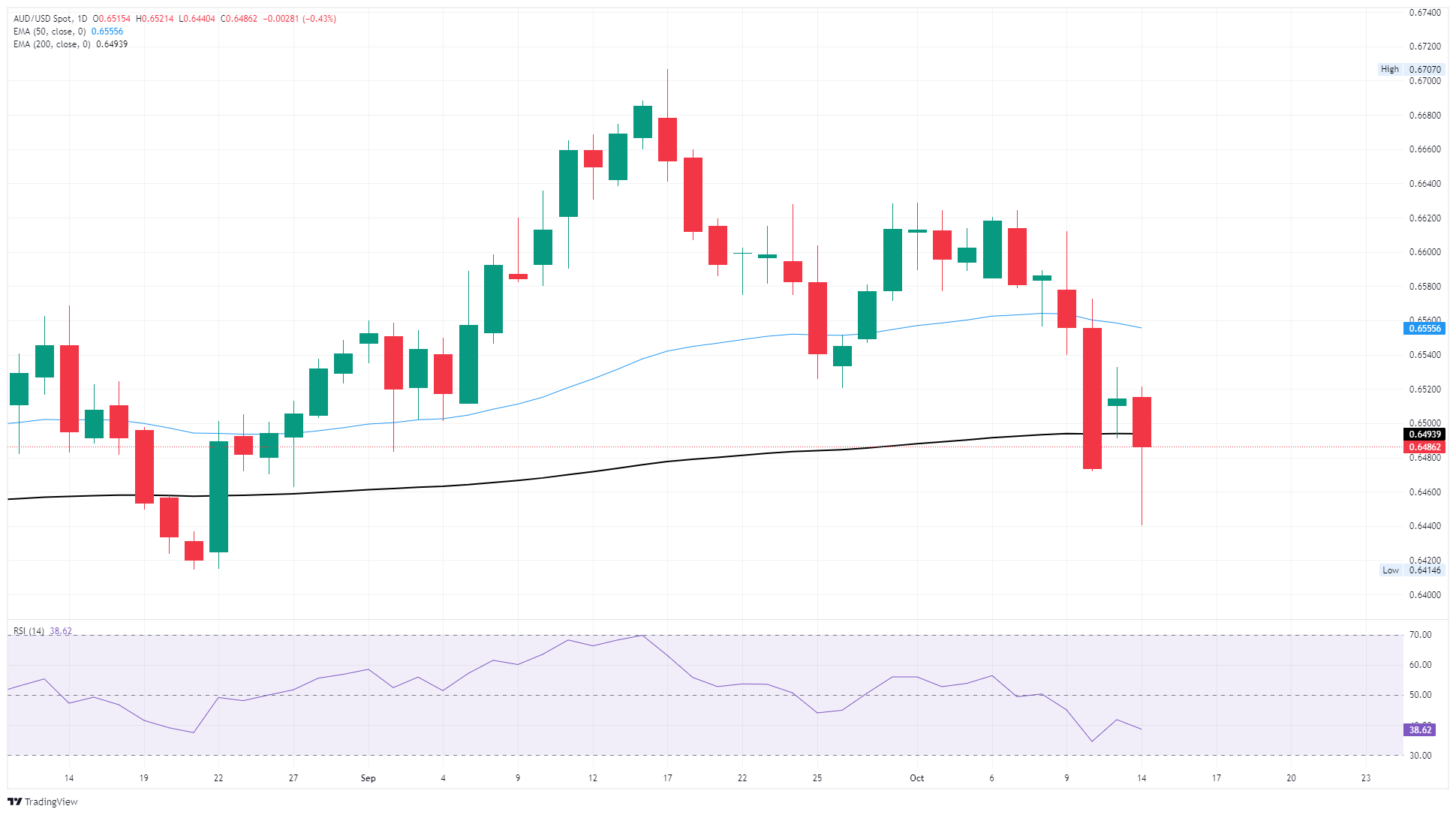
At the press time, the AUD/USD pair is up 0.25% on the day to trade at 0.6502.
Australian Dollar Price This week
The table below shows the percentage change of Australian Dollar (AUD) against listed major currencies this week. Australian Dollar was the strongest against the New Zealand Dollar.
| USD | EUR | GBP | JPY | CAD | AUD | NZD | CHF | |
|---|---|---|---|---|---|---|---|---|
| USD | -0.03% | 0.08% | -0.38% | 0.31% | 0.14% | 0.41% | -0.11% | |
| EUR | 0.03% | 0.11% | -0.32% | 0.32% | 0.25% | 0.44% | -0.09% | |
| GBP | -0.08% | -0.11% | -0.40% | 0.22% | 0.13% | 0.33% | -0.22% | |
| JPY | 0.38% | 0.32% | 0.40% | 0.65% | 0.48% | 0.84% | 0.23% | |
| CAD | -0.31% | -0.32% | -0.22% | -0.65% | -0.20% | 0.12% | -0.44% | |
| AUD | -0.14% | -0.25% | -0.13% | -0.48% | 0.20% | 0.21% | -0.35% | |
| NZD | -0.41% | -0.44% | -0.33% | -0.84% | -0.12% | -0.21% | -0.56% | |
| CHF | 0.11% | 0.09% | 0.22% | -0.23% | 0.44% | 0.35% | 0.56% |
The heat map shows percentage changes of major currencies against each other. The base currency is picked from the left column, while the quote currency is picked from the top row. For example, if you pick the Australian Dollar from the left column and move along the horizontal line to the US Dollar, the percentage change displayed in the box will represent AUD (base)/USD (quote).
This section was published on Wednesday at 23:30 GMT as a preview of China's CPI data.
Chinese CPI/PPI overview
China releases its latest Consumer Price Index (CPI) and Producer Price Index (PPI) inflation metrics early Wednesday at 01:30 GMT, and will be providing markets with a much-needed update on potential trade war fallout between China and the US as trade tensions between the two giants ramps up once again.
While tariff impacts and economic inflation from China don’t impact the Australian Dollar (AUD) directly, Australia’s economic zone is tied tightly to demand growth in domestic Chinese markets, and rapid shifts in Chinese inflation figures will have knock-on consequences for Australian growth prospects.
Chinese CPI inflation is expected to show a 0.2% bump MoM in September, compared to the previous month’s sluggish 0.0%. On an annualized basis, Chinese CPI inflation is still expected to hold on the low side, forecast at a 0.1% contraction, but still an improvement over the previous YoY period of -0.4%.
Chinese PPI tells a vastly different story, expected to clock in at -2.3% YoY in September, but even this represents an improvement from August’s -2.9% YoY print.

How could it impact AUD/USD?
With Australia’s close economic ties to China, what’s good (or bad) for the gander is frequently the same for the goose. As China takes steps to throw off downside economic fallout from the US’s steady ramp-up of trade war rhetoric through 2025, signs of continued domestic growth will help bolster expectations of continued economic expansion in Australia. On the other hand, a steepening economic slump in China could spell doom for Australia, which is already teetering on a wobbly economy.
Healthy inflationary pressures in China would typically provide low-pressure yet sustained bullish pressure for the Australian Dollar (AUD), while a further steepening into a deflationary hole will erode the Aussie’s market position over time.
AUD/USD daily chart
Australian Dollar FAQs
One of the most significant factors for the Australian Dollar (AUD) is the level of interest rates set by the Reserve Bank of Australia (RBA). Because Australia is a resource-rich country another key driver is the price of its biggest export, Iron Ore. The health of the Chinese economy, its largest trading partner, is a factor, as well as inflation in Australia, its growth rate and Trade Balance. Market sentiment – whether investors are taking on more risky assets (risk-on) or seeking safe-havens (risk-off) – is also a factor, with risk-on positive for AUD.
The Reserve Bank of Australia (RBA) influences the Australian Dollar (AUD) by setting the level of interest rates that Australian banks can lend to each other. This influences the level of interest rates in the economy as a whole. The main goal of the RBA is to maintain a stable inflation rate of 2-3% by adjusting interest rates up or down. Relatively high interest rates compared to other major central banks support the AUD, and the opposite for relatively low. The RBA can also use quantitative easing and tightening to influence credit conditions, with the former AUD-negative and the latter AUD-positive.
China is Australia’s largest trading partner so the health of the Chinese economy is a major influence on the value of the Australian Dollar (AUD). When the Chinese economy is doing well it purchases more raw materials, goods and services from Australia, lifting demand for the AUD, and pushing up its value. The opposite is the case when the Chinese economy is not growing as fast as expected. Positive or negative surprises in Chinese growth data, therefore, often have a direct impact on the Australian Dollar and its pairs.
Iron Ore is Australia’s largest export, accounting for $118 billion a year according to data from 2021, with China as its primary destination. The price of Iron Ore, therefore, can be a driver of the Australian Dollar. Generally, if the price of Iron Ore rises, AUD also goes up, as aggregate demand for the currency increases. The opposite is the case if the price of Iron Ore falls. Higher Iron Ore prices also tend to result in a greater likelihood of a positive Trade Balance for Australia, which is also positive of the AUD.
The Trade Balance, which is the difference between what a country earns from its exports versus what it pays for its imports, is another factor that can influence the value of the Australian Dollar. If Australia produces highly sought after exports, then its currency will gain in value purely from the surplus demand created from foreign buyers seeking to purchase its exports versus what it spends to purchase imports. Therefore, a positive net Trade Balance strengthens the AUD, with the opposite effect if the Trade Balance is negative.
Author

FXStreet Team
FXStreet
Composed of a group of economic journalists and FX experts, the FXStreet content team produces and oversees all content published on FXStreet. It provides a purely journalistic approach to the Forex market.

















