Canadian Unemployment Rate came in at 6.9% in October

Canada’s Unemployment Rate ticked lower to 6.9% in October (from 7.1%), coming in below analysts' expectations, according to Statistics Canada. In addition, the Net Change in Employment increased by 66.6K individuals (from 60.4K), while the Participation Rate improved to 65.3% (from 65.2%). Finally, Average Hourly Wages, a proxy of inflation, rose by 4% over the last twelve months.
Market reaction
The Canadian Dollar (CAD) picks up pace and drags USD/CAD back below the 1.4100 support in the wake of the release, reversing a six-day consecutive daily advance.
Canadian Dollar Price Today
The table below shows the percentage change of Canadian Dollar (CAD) against listed major currencies today. Canadian Dollar was the strongest against the New Zealand Dollar.
| USD | EUR | GBP | JPY | CAD | AUD | NZD | CHF | |
|---|---|---|---|---|---|---|---|---|
| USD | -0.19% | 0.00% | 0.06% | -0.19% | -0.16% | 0.16% | -0.20% | |
| EUR | 0.19% | 0.18% | 0.25% | -0.00% | 0.02% | 0.34% | -0.02% | |
| GBP | -0.00% | -0.18% | 0.06% | -0.21% | -0.16% | 0.16% | -0.20% | |
| JPY | -0.06% | -0.25% | -0.06% | -0.22% | -0.20% | 0.10% | -0.24% | |
| CAD | 0.19% | 0.00% | 0.21% | 0.22% | 0.02% | 0.32% | -0.01% | |
| AUD | 0.16% | -0.02% | 0.16% | 0.20% | -0.02% | 0.32% | -0.03% | |
| NZD | -0.16% | -0.34% | -0.16% | -0.10% | -0.32% | -0.32% | -0.36% | |
| CHF | 0.20% | 0.02% | 0.20% | 0.24% | 0.01% | 0.03% | 0.36% |
The heat map shows percentage changes of major currencies against each other. The base currency is picked from the left column, while the quote currency is picked from the top row. For example, if you pick the Canadian Dollar from the left column and move along the horizontal line to the US Dollar, the percentage change displayed in the box will represent CAD (base)/USD (quote).
This section below was published as a preview of the Canadian labour market report for October at 11:38 GMT.
Canada Employment Overview
The Canadian labour market data for October is due for release today at 13:30 GMT. Statistics Canada is expected to show that employers laid off 2.5K workers, against hiring of 60.4K job-seekers in September.
Signs of slowdown in the job market are expected to be unfavorable for the Canadian Dollar (CAD), given that cooling labor market conditions prompt the need of more interest rate cuts by the Bank of Canada.
Meanwhile, the Canadian Unemployment Rate is expected to remain steady at 7.1%. This is the highest level seen since July 2021.
Apart from the job data, investors will focus on Average Hourly Wages, an economic indicator that reflects chance in wage growth. In September, the wage growth measure rose by 3.6% on an annualized basis.
How could the Canadian employment data affect USD/CAD?
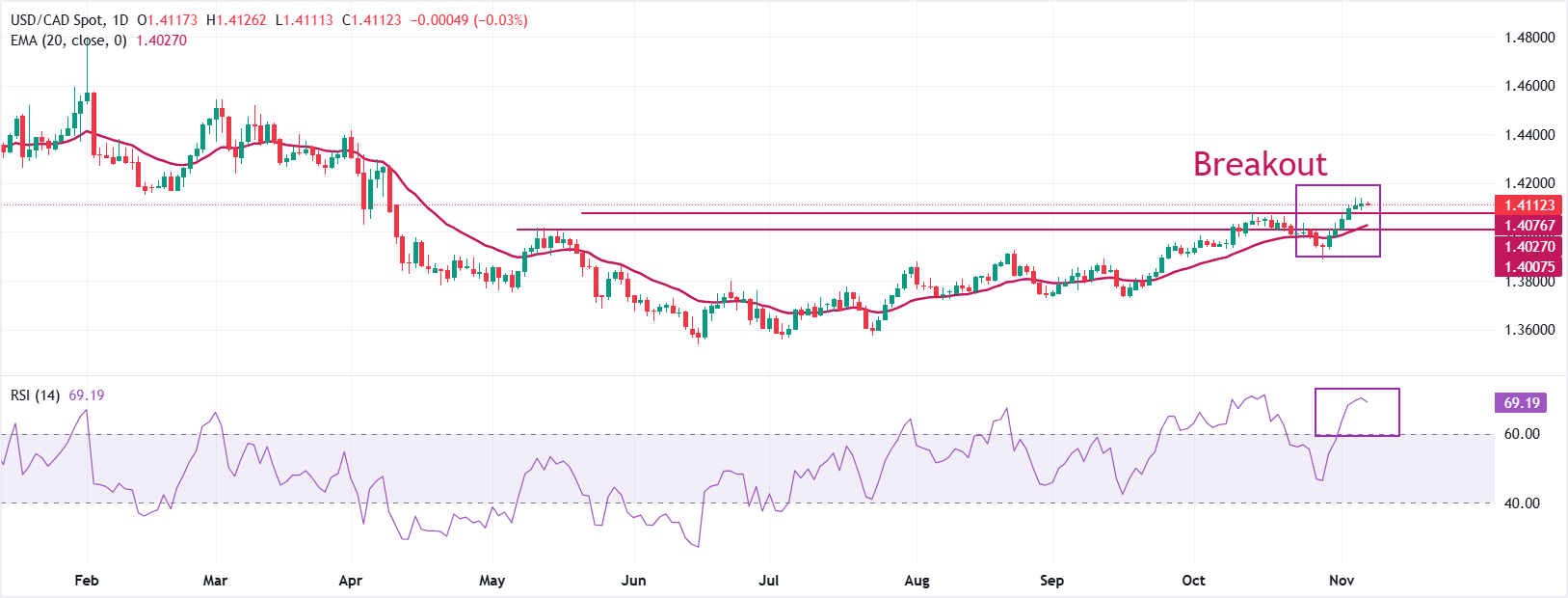
The USD/CAD pair trades in a tight range around 1.4100 ahead of the Canadia labour market data release. Broadly, the Loonie pair is bullish as it holds the breakout of the previous resistance zone placed in a range between 1.4016-1.4080.
The upward-sloping 20-day Exponential Moving Average (EMA) near 1.4027 suggests that the near-term trend is bullish.
The 14-day Relative Strength Index (RSI) trades around 70.00, indicating a strong bullish momentum.
Looking up, the USD/CAD pair could rise towards the round-level figure of 1.4200 and the April 9 high of 1.4274 if it breaks above the November 6 high of 1.4140
On the flip side, the asset could slide towards the round level of 1.3600 and June 16 low of 1.3540 if it breaks below the August 7 low of 1.3722.
Economic Indicator
Net Change in Employment
The Net Change in Employment released by Statistics Canada is a measure of the change in the number of people in employment in Canada. Generally speaking, a rise in this indicator has positive implications for consumer spending and indicates economic growth. Therefore, a high reading is seen as bullish for the Canadian Dollar (CAD), while a low reading is seen as bearish.
Read more.Next release: Fri Nov 07, 2025 13:30
Frequency: Monthly
Consensus: -2.5K
Previous: 60.4K
Source: Statistics Canada
Canada’s labor market statistics tend to have a significant impact on the Canadian dollar, with the Employment Change figure carrying most of the weight. There is a significant correlation between the amount of people working and consumption, which impacts inflation and the Bank of Canada’s rate decisions, in turn moving the C$. Actual figures beating consensus tend to be CAD bullish, with currency markets usually reacting steadily and consistently in response to the publication.
Author

FXStreet Team
FXStreet
Composed of a group of economic journalists and FX experts, the FXStreet content team produces and oversees all content published on FXStreet. It provides a purely journalistic approach to the Forex market.














