What are the different types of IRAs and which one is right for you?

Given the uncertainty surrounding the future of Social Security and the fact that people are living longer, Individual Retirement Accounts (IRAs) have become an essential tool for building a solid supplementary pension within retirement planning.
But the universe of IRAs is much wider than many might imagine. Between classic accounts, those designed for the self-employed or small businesses, rollover IRAs and self-directed accounts, there's a retirement planning solution to suit almost every personal and professional situation.
Here's an in-depth exploration of the different types of IRA, with their rules, tax advantages, constraints and target audiences.
Classic IRAs: Roth and Traditional
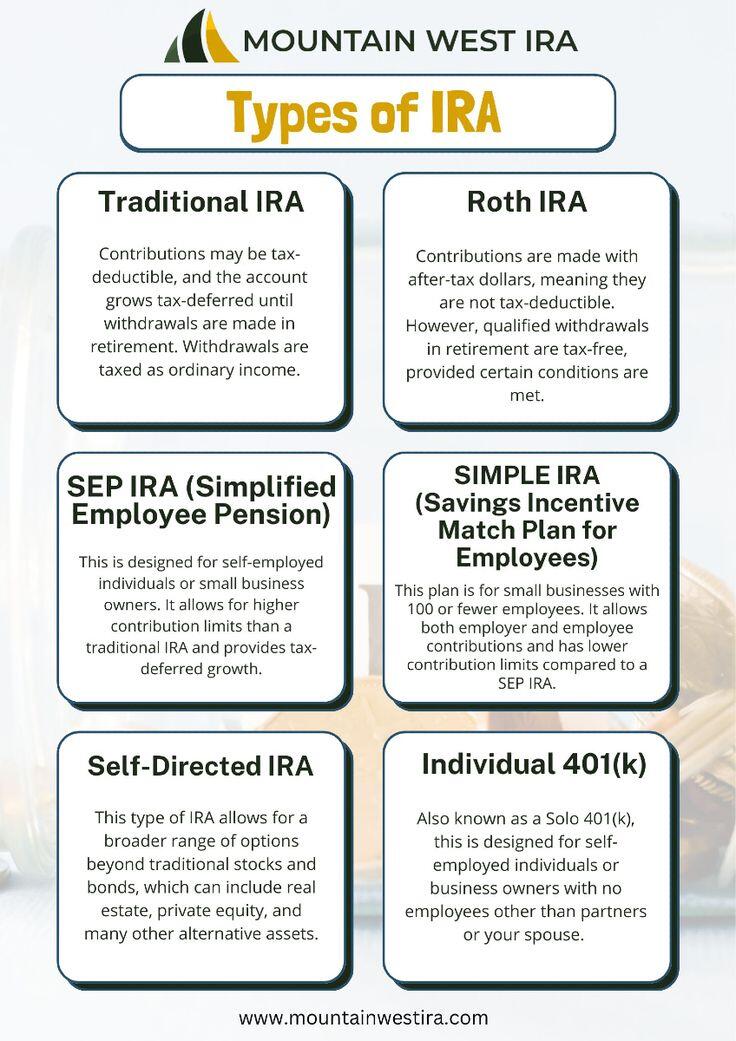
Traditional IRA
The Traditional IRA is the most widely used retirement account. Contributions are often tax-deductible, depending on income level and access to a company retirement plan.
Earnings accumulate tax-free, but withdrawals are taxed at retirement, and Required Minimum Distributions (RMDs) are mandatory from age 73.
Tax advantage: Immediate tax savings.
Preferred if you're in a high tax bracket today and anticipate lower income in retirement.
Roth IRA
The Roth IRA works with after-tax contributions. In return, withdrawals are completely tax-free, including earnings. There is no RMD during the owner's lifetime.
Tax advantage: Total exemption on withdrawal.
Limitation: Inaccessible above a certain annual income ($165,000 for a single person in 2025).
Preferable if you're young, or if you anticipate a rise in taxes or income over the long term.
IRAs for the self-employed and small businesses
SEP-IRA
Designed for self-employed workers and small business owners, the SEP-IRA (Simplified Employee Pension) allows contributions of up to 25% of income, with a limit of $70,000 in 2025.
Only the employer is authorized to make contributions, but must pay all eligible employees the same percentage of their remuneration.
Advantage: Higher contribution limit, greater flexibility.
Limitation: No employee contribution is possible and there is no catch-up after age 50.
SIMPLE IRA
The SIMPLE IRA (Savings Incentive Match Plan for Employees) is a lighter alternative to the 401(k) for companies with fewer than 100 employees.
It allows employees to contribute, with a mandatory employer contribution (up to 3% of salary or 2% lump-sum).
The contribution ceiling is set at $16,500 in 2025, with the possibility of additional contributions for people nearing retirement, depending on their age.
Advantage: Easy for employers to set up.
Limitation: Increased withdrawal penalties in the first two years.
Transfer, conversion and couple IRAs
Rollover IRA
This account is used to transfer funds from an old company plan (401(k), 403(b), etc.) to a personal IRA, tax-free. It lets you keep the tax benefit while broadening your investment possibilities.
Advantages: Consolidation and flexibility.
Ideal if you change employers or retire.
Roth Conversion IRA
This account is used to convert a Traditional IRA into a Roth IRA. The transaction is taxable immediately, but allows lifetime tax-free withdrawals.
A useful strategy for smoothing taxation over the long term, particularly in periods of low income.
Spousal IRA
A spouse with no income can contribute to an IRA if the other spouse has sufficient income and the couple declares their income together.
The account is individual and subject to the same limits ($7,000 or $8,000 if age 50 or over).
Preferred if one member of the couple does not work.
Specialized IRAs for heirs, children or special cases
Inherited IRA or Beneficiary IRA
Allows beneficiaries of an IRA account to inherit funds while maintaining tax status. Rules vary depending on whether the beneficiary is a spouse or not, and on the date of death.
It is important to note that most beneficiaries must empty the account within ten years.
Custodial IRA
An IRA (often Roth) opened in the name of a minor, managed by a parent or guardian. The child must have a declared income, even modest.
A good choice if you want to introduce a child to retirement savings as a teenager.
Self-directed IRAs: Maximum diversification, higher constraints
Self-Directed IRA
A Self-Directed IRA (SDIRA) is an account (Traditional or Roth) offering more investment diversification within an IRA: Real Estate, Gold, Cryptocurrencies, Shares in unlisted companies, etc.
It requires a specialized custodian who manages the assets on behalf of the account holder. While the investor has more freedom to choose where to invest, he or she cannot directly manage or own the assets held in the account. It is strictly forbidden to practice any form of self-management or personal use.
This includes the purchase of property or assets for one's own use (such as buying a house through the IRA to live in or rent to a family member), transactions between the IRA account and the account holder (known as self-dealing) and financing or personal benefit arising from an IRA investment (for example, as a director of a company in which the account has invested).
These restrictions are strictly regulated by the IRS, and failure to comply can result in severe tax penalties, or even complete disqualification of the account.
Advantage: Maximum diversification.
Risk: Regulatory complexity, higher fees, strict IRS control.
Thematic IRAs: Gold, Cryptocurrencies, Real Estate, Private Equity...
Gold IRA
A Gold IRA allows you to invest in physical precious metals (Gold or Silver ingots or coins, etc.), stored in secure deposits. This is a specialized SDIRA.
Preferred if you're looking for inflation protection and a tangible store of value.
Real Estate IRA
Allows the purchase of rental property via the retirement account. All rental income and expenses must flow through the IRA.
Best suited to experienced real estate investors.
Crypto IRA
Offers investment in digital assets (Bitcoin, Ethereum, etc.) via a specialized IRS-approved platform.
Ideal if you want to expose part of your retirement savings to cryptos, while benefiting from an advantageous tax framework.
Private Equity IRA or Venture IRA
Allows you to invest in unlisted companies, start-ups or private equity funds. Often structured via an SDIRA.
Preferred if you are a sophisticated investor or if you are interested in private opportunities.
Other special cases
- Nondeductible IRA: Traditional non-deductible account, used as a springboard for a Roth conversion (backdoor Roth IRA).
- Backdoor Roth IRA: Strategy enabling high-income earners to access the Roth via a non-deductible account conversion.
- Mega Backdoor Roth IRA: Conversion of after-tax contributions from a 401(k) to a Roth IRA, with much higher limits.
- Deemed IRA: IRA sub-account within a corporate 401(k), uncommon, but technically permitted by the IRS.
Choose the IRA that's right for you
Whether you're looking to reduce your current tax bill, prepare for long-term retirement, maximize your contributions or diversify your wealth with non-traditional assets, there's an IRA strategy to suit every profile.
Given this diversity, it is advisable to consult a financial or tax advisor, particularly to avoid costly mistakes in transfers, conversions or asset selection.
Used properly, IRAs remain one of the most powerful tools for building solid retirement planning beyond Social Security income alone.
IRAs FAQs
An IRA (Individual Retirement Account) allows you to make tax-deferred investments to save money and provide financial security when you retire. There are different types of IRAs, the most common being a traditional one – in which contributions may be tax-deductible – and a Roth IRA, a personal savings plan where contributions are not tax deductible but earnings and withdrawals may be tax-free. When you add money to your IRA, this can be invested in a wide range of financial products, usually a portfolio based on bonds, stocks and mutual funds.
Yes. For conventional IRAs, one can get exposure to Gold by investing in Gold-focused securities, such as ETFs. In the case of a self-directed IRA (SDIRA), which offers the possibility of investing in alternative assets, Gold and precious metals are available. In such cases, the investment is based on holding physical Gold (or any other precious metals like Silver, Platinum or Palladium). When investing in a Gold IRA, you don’t keep the physical metal, but a custodian entity does.
They are different products, both designed to help individuals save for retirement. The 401(k) is sponsored by employers and is built by deducting contributions directly from the paycheck, which are usually matched by the employer. Decisions on investment are very limited. An IRA, meanwhile, is a plan that an individual opens with a financial institution and offers more investment options. Both systems are quite similar in terms of taxation as contributions are either made pre-tax or are tax-deductible. You don’t have to choose one or the other: even if you have a 401(k) plan, you may be able to put extra money aside in an IRA
The US Internal Revenue Service (IRS) doesn’t specifically give any requirements regarding minimum contributions to start and deposit in an IRA (it does, however, for conversions and withdrawals). Still, some brokers may require a minimum amount depending on the funds you would like to invest in. On the other hand, the IRS establishes a maximum amount that an individual can contribute to their IRA each year.
Investment volatility is an inherent risk to any portfolio, including an IRA. The more traditional IRAs – based on a portfolio made of stocks, bonds, or mutual funds – is subject to market fluctuations and can lead to potential losses over time. Having said that, IRAs are long-term investments (even over decades), and markets tend to rise beyond short-term corrections. Still, every investor should consider their risk tolerance and choose a portfolio that suits it. Stocks tend to be more volatile than bonds, and assets available in certain self-directed IRAs, such as precious metals or cryptocurrencies, can face extremely high volatility. Diversifying your IRA investments across asset classes, sectors and geographic regions is one way to protect it against market fluctuations that could threaten its health.
Author

Ghiles Guezout
FXStreet
Ghiles Guezout is a Market Analyst with a strong background in stock market investments, trading, and cryptocurrencies. He combines fundamental and technical analysis skills to identify market opportunities.

















