|

Walmart (NYSE:WMT) $120 target precedes a dip

Walmart (NYSE: WMT) continues to lead the market following its rebound last year. Today, we examine the Elliott Wave structure behind its current breakout. This analysis charts the precise pathway and key upside targets for its next advance. Our technical blueprint reveals a compelling setup, driven entirely by strong momentum.

Elliott Wave analysis

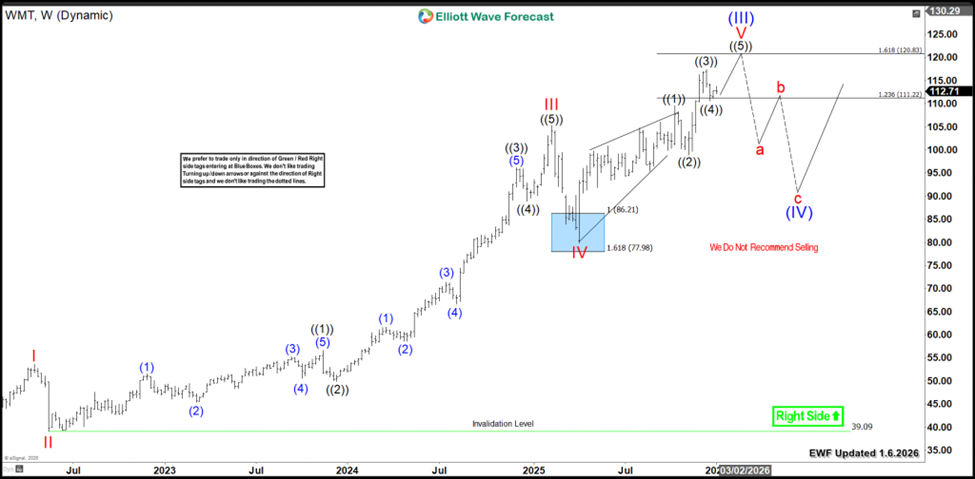
WMT’s recent rally originated from the $86 – $77 Blue Box area. Specifically, buyers emerged during the April 2025 market dip. Subsequently, the stock concluded its wave IV pullback. Then, it traded into new all-time highs within the current wave V.

Currently, it shows three swings into new highs. Therefore, the sequence remains incomplete. Consequently, it needs at least one more swing to finish its five-wave advance from the April low.

Importantly, WMT already trades within the $111 – $120 initial target zone. Hence, investors should avoid chasing the rally here. After wave ((III)) completes, a larger wave ((IV)) pullback will begin. This correction will then create the next strategic buying opportunity before the uptrend resumes.

WMT weekly chart 1.06.2026
Chart

Conclusion

WMT’s weekly bullish cycle remains firmly intact. Therefore, investors should target buying opportunities within weekly pullbacks. Utilize our Elliott Wave strategy for precise entry timing. Specifically, establish positions after a 3, 7, or 11-swing correction completes. Additionally, our proprietary Blue Box system pinpoints high-probability entry zones. Consequently, this disciplined

Author

Elliott Wave Forecast Team

Elliott Wave Forecast Team

ElliottWave-Forecast.com

More from Elliott Wave Forecast Team
Share:

Editor's Picks

AUD/USD hangs near two-month low as RBA bets counter easing Iran tensions

AUD/USD drifts lower during the Asian session on Tuesday, though it manages to hold above a nearly two-month low touched the previous day amid mixed cues. Diminishing odds of a near-term RBA rate hike act as a headwind for the Aussie, while the US Dollar draws some support from hawkish Fed expectations. However, easing tensions in the Middle East keeps US Dollar bulls on the defensive and should limit losses for the currency pair ahead of US inflation figures.

USD/JPY consolidates above 160.00 amid intervention fears, Israel-Iran ceasefire

USD/JPY holds steady above 160.00 during the Asian session on Tuesday as expectations that authorities will step in again to prop up the Japanese Yen hold back bulls from placing fresh bets. Moreover, a de-escalation of tensions between Israel and Iran undermines the safe-haven US Dollar, capping the currency pair. Traders also seem hesitant and opt to wait for the release of the latest US inflation figures on Wednesday and Thursday.

Gold remains depressed as hawkish Fed bets offset softer USD

Gold struggles to attract any meaningful buyers and remains close to its lowest level since March 23, touched the previous day. Expectations of more hawkish central banks, including the US Fed, continue to undermine demand for the non-yielding bullion. Meanwhile, a halt in fighting between Israel and Iran keeps the US Dollar bulls on the defensive, which should act as a tailwind for the precious metal as traders await the latest US inflation figures, due on Wednesday and Thursday.

Strategy resumes BTC accumulation with 1,550 Bitcoin purchase, adjusts STRC dividend schedule

Bitcoin treasury firm Strategy bought 1,550 BTC last week for roughly $101.3 million, according to a Form 8-K filing on Monday. The purchase, made at an average price of $65,332 per Bitcoin, was funded through proceeds from the company's at-the-market equity offering program.

$1.75 trillion: Is SpaceX the most popular IPO in history, or the most engineered?

On June 12, the largest initial public offering (IPO) in history is set to hit the tape, and almost nobody is asking whether the price is right, because almost everybody already wants in.

The US economy defies the rules: 100 days into the Oil shock and the recession signal is still missing

More than three months after the start of the Iran war and the resulting disruption to global energy markets, the US economy continues to display remarkable resilience. The conflict has triggered a sharp rise in Oil prices, reignited inflationary pressures and fueled widespread concerns about a potential economic slowdown.