Wall Street stocks supported: no airstrike on Syria while earning season approaching
- President Trump tweeted: “Never said when an attack on Syria would take place.”
- The market is getting ready for the earning season.

US stocks were mainly higher as the Middle-East tensions are somewhat softening and that investors are shifting their focus to earning season which starts on Friday.
The S&P 500 Index, closed 21.80 points higher or 0.8% to 2,663.99. The Dow Jones Industrial Average gained 293.60 points or 1.2% to 24,483.05. The Nasdaq Composite Index gained 71.22 points or 1% and reached 7,140.25.
Gains were seen among most sectors. 24 out of the 30 components in the Dow Jones were in the green while 6 out of the 11 main sectors in the S&P 500 were in gains. The financial sector was the leading sector as banks will report their earnings in the coming days.
Investors are for the time being putting aside the geopolitical concerns. Last Sunday an alleged chemical weapons attack by the Syrian government triggered a reaction from the US which pledged to retaliate by sending missiles to Syria. However, early Thursday, the president tweeted that he doesn’t have a timeline and whether he would send an airstrike or not.
Meanwhile, the trade ware tensions are also somewhat abating as China’s President said that he was willing to open up its economy and push free trade. However, a Commerce Ministry spokesman, Gao Feng said the recent comments made by the Chinese President “have nothing to do with the trade disputes with the US. The Chinese government is opening the economy “at its own pace, in its own direction, which is already fixed.”
“On one hand, you have earnings that are expected to be strong and the S&P 500 has repeatedly tested its 200-day moving average and held above it. On the other, you have erratic policies and questions over what will happen in Syria, with trade, with the Russia investigation. There are a lot of positive forces and a lot of negative forces in the market, and the battle between them is leading to a lot of day-to-day volatility, we’re trying to find a direction, each shift has nothing to do with the next, and we’re stuck in a range. It’s a tough environment for investors.” commented Donald Selkin at Newbridge Securities.
S&P 500 Index: 4-hour chart
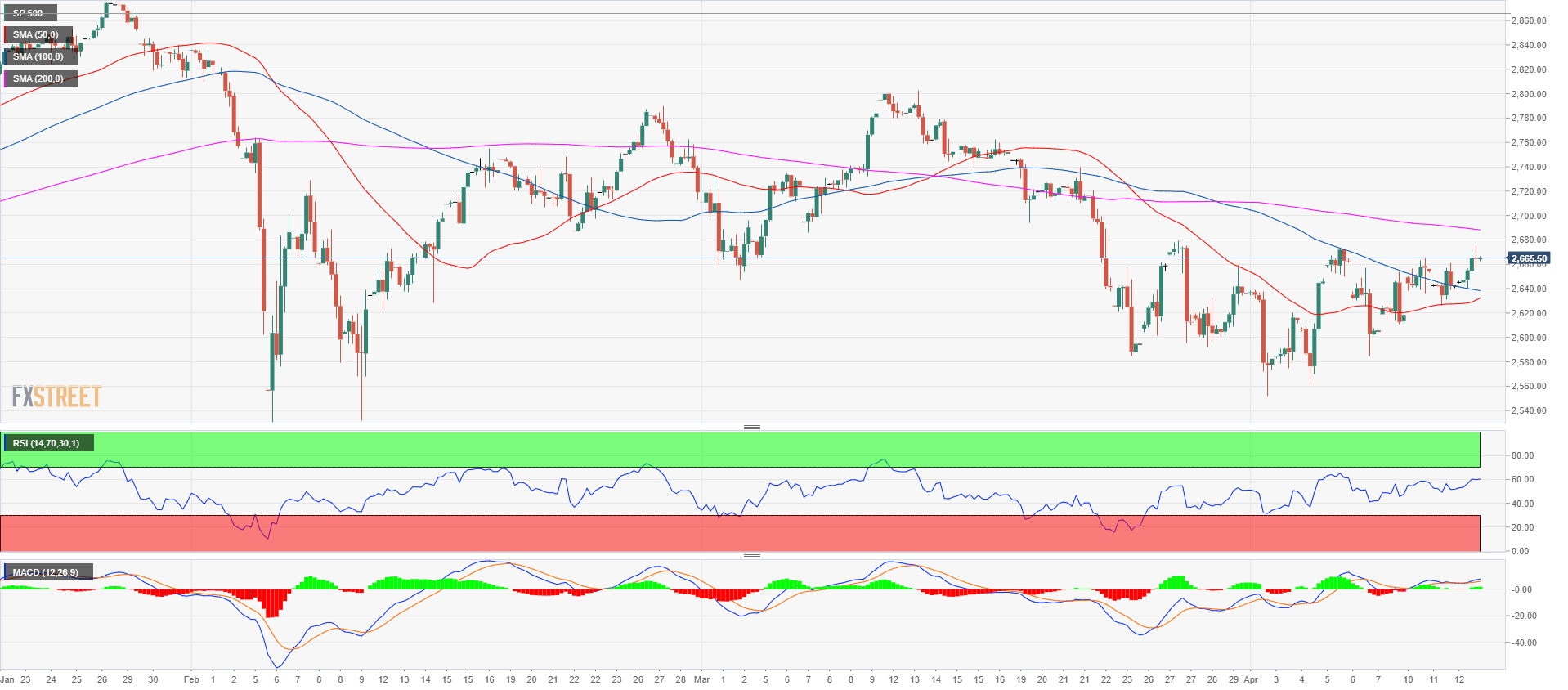
The market is trying to push above 2,680. Resistances are seen at 2,679.25 and at 2,740 swing highs while supports lie at 2,585 swing low and 2,551.75 cyclical low.
Author

Flavio Tosti
Independent Analyst