USD tumbles on Clinton's email case, US stocks erase gains

It was being a weak day for the US dollar and suddenly the decline accelerated after the FBI reopened the Clinton email case, less than two weeks before the presidential elections. The US dollar tumbled in the market and the yen surged amid risk aversion.
The Dow Jones index dropped quickly to 18,095 a 2-day low, before bouncing back to the upside. It was about to end Friday and the week practically unchanged around 18,180. Before the Clinton report, the stock index was up, testing the 18,250 area.
DXY down
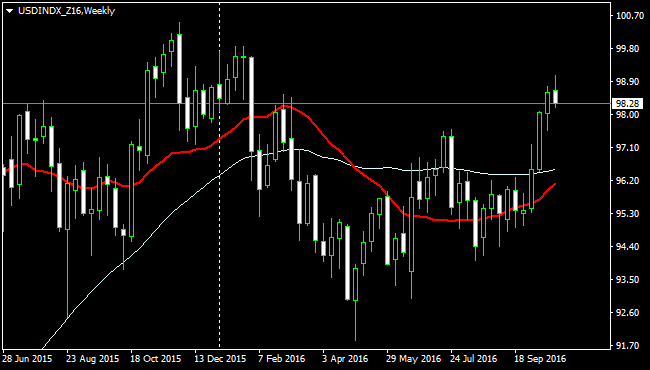
The US dollar index was falling, trading slightly above 98.55 and then tumbled to 98.17, hitting the lowest level in a week. It then bounced to the upside, but failed to regain the 98.50 zone.
Near the end of the week it was hovering around 98.30, marginally lower for the week. The recent slide pushed the index into negative territory for the week. It is going to be the first decline after rising 3.75% during the previous three weeks. On Tuesday it reached the highest level since March above 99.00 but it was rejected.
Heavy calendar ahead for the US
Next week, the week before the election, the campaign could get more intense. In the economic front, it will also be a busy week, that includes several employment reports and the FOMC meeting.
Regarding the Federal Reserve, analysts from Danske Bank, expect it to maintain the target range at 0.25-0.50%, in line with consensus, arguing that is near the presidential election. “The most interesting part is the FOMC statement”, but they don’t see any major changes to the FOMC statement, “as it was already quite hawkish last time, as it stated that the case for a rate hike had ‘strengthened’, although it may say that economic data have supported its view that growth has picked up pace.”
On Friday, the official employment report will be released. “We continue to receive mixed signals about the labour market”, said analysts from Danske, that estimate jobs growth of around 170,000 in October.
Author

Matías Salord
FXStreet
Matías started in financial markets in 2008, after graduating in Economics. He was trained in chart analysis and then became an educator. He also studied Journalism. He started writing analyses for specialized websites before joining FXStreet.