|

USD/TRY records fresh all-time highs near 9.0000

  • USD/TRY moves closer to 9.0000, new record highs.
  • Rumours of a Kavcioglu-Erdogan short-circuit hurts the lira.
  • US Nonfarm Payrolls, Unemployment Rate come next in the docket.

The Turkish lira depreciates to all-time lows vs. the greenback and lifts USD/TRY to fresh record highs just below the 9.0000 level on Friday.

USD/TRY up on another Erdogan-CBRT round

USD/TRY clocked fresh all-time highs at the end of the week after news said that President R.T.Erdogan could be losing faith in S.Kavcioglu, the head of the Turkish Central Bank (CBRT).

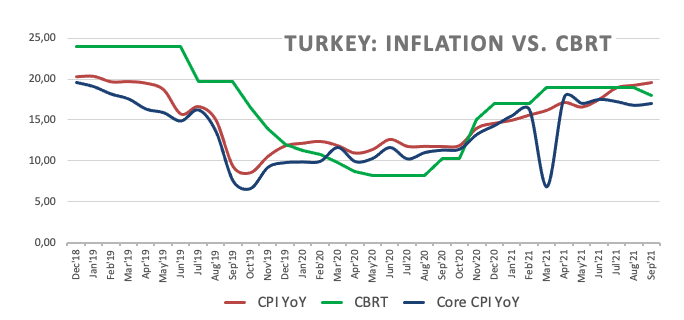
In fact, rumours remained on the rise despite the CBRT unexpectedly reduced the One-Week Repo Rate by 100bps to 18% at its September meeting. Indeed, according to these speculations, President Erdogan deemed the recent interest rate cut as coming too late.

However, how unexpected the latest rate cut was is a matter of debate, as the central bank had previously announced that it will shift to the Core inflation (instead of the headline CPI) when it comes to set the policy rate.

While fundamentals in Turkey have exhibited quite a moderate recovery, including stellar figures for the GDP, inflation remains elevated, putting to rest previous forecasts that inflation could have peaked in May-June. On the latter, inflation in September rose to 36-month high at 19.58%.

It seems S.Kavcioglu now has his days as CBRT Governor counted… no surprises here.
USD/TRY key levels

So far, the pair is gaining 0.78% at 8.9372 and a drop below 8.8297(monthly low Oct.1) would aim for 8.7345 (20-day SMA) and finally 8.6806 (monthly high Aug.11). On the other hand, the next up barrier lines up at 8.9708 (all-time high Oct.7) followed by 9.0000 (round level).

Author

Pablo Piovano

Born and bred in Argentina, Pablo has been carrying on with his passion for FX markets and trading since his first college years.


More from Pablo Piovano
Share:

Editor's Picks

AUD/USD stays bid above 0.7100 on Australian trade data, Mideast optimism

AUD/USD clings to minor recovery gains above 0.7100 in the Asian session on Thursday as a new Israel-Lebanon ceasefire keeps a lid on the safe-haven US Dollar. Meanwhile, strong AustralianTrade Balane data also help the Aussie pair sustain the bounce from weekly lows.

USD/JPY hovers near the 160.00 intervention threshold on Mideast tensions

USD/JPY struggles to find acceptance above 160.00 and retreats from a one-month high in the Asian session on Thursday amid fears that authorities will step in again to prop up the Japanese Yen. Furthermore, a new Israel-Lebanon ceasefire caps the US Dollar and supports the currency pair. However, renewed US-Iran tensions keep the downside limited in the Greenback and the pair.

Gold rebounds from one-week low as Israel-Lebanon truce pressures safe-haven USD

Gold gains some positive traction on Thursday and climbs to the $4,475 area during the Asian session, reversing a major part of the previous day's slide to a one-week low. The Israel-Lebanon truce prompts some profit-taking around the US Dollar and supports the commodity. 


Ethereum: Long-term holders' capitulation drives ETH below $1,800

Ethereum has fallen below $1,800 on Wednesday, the first time since May 2025 following accelerated spot selling pressure and distributions from long-term holders. The Age Consumed metric, which tracks the movement of previously idle tokens or long-term holders' coins, spiked over the past two days as prices declined, indicating increased selling activity among this cohort.

Kevin Warsh takes the Fed helm: What it means for the US Dollar
The Federal Reserve moves away from the highly predictable "forward guidance" model of the Jerome Powell era to a new “Kevin Warsh environment”, characterized by less communication, more policy surprises, and an increased focus on the Fed's complex balance sheet.
Recession on paper: What really moves the Canadian Loonie now?

Statistics Canada handed the headline writers a gift and the analysts a headache. Real GDP shrank 0.1% on an annualized basis in the first quarter, and with the fourth quarter of 2025 revised down to a 1.0% contraction, that is two negative quarters in a row, the textbook definition of a technical recession and Canada's first since the pandemic.