|

USD/TRY keeps the range bound trade around 32.20 post-CBRT

  • The Turkish lira depreciates slightly around 32.20 vs. the Dollar.
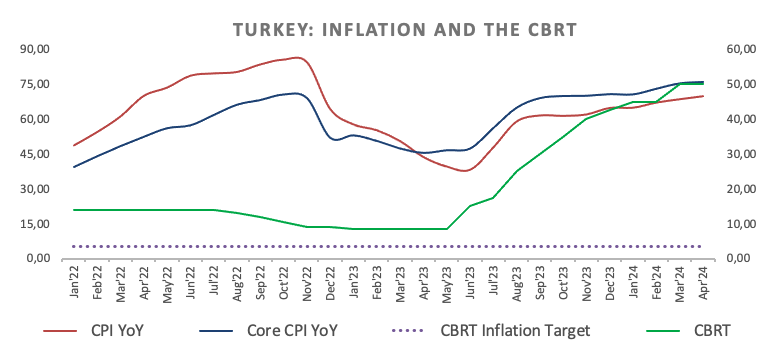
  • The CBRT kept the One-Week Repo Rate unchanged at 50.0%.
  • The central bank sees a disinflationary scenario in H2 2024.

The Turkish lira maintains its consolidative phase well in place on Thursday, hovering around the low-32.00s in the wake of the CBRT’s interest rate decision.

USD/TRY faces extra consolidation in the near term

So far, there have been no changes to the side-lined theme around the Turkish currency, which has remained trapped within the 32.00–32.60 range since mid-March.

On Thursday, the Turkish central bank (CBRT) maintained its One-Week Repo Rate unchanged at 50.00%, as broadly anticipated.

The CBRT stated that its decision on rates came after taking into account the delayed impacts of monetary tightening, adding that it is closely monitoring the effects on credit conditions and domestic demand.

In the statement, the bank emphasized its vigilance regarding inflation risks, citing a "limited decline in the underlying trend of monthly inflation in April."

In addition, the bank also indicated that it would tighten its policy stance if a significant and persistent increase in inflation was anticipated.

Moving forward, market expectations see a nearly 72 bps increase at the bank’s next gathering on June 27.

It is worth noting that headline inflation in Türkiye rose by 69.80 in the year to April.
USD/TRY key levels to watch

So far, the pair is advancing 0.10% to 32.1950 and faces the next up barrier at the all-time high of 32.6461 (April 19). On the flip side, a break below the weekly low of 31.9722 (April 29) would expose another weekly bottom of 31.7390 (March 21) and finally the temporary 100-day SMA of 31.4788.

Author

Pablo Piovano

Born and bred in Argentina, Pablo has been carrying on with his passion for FX markets and trading since his first college years.


More from Pablo Piovano
Share:

Markets move fast. We move first.

Orange Juice Newsletter brings you expert driven insights - not headlines. Every day on your inbox.

By subscribing you agree to our Terms and conditions.

Editor's Picks

EUR/USD eases from around 1.1800 after US GDP figures

The US Dollar is finding some near-term demand after the release of the US Q3 GDP. According to the report, the economy expanded at an annualized rate of 4.3% in the three months to September, well above the 3.3% forecast by market analysts.

GBP/USD retreats below 1.3500 on modest USD recovery

GBP/USD retreats from session highs and trades slightly below 1.3500 in the second half of the day on Tuesday. The US Dollar stages a rebound following the better-than-expected Q3 growth data, limiting the pair's upside ahead of the Christmas break.

Gold rises to record high above $4,500 on safe-haven flows

Gold rises and hits its record high around $4,505 during the Asian session on Wednesday. The precious metal gains momentum as the Israel-Iran conflict and the rising in US-Venezuela tensions boost the safe-haven demand. Furthermore, the recent soft US inflation and cool jobs reports have fueled market expectations for at least two 25-basis-point rate cuts from the US Federal Reserve next year. 

The crypto market is preparing us for a deeper global sell-off

The crypto market capitalisation fell by 1.4% to $2.97T, falling below the $3T mark once again. The market was unable to repeat the robust rebound from the local bottom, as it did after 23 November and 2 December, indicating increased pressure from sellers.

Ten questions that matter going into 2026

2026 may be less about a neat “base case” and more about a regime shift—the market can reprice what matters most (growth, inflation, fiscal, geopolitics, concentration). The biggest trap is false comfort: the same trades can look defensive… right up until they become crowded.

Dogecoin ticks lower as low Open Interest, funding rate weigh on buyers

Dogecoin extends its decline as risk-off sentiment dominates across the crypto market. DOGE’s derivatives market remains weak amid suppressed futures Open Interest and perpetual funding rate.