USD/RUB bounces from one-month lows, bulls lift the pair near 79.70s
- The USD/RUB is set to end the week with losses, of 6.18%, despite Friday’s jump.
- The Russia-Ukraine hostilities and peace talks continue but at a slower pace.
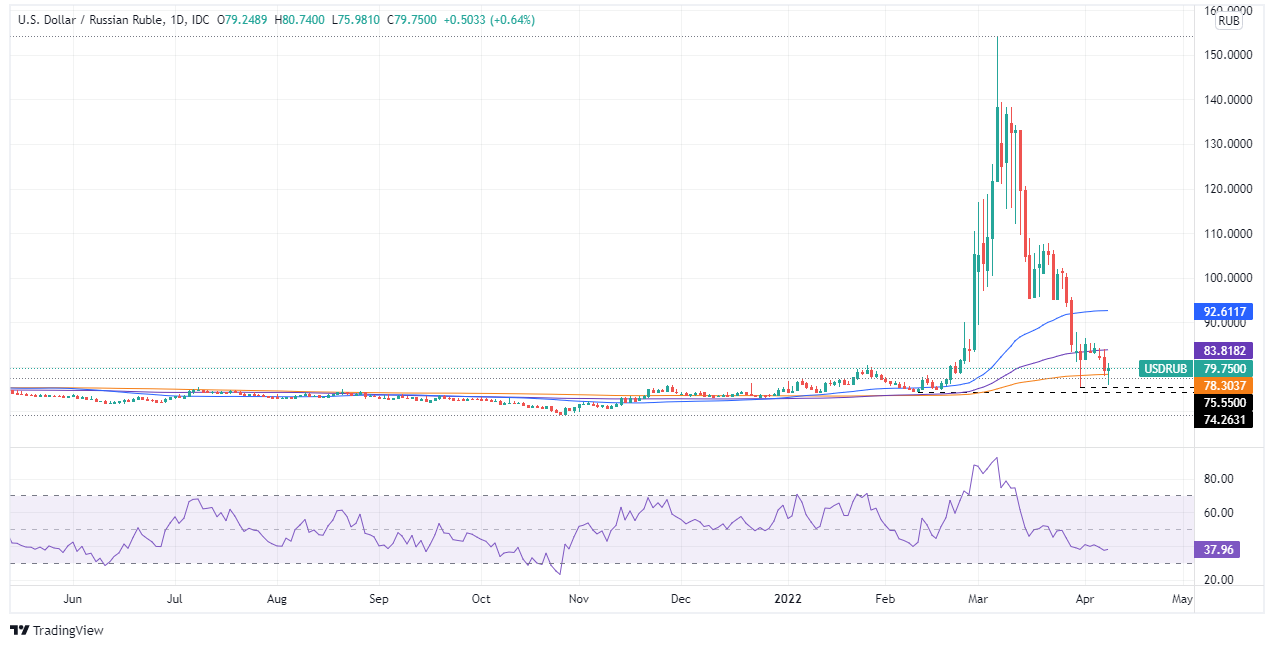
- USD/RUB Price Forecast: Bulls charged at the break of the 200-DMA and pushed the pair up 500 pips.

The USD/RUB fell and reached a fresh monthly low at 75.6625 but is back above the 200-day moving average (DMA), which lies at 78.2997, in the middle of a mixed-sentiment trading session. At the time of writing, the USD/RUB is trading at 79.7500, up 0.64%.
Geopolitical jitters linked to the Russia-Ukraine war were shrugged off by market players, as shown by global equities rising. The Ukrainian advisor Podolyak said negotiations with Russia continue online constantly, but the mood changed after the Bucha events.
In the meantime, US Treasury yields remain higher on Friday, led by the 10-year T-note rising five basis points, sitting at 2.70%, which underpinned the buck. The US Dollar Index, a gauge of the greenback’s value vs. a basket of its rivals, is back below 100, up 0.09%, at 99.844, after reaching 100.189 for the first time since May 2020.
On Friday, the Russian Central Bank surprisingly cut rates by 300 bps, from 20% to 17%, as market players expected the central bank to stay on hold.
Elsewhere on Wednesday, the Federal Reserve revealed its March minutes. The Fed stated that most participants were eager to hike rates 50 bps if not for Ukraine. The Fed agreed to cap its balance sheet by an amount of $95 billion, $60 billion on US Treasuries, and $35 billion on mortgage-backed securities (MBS). Furthermore, the minutes showed that participants wanted the Quantitative Tightening to begin by May, following the May 4 meeting, where market participants, as demonstrated by STIRS, are pricing in an 88% chance of a 50 bps hike.
On Thursday, St. Louis President James Bullard said that the Fed policy rate was too low, by about 300 basis points. He added that the Fed is not that far behind the curve and expects the Federal Funds Rate (FFR) to end the year at around 3.5%.
Later during the day, Chicago’s Fed President Charles Evans said that the Fed would probably go to get neutral, setting by the end of this year or early next.
USD/RUB Price Forecast: Technical outlook
The USD/RUB upward bias was tested as the price broke below the 200-day moving average (DMA) at 78.3059. On Wednesday, it was noted that “a daily close under the 80.3254 level would further extend losses, and the USD/RUB could aim toward the 200-day moving average (DMA).” On Thursday, that happened, and a close was achieved at 79.2467, opening the door for a test of the 200-DMA.
Early Friday, the USD/RUB broke the 200-DMA and reached a daily low at 75.9810, but higher US yields underpinned the greenback and lifted the pair above the 200-DMA and beyond the 79.5000 mark.
That said, the USD/RUB first resistance would be 82.7882. A breach of the latter would expose essential resistance levels. The next supply zone would be the 100-DMA at 83.8276, followed by the 50-DMA at 92.63305.
Author

Christian Borjon Valencia
FXStreet
Markets analyst, news editor, and trading instructor with over 14 years of experience across FX, commodities, US equity indices, and global macro markets.

















