|

USD/NOK finds some traction despite soft US data

  • USD/NOK is trading higher by 0.30%, quoted at 10.69 during Thursday's session.
  • A surprise increase in Initial Jobless Claims suggests a slowing down of the US economy, which weighs on the USD.
  • Markets are pricing in sooner interest rate cuts by the Fed following the recent soft CPI report.

On Thursday, the USD/NOK traded higher despite the ongoing data including April’s Consumer Price Index (CPI) reported on Wednesday which came in softer than expected. The softer data is making markets think that the Federal Reserve (Fed) might consider sooner rate cuts than anticipated. As for now, the best-case scenario for markets continues to be a first cut in September.

The US economy hints at a potential slowdown as reflected by the unexpected hike in Initial Jobless Claims and the dip in the Philadelphia Fed Manufacturing Survey, shifting markets into believing the Federal Reserve may introduce rate cuts sooner, generating downward pressure on the USD. The weekly Initial Jobless Claims for the week observed a rise to 222K, surpassing predictions, and displaying an upward revision to 232K for the previous week's data. The Philadelphia Fed Manufacturing Survey for May showed a slump to 4.5, failing to meet market expectations.

USD/NOK technical analysis

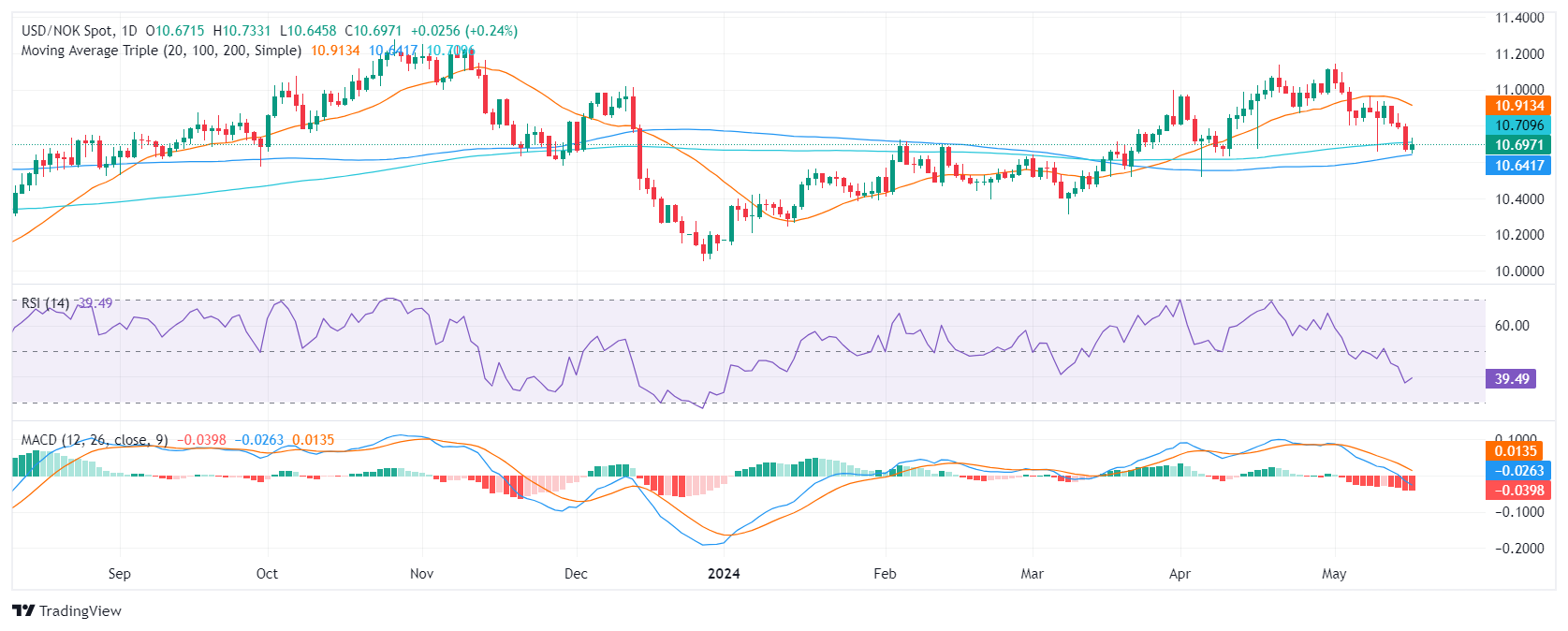
On the daily chart, the Relative Strength Index (RSI) of USD/NOK suggests negative momentum, signaled by a consistent positioning of the pair below the 50 mark. Despite the negative trend, the RSI value in the most recent session hints at potential easing, edging up to roughly 41 from a near-oversold low of 39.

USD/NOK daily chart
Author

Patricio Martín

Patricio is an economist from Argentina passionate about global finance and understanding the daily movements of the markets.


More from Patricio Martín
Share:

Editor's Picks

AUD/USD bounces off weekly low on Israel-Lebanon ceasefire

AUD/USD recovers slightly from the weekly low during the Asian session on Thursday as a new Israel-Lebanon ceasefire keeps a lid on the safe-haven US Dollar. Meanwhile, the US and Iran remain at odds over key issues, which, along with hawkish Fed expectations, act as a tailwind for the buck. Furthermore, diminishing odds of an RBA rate hike in June cap the currency pair as traders keenly await the US NFP report on Friday.

USD/JPY remains close to 160.00 intervention threshold on Mideast tensions

USD/JPY struggles to find acceptance above 160.00 and retreats from a one-month high during the Asian session on Thursday amid fears that authorities will step in again to prop up the Japanese Yen. Furthermore, a new Israel-Lebanon ceasefire caps the US Dollar and supports the currency pair. However, renewed US-Iran tensions favor the USD bulls amid Fed rate hike bets and also hold back the JPY bulls from placing aggressive bets amid economic risks stemming from the Middle East conflict, suggesting that dips are likely to be bought into.

Gold bounces off one-week low; upside seems capped on Iran uncertainty

Gold recovers from a one-week low touched during the Asian session on Thursday, as news of an Israel-Lebanon ceasefire acts as a headwind for the safe-haven US Dollar. However, renewed hostilities in the Gulf, along with stalled US-Iran peace talks, keep geopolitical risks in play and should support the USD. Moreover, US-Iran tensions remain supportive of higher Crude Oil prices, fueling inflationary concerns and bolstering bets for higher interest rates for longer. This should cap the non-yielding bullion and warrants caution for bulls.


Bitcoin drops below $65K amid reinforced bear market signals

Bitcoin dipped further below $65,000 on Wednesday, with onchain data from Glassnode signaling a market firmly in a bear phase. The decline has pushed prices back into a key valuation range between the Realized Price and the True Market Mean. Glassnode noted that a key shift in market structure has also emerged.

The upside-down math of debt
In 2010, Professors Carmen Reinhart and Kenneth Rogoff published a paper, Growth in a Time of Debt, which instantly went viral. The main thesis of the paper was that once a government's debt-to-GDP ratio crosses above 90%, a financial crisis and default are around the corner.
Recession on paper: What really moves the Canadian Loonie now?

Statistics Canada handed the headline writers a gift and the analysts a headache. Real GDP shrank 0.1% on an annualized basis in the first quarter, and with the fourth quarter of 2025 revised down to a 1.0% contraction, that is two negative quarters in a row, the textbook definition of a technical recession and Canada's first since the pandemic.