USD/MXN prolongs its downward streak despite hawkish Fed remarks
- Despite Fed Chair Jerome Powell’s hawkish tone, USD/MXN declined to 17.0651, a 0.09% decrease.
- Powell emphasized the US economy’s resilience and potential for further tightening, notwithstanding labor market softness.
- USD/MXN continues to dip, hovering just above the day’s low of 17.0452, unaffected by Powell’s remarks.

USD/MXN extends its losses past the 17.1000 figure, drops for the fourth consecutive day, after hitting a daily high of 17.1231 amidst hawkish remarks by the US Federal Reserve (Fed) Chair Jerome Powell at a panel hosted by the European Central Bank (ECB). The USD/MXN is trading at 17.0651, down 0.09%.
Mexican Peso holds steady as US Dollar experiences losses, extending the USD/MXN’s downward trend for a fourth consecutive day
Wall Street trades mixed, as the S&P and the Dow Jones register minuscule losses amidst the US Government restricting NVIDIA chipmaking availability to China. Meanwhile, Fed Chair Jerome Powell stated that monetary policy “has not been restrictive for long,” highlighting that most Fed policymakers are still seeing additional tightening, as seen in the dot-plots report. Powell commented that the US economy remains resilient, based on the latest data, and downplayed a possible recession. He added that the US central bank needs to see more softening regarding the labor market.
After Powell’s hawkish comments, the USD/MXN did not stop its fall, though it remains slightly above the daily low of 17.0452.
Data-wise, the US Trade deficit contracted by 6.1% to $-91.1 billion, vs. April’s $-97.1 billion, as shown by the US Department of Commerce. Sources cited by Reuters commented, “Even with the narrowing in May, the goods trade deficit is up by over 10% since March, and trade will likely be a drag on economic growth in the second quarter.”
On the Mexican front, an absent economic calendar keeps traders leaning on market sentiment and dynamics surrounding the greenback. The Bank of Mexico (Banxico) decision to hold rates unchanged at 11.25% in the latest monetary policy decision was expected to weaken the Mexican Peso (MXN). But the interest rate differential with other currencies makes the “carry trade” attractive, as Banxico is expected to maintain borrowing costs higher for longer.
Given the backdrop, the USD/MXN downtrend remains intact, influenced by economic factors. The only way the pair could shift gears is a central bank divergence, like Banxico cutting rates while the Fed increases them, shrinking the interest rate differential. Another factor that could derail the MXN from appreciating further would be a recession in the United States (US), which would see increased outflows from emerging markets towards safe-haven assets.
Upcoming events
The US economic agenda will disclose Initial Jobless Claims, GDP data, housing data, and a slew of Federal Reserve speakers.
USD/MXN Price Analysis: Technical outlook
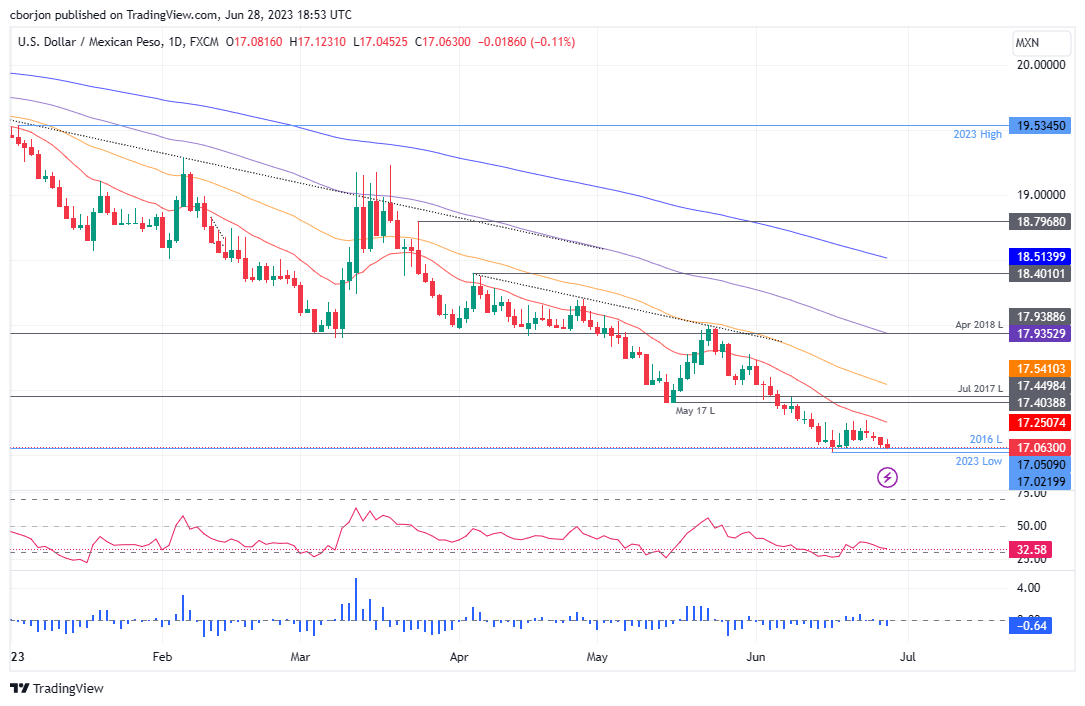
The USD/MXN is downward biased but is trading sideways, capped on the upside by the June 23 high of 17.2644 and by support at the year-to-date (YTD) low of 17.0215. A breach of the latter will expose the 17.00 mark, followed by an October 2015 low of 16.3267. On the other hand, the break above the June 23 high will expose the May 17 low of 17.4038, seen as intermediate resistance, ahead of testing the 50 and 100-day EMAs, each at 17.5409 and 17.9352, respectively.
Author

Christian Borjon Valencia
FXStreet
Markets analyst, news editor, and trading instructor with over 14 years of experience across FX, commodities, US equity indices, and global macro markets.