USD/MXN plummets to fresh multi-year lows, beneath 17.4000 on upbeat Mexican data
- USD/MXN pair tumbles past YTD low, despite potential shifts in Federal Reserve policy on the horizon.
- US economic deceleration prompts recession fears, despite the addition of 339K jobs in Nonfarm Payrolls.
- Mexican auto sector thrives, propelling production by 25% YoY, with exports advancing 14.2%.
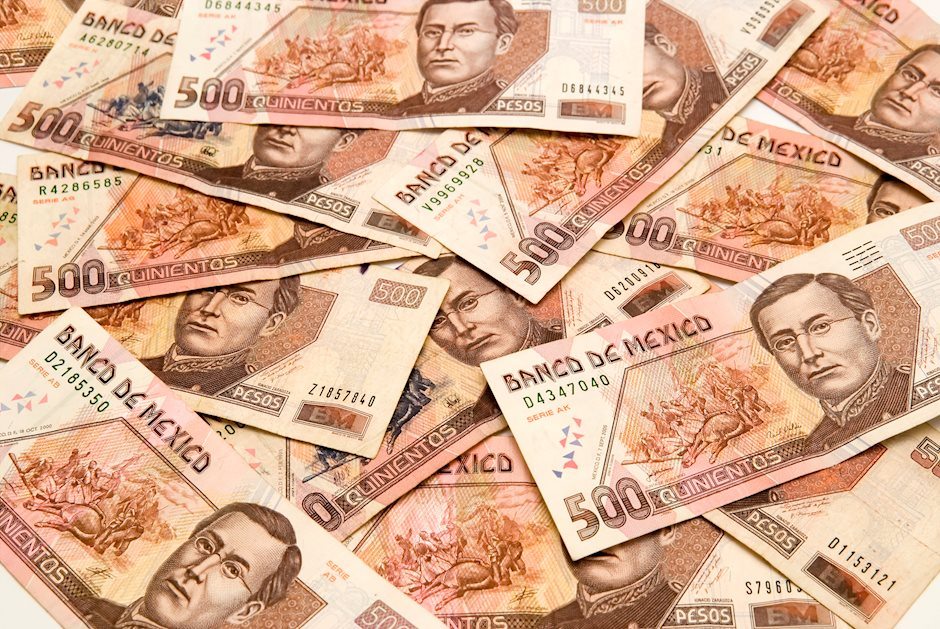

The Mexican Peso (MXN) achieved another multi-year high against the US Dollar (USD), as the USD/MXN pair tumbled past the previous year-to-date (YTD) low of 17.4038 and dived toward 17.3993 before reversing its course toward the 17.40 area. An absent US economic docket keeps traders looking forward to the upcoming Federal Reserve meeting and leaning on the market mood. The USD/MXN is trading at 17.4009, down 0.37%.
USD/MXN plunges despite mixed US labor market signals; auto sector fuels Mexican economy
Sentiment shifted mixed but remains fragile amidst the lack of economic data in the United States. However, recession fears reignited after business activity slowed, as May’s Manufacturing PMI came into contractionary territory, while the services PMI stood above 50. Nevertheless, the latter is following a downward path, indicating that consumer spending is weakening; therefore, the economy is decelerating.
Aside from this, the labor market gave mixed signals, as May Nonfarm Payrolls created 339K jobs, but the unemployment rate ticked from 3.4% to 3.7%. Although that’s a sign the Federal Reserve (Fed) sought that spending could edge lower, creating more jobs than expected would likely deter the Fed from cutting rates in 2024.
Last week, Federal Reserve officials were vocal about skipping an interest rate increase in June to assess the conditions of cumulative tightening. But given that some other central banks are struggling to see inflation moving downward, like the Reserve Bank of Australia (RBA) lifting rates 50 bps in the last two meetings after pausing, it could influence the Fed from committing the same mistake.
Even though the US Dollar Index (DXY), which tracks the performance of the buck against a basket of its rivals, climbs toward 104.142, up 0.10%, the Mexican Peso remains resilient to give back some of its yearly gains of 10.60%.
The Mexican agenda featured Auto Production, which rose by 25%, crushing April’s 14% YoY, while Auto Exports advanced 14.2%, exceeding the prior’s month 5% YoY. Given the latest data revealed, the USD/MXN extended its losses to new yearly lows
USD/MXN Price Analysis: Technical outlook
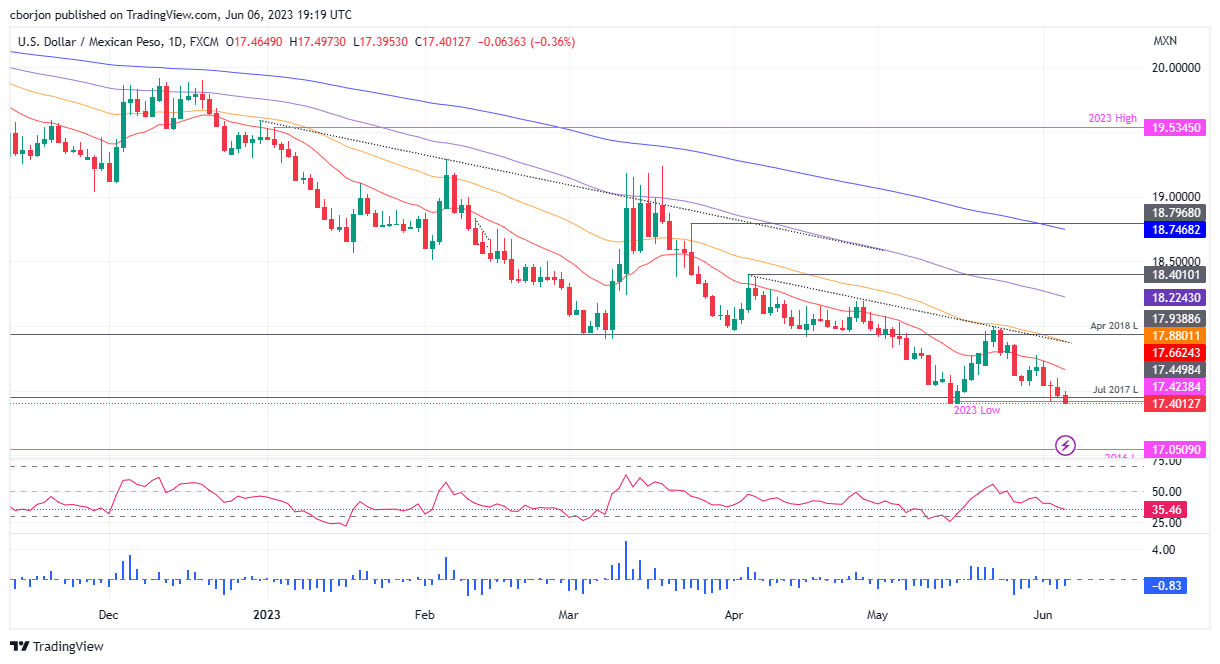
After piercing the previous YTD low, the USD/MXN could pose a threat to fall toward the 2016 yearly lows of 17.0500, ahead of the 17.00 figure. Even though the Relative Strength Index (RSI) indicator remains in bearish territory suggesting further downside is expected, price action looks overextended. The 3-day Rate of Chang (RoC) means that sellers remain in charge, but compared to the last week through at -1.97, it’s closing towards a neutral area, indicating that traders are booking profits. Conversely, if the USD/MXN reclaims the 17.5000 psychological price level, that could pave the way to the 20-day EMA at 17.6628, followed by the 50-day EMA at 17.8802.
Author
Christian Borjon Valencia
FXStreet
Markets analyst, news editor, and trading instructor with over 14 years of experience across FX, commodities, US equity indices, and global macro markets.