USD/MXN losses ground as US economic data falters dips below 16.8000
- USD/MXN trades at 16.7508, down 0.26%, as disappointing US labor and GDP data weaken the Greenback, pushing US Treasury yields lower.
- US Dollar Index (DXY) plunges over 1% to 103.133, amplifying USD/MXN losses amid a backdrop of overall USD weakness.
- S&P Global’s Jose Perez expects stable Mexican monetary policy into 2024, reinforcing a downward bias for USD/MXN, though the pair remains above its YTD low of 16.6238.

The Mexican Peso (MXN) strengthened against the US Dollar (USD) on Wednesday after data from the United States (US) that the economy is decaying, according to the latest jobs and growth data. Hence, US Treasury bond yields dropped, a headwind for the Greenback. The USD/MXN is trading at 16.7508, losing 0.26% after hitting a high of 16.8029.
Mexican Peso capitalizes on weak US GDP jobs data while stable Mexcian monetary policy brightens its outlook
An upbeat market sentiment boosts appetite for the emerging market currency, as reflected by US equities rising. The Greenback is on the back foot after the US Commerce Department downward revised Q2 Gross Domestic Product (GDP) from 2.4% to 2.1%. Although figures exceed the first quarter data, the economy is stagnating, as the current week’s labor market data had shown.
In regards to that, private hiring slowed down, as announced by ADP on its National Employment report, which reported private companies added just 177K jobs, below estimates of 195K. That, alongside a weaker weekly job openings report, paints a not-so-good scenario for Friday’s US Nonfarm Payrolls report.
US Treasury bond yields fell and weighed on the Greenback in reaction to the data. The US Dollar Index (DXY), a measure of the buck’s value against a basket of six currencies, plunged more than 1% at 103.133. Hence, the USD/MXN extended its losses amid overall USD weakness.
Across the border, Jose Perez, the head of Emerging Markets Research at S&P Global, said he does not expect significant changes in Mexico’s credit profile in 2024. Perez added he expects Mexico’s monetary policy to remain stable, and rates could begin to ease in early 2024.
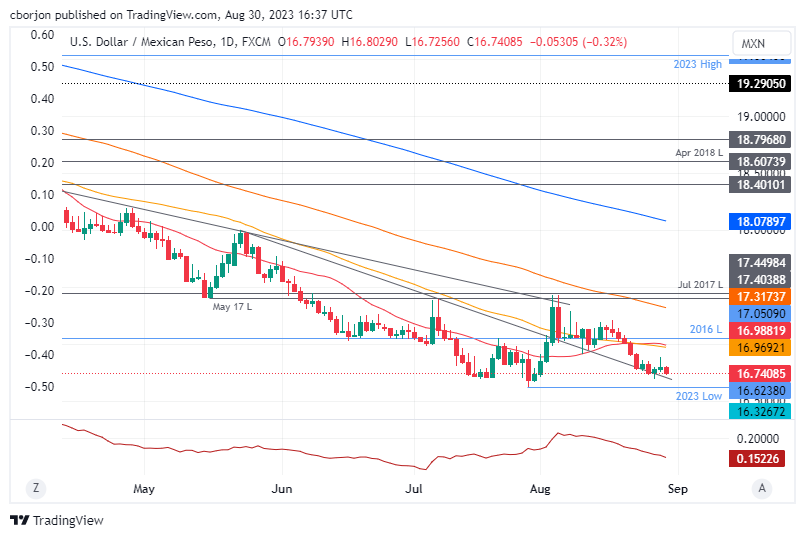
That said, given the Bank of Mexico (Banxico) forward guidance of higher for longer, the USD/MXN outlook is likely to remain downward biased, but the lack of a more robust catalyst keeps the pair above the YTD low of 16.6238.
USD/MXN Price Analysis: Technical outlook
From a technical standpoint, the USD/MXN has consolidated at around 16.6900/16.8900 during the week, as the 50 and 20-day Moving Average (DMA) shifted flat at 16.9694 and 16.9886, respectively, suggesting the pair is awaiting a fresh catalyst. Downside risks emerge at the weekly low of 16.6923, exposing the year-to-date (‘YTD) low of 16.6238. Otherwise, if the USD/MXN exceeds the weekly high, the 50-DMA at 16.9694 would be up for grabs.
Author

Christian Borjon Valencia
FXStreet
Markets analyst, news editor, and trading instructor with over 14 years of experience across FX, commodities, US equity indices, and global macro markets.

















