USD/MXN faces losses as US PMI slows, yield curve inverts
- USD/MXN was down by 0.30% in H2 2023 following weak US manufacturing data and yield curve inversion.
- US manufacturing activity slows for an eighth consecutive month, impacting USD performance.
- Recession fears rise as the US yield curve experiences pronounced inversion, signaling a potential economic slowdown.

USD/MXN begins the second half of 2023 with losses of almost 0.30% after hitting a daily high of 17.1485 after data from the United States (US) showed manufacturing activity continues at depressed levels. Furthermore, a deep inversion of the US yield curve sparked recession fears, a headwind for the US Dollar (USD). At the time of writing, the USD/MXN is trading at 17.0467.
Sluggish US manufacturing and yield curve inversion weigh on USD/MXN exchange rate outlook
US manufacturing activity slowed for eight straight months, as revealed by the Institute for Supply Management (ISM), with June data coming below May 46.9 at 46.0. Digging into the report, prices paid by manufacturers slowed down for the third month In a row, contrarily to services, though it remains above December 2022 through of 39.40. In the services sector, input prices remain high due to wage growth, reflecting a tight labor market.
Regarding traders, expectations for a 25 bps rate hike in July remained unchanged compared to last Friday’s odds at 87%, as shown by the CME FedWatch Tool. Nevertheless, today’s data released pushed the odds lower for the November FOMC meeting to 33%.
Of note, USD/MXN must be wary that recent data pushed aside woes for a recession, but last Friday’s US inflation report lowered expectations the Federal Reserve (Fed) would hike two times toward the end of 2023. Nevertheless, the US Dollar Index (DXY), which measures the buck’s performance against a basket of peers, advanced 0.03%, up at 102.951, as US Treasury bond yield recovered.
The US yield curve has experienced its most pronounced inversion since March 2023, with a negative spread of -1.078%. This development arises from the US 2-year yield reaching 4.923%, while the 10-year yield stands at 3.843%. This inversion indicates that investors anticipate the potential impact of continued tightening measures by the Fed, potentially leading to a slowdown in economic growth and even the risk of a recession.
Across the border, the latest employment report in Mexico on Friday was a headwind for the Mexican Peso (MXN). Meanwhile, data revealed on Monday by S&P Global showed the Manufacturing PMI for June came at 50.90, exceeding May’s 50.50.
In the meantime, the Bank of Mexico (Banxico) reported that remittances in May, came to $5.7 billion, breaking a monthly record, according to the central bank. Aside from this, Banxico’s poll showed that most analysts estimate interest rates will finish at 11.00% in 2023 while revising inflation lower. Regarding the USD/MXN exchange rate, most analysts expect the pair to end the year at 18.33 pesos per dollar, below the prior’s poll figure of 18.96.
Hence, the interest rate differential is still favoring USD/MXN downside, as the Fed is expected to lift rates to 5.25%-5.50%, as shown by money market futures, while Banxico is estimated to end at 11%. That would likely keep potential USD/MXN gains capped.
USD/MXN Price Analysis: Technical outlook
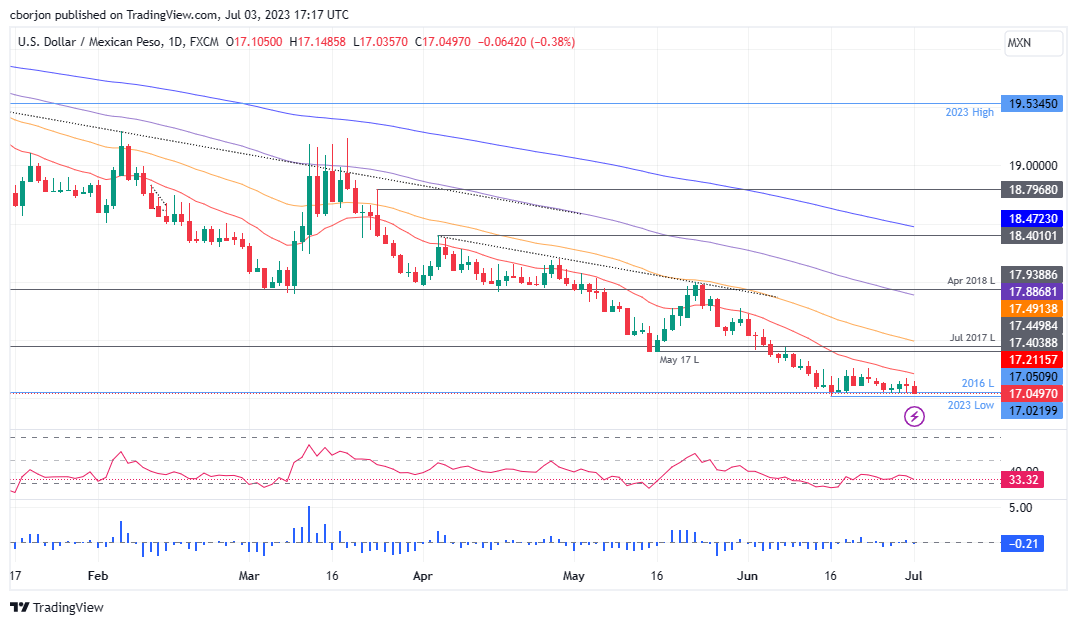
From a technical perspective, the USD/MXN would likely extend its downtrend as it approaches the 17.00 barrier, threatening to reach levels last seen in October 2015, at 16.3267, before USD/MXN sellers edge toward the 16.00 figure. On the flip side, USD/MXN buyers remain unable to reclaim the 20-day Exponential Moving Average at 17.2113, which, once cleared and the USD/MXN pair could rally toward the May 26 low turned resistance at 17.4038 before testing the 50-day EMA at 17.4912.
Author

Christian Borjon Valencia
FXStreet
Markets analyst, news editor, and trading instructor with over 14 years of experience across FX, commodities, US equity indices, and global macro markets.

















