USD/MXN drops as inflation cools down in Mexico, traders eye Banxico’s monetary policy decision
- Mexico’s inflation progress, as INEGI reports, CPI continuing its downtrend.
- Following CPI data, most analysts expect Banxico to keep rates unchanged at 11.25%, with potential rate cuts in Q4 2023.
- Federal Reserve policymakers showed mixed signals as traders eye US CPI on August 10.

The Mexican Peso (MXN) gains some traction as the USD/MXN pair edges lower after inflation data from Mexico portrays the deflationary process continues with success, ahead of Thursday’s monetary policy by the Bank of Mexico (Banxico). At the time of writing, the USD/MXN trades at 17.0830, down 0.14%.
USD/MXN dips as traders wait for US inflation data and Banxico’s decision
The Instituto National of Estadistica Geografia e Informatica (INEGI) revealed the Consumer Price Index for July came below estimates of 0.49% MoM, at 0.48%, while annually based, hit 4.79%, as foreseen and a quarter of percentage below June’s figures. Nevertheless, as in most developed economies, core CPI is showing some stickiness, coming at 6.64% YoY, below estimates of 6.68%, and 0.25% beneath June’s 6.89%.
Following the inflation release, most analysts foresee Banxico’s holding rates unchanged at 11.25% on the August 10 monetary policy reunion. Pantheon Economics expects the first rate cut by Q4 2023.
Meanwhile, an absent US economic agenda would keep traders awaiting the release of the US inflation data. The Consumer Price Index (CPI) is expected to remain unchanged compared to June’s 0.2% MoM, while market analysts foresee a dip to 3% from 3.3% YoY. Core CPI is estimated to print 0.2% MoM as the prior month’s release, and YoY is projected to stay at 4.8% as June’s.
In the meantime, Federal Reserve officials begin to shift towards a neutral stance, led by Philadelphia Fed President Patrick Harker, saying the Fed is at a stage where it could keep rates unchanged unless data suggests the opposite. Contrarily, Fed Governor Michelle Bowman stated the Fed needs to keep the pedal to the metal, lifting rates to curb inflation.
Expectations for a rate hike in September remained depressed, with odds at a 15% chance, as shown by the CME FedWatch Tool.
The US Dollar Index (DXY), a gauge of the buck’s value against a basket of six currencies, is losing some traction, down by 0.11%, at 102.430, undermined by falling UST bond yields. The US 10-year benchmark note rate is 4.00%, down two basis points.
USD/MXN Price Analysis: Technical outlook
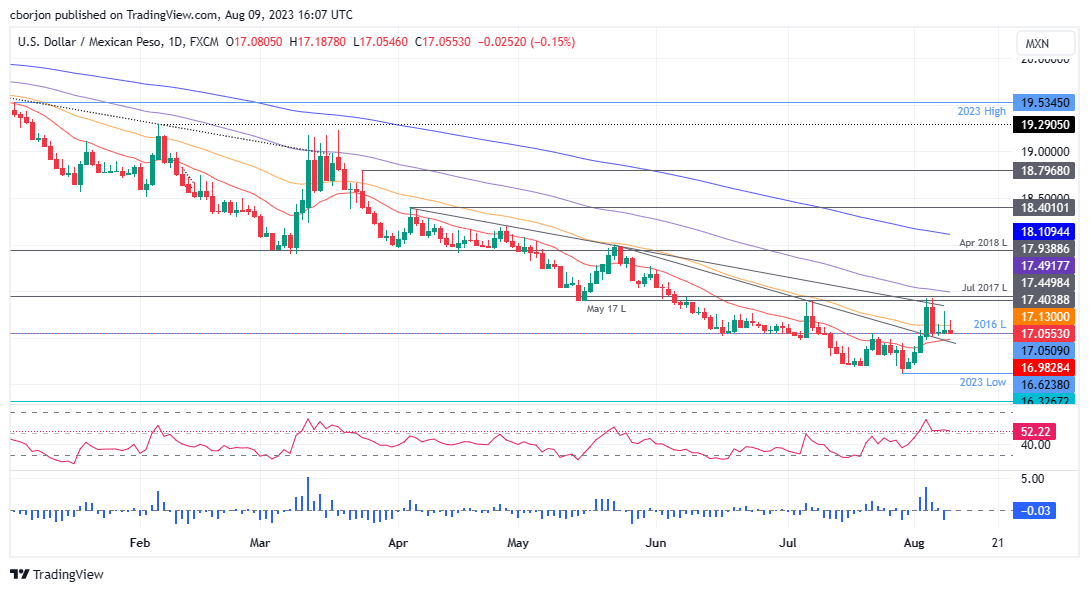
The USD/MXN is trading sideways above the 17.0000 figure for the fifth straight day, capped on the upside by the 50-day Exponential Moving Average (EMA) at 17.1308, while the figure and the 20-day EMA at 16.9849 act as support levels for the US Dollar bulls. If USD/MXN clears the 50-day EMA, that could exacerbate a move toward the crucial May 17 low of 17.4038, turned resistance. A daily close above the latter could pave the way to test the 100-day EMA at 17.4922. Conversely, if USD/MXN drops below the 20-day EMA, the pair could challenge the year-to-date (YTD) low of 16.6238.
Author

Christian Borjon Valencia
FXStreet
Markets analyst, news editor, and trading instructor with over 14 years of experience across FX, commodities, US equity indices, and global macro markets.

















