USD/MXN advances amid global risk-aversion and strong US Dollar
- USD/MXN rises 0.30% on Tuesday amidst a risk-off impulse.
- Chinese economic woes spurred by imports and exports plunging weakened the Mexican Peso.
- Upcoming Mexican inflation data on Wednesday could shed some light on the Bank of Mexico’s next monetary policy decision.

USD/MXN gained traction on Tuesday as risk-aversion triggered outflows from the emerging market currency, one of the largest gainers against the US Dollar (USD) during the year. Soft economic data from China shifted sentiment sour while the greenback rose. At the time of writing, the USD/MXN is trading at 17.1488, with gains of 0.52%.
Emerging market currency USD/MXN witnesses a rally due to soft Chinese economic data and robust US Dollar dynamics
Risk aversion is one of the main reasons, behind the USD/MXN advance on Tuesday, with investors shifting toward the safe-haven status of the greenback after data from China showed that Exports and Imports slumped. Given the backdrop, and China’s deflationary scenario, worldwide economic recovery is at the brisk of a deeper slowdown.
Aside from this, the economic agenda in the United States (US) revealed that its trade deficit shrank in June, as revealed by the US Commerce Department. Exports came at $247.5 billion, below May’s $247 billion, while Imports dipped to $313 billion from $316.1 billion the prior’s month. Hence, the Trade Balance came at $-65.5, a tick higher than the $-65 billion estimated but below the previous reading of $-68.3 billion.
US Treasury bond yields are extending their losses, despite overall US Dollar strength. The US 10-year benchmark note rate sits at 4.022%, losses seven basis points, while the US Dollar Index (DXY) portrays the greenback gaining 0.52%, at 102.612.
Nevertheless, recent commentary from Fed speakers is witnessing a shift from hiking rates to keeping them on hold, except for the Federal Reserve (Fed) Governor Michell Bowman, saying that more rate increases are needed.
On the dovish front, Philadelphia Fed President Patrick Harer said the Fed “can leave interest rates where they are.” However, he added, “Absent any alarming new data between now and mid-September,” the Fed can be “patient and hold rates steady.” Echoing some of his comments was Atlanta’s Fed President Raphael Bostic, saying no more increases are necessary.
On the Mexican front, a light agenda would keep USD/MXN traders leaning on market mood and US Dollar dynamics. However, that would change on Wednesday, as inflation figures for July would be revealed. The Consumer Price Index (CPI) every month is expected at 0.9%, while on an annual basis is estimated at 4.79%. On the US front, the release of July inflation data is much awaited by market participants, with estimates remaining unchanged compared to last month’s data.
USD/MXN Price Analysis: Technical analysis
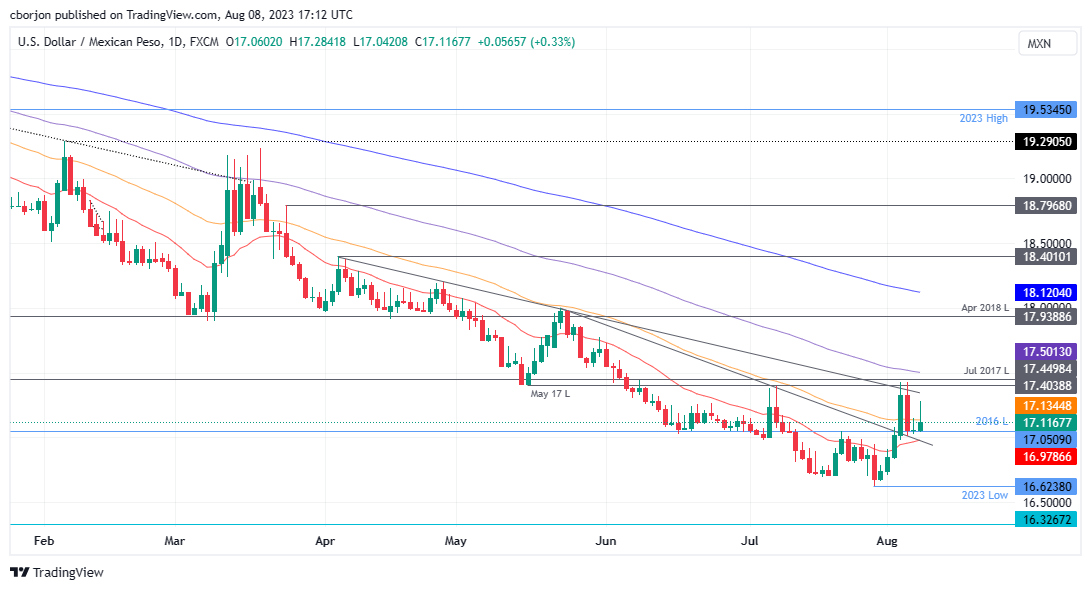
From a technical standpoint, the USD/MXN downtrend remains intact until buyers reclaim the May 17 daily low of 17.4038, which could pave the way for a test of the 100-day Exponential Moving Average (EMA) at 17.5015. Still, firstly, USD/MXN buyers must crack the 50-day EMA at 17.1347. Conversely, if USD/MXN slumps past 17.0000, the year-to-date (YTD) low of 16.6238 could be put into play.
Author

Christian Borjon Valencia
FXStreet
Markets analyst, news editor, and trading instructor with over 14 years of experience across FX, commodities, US equity indices, and global macro markets.














