USD/KRW gets knocked lower by US-Korea currency talks
- USD/KRW briefly backslid below 1,400.00 on Wednesday as the Korean Won catches a bid.
- Details remain thin, but US representatives were reported to have engaged directly in FX market discussions with Korea.
- The Korean Won, which has fallen against the Greenback for decades, could be set for a recovery run.

USD/KRW snapped lower on Wednesday, declining 2.3% peak-to-trough on the day after rumors emerged that representatives from both the United States (US) and South Korea had directly spoken about FX markets on May 5. Details of the conversation remain light, but according to sources, South Korea’s Deputy Finance Minister Choi Ji-young and US Treasury Assistant Secretary for International Trade and Development Robert Kapoth directly discussed the Dollar-Won exchange rate while attending the Asian Development Bank’s Annual Meeting in Milan.
US Dollar on a structural path toward intentional weakness?
White House representatives have fiercely opposed the insinuation that the US is pursuing a Dollar-weakening strategy as part of its across-the-board “revamp” of US trade policies. However, US President Donald Trump has been quite open about his desire to weaken the US Dollar to shrink trade deficits and make US manufacturing more competitive, even if it comes at the cost of the US service sector. At the last tally, highly profitable services activity accounted for nearly 80% of the US economy.
The Korean Won has been on a steady decline against the Greenback for over a decade, but Dollar-weakening strategies from the US could put the Won, as well as other devalued currencies, on pace for a strong, long-term turnaround. As noted by Goldman Sachs analysts, headlines such as SK-US FX discussions “puts renewed focus on the scope for undervalued trade surplus currencies to appreciate in a weaker Dollar environment.”
USD/KRW price forecast
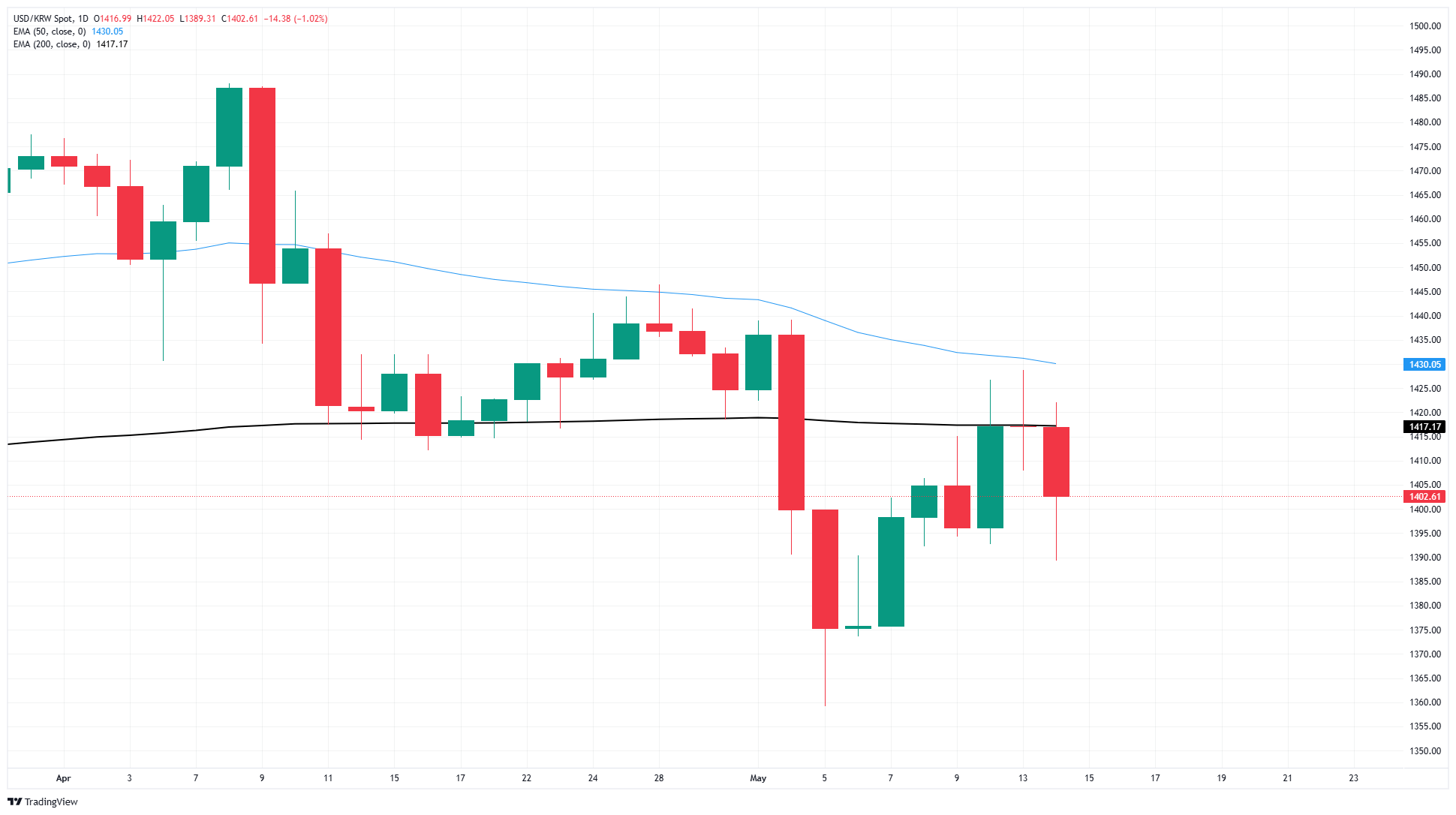
Despite a 2.3% top-to-bottom plunge on Wednesday, USD/KRW recovered some ground intraday, bringing the pair’s downside to a more reasonable one percent. The pair is still trading into near-term congestion just south of the 200-day Exponential Moving Average (EMA) near 1,415.00. However, sea change driven by fundamental shifts could see the pair enter a sustained drop below 1,360.00.
USD/KRW daily chart
US Dollar FAQs
The US Dollar (USD) is the official currency of the United States of America, and the ‘de facto’ currency of a significant number of other countries where it is found in circulation alongside local notes. It is the most heavily traded currency in the world, accounting for over 88% of all global foreign exchange turnover, or an average of $6.6 trillion in transactions per day, according to data from 2022. Following the second world war, the USD took over from the British Pound as the world’s reserve currency. For most of its history, the US Dollar was backed by Gold, until the Bretton Woods Agreement in 1971 when the Gold Standard went away.
The most important single factor impacting on the value of the US Dollar is monetary policy, which is shaped by the Federal Reserve (Fed). The Fed has two mandates: to achieve price stability (control inflation) and foster full employment. Its primary tool to achieve these two goals is by adjusting interest rates. When prices are rising too quickly and inflation is above the Fed’s 2% target, the Fed will raise rates, which helps the USD value. When inflation falls below 2% or the Unemployment Rate is too high, the Fed may lower interest rates, which weighs on the Greenback.
In extreme situations, the Federal Reserve can also print more Dollars and enact quantitative easing (QE). QE is the process by which the Fed substantially increases the flow of credit in a stuck financial system. It is a non-standard policy measure used when credit has dried up because banks will not lend to each other (out of the fear of counterparty default). It is a last resort when simply lowering interest rates is unlikely to achieve the necessary result. It was the Fed’s weapon of choice to combat the credit crunch that occurred during the Great Financial Crisis in 2008. It involves the Fed printing more Dollars and using them to buy US government bonds predominantly from financial institutions. QE usually leads to a weaker US Dollar.
Quantitative tightening (QT) is the reverse process whereby the Federal Reserve stops buying bonds from financial institutions and does not reinvest the principal from the bonds it holds maturing in new purchases. It is usually positive for the US Dollar.
Author

Joshua Gibson
FXStreet
Joshua joins the FXStreet team as an Economics and Finance double major from Vancouver Island University with twelve years' experience as an independent trader focusing on technical analysis.