USD/JPY spins a tight circle as markets weigh sentiment balance
- USD/JPY tested higher on Wednesday, but remains capped below 148.50.
- Risk sentiment and Fed rate cut expectations remain the key drivers of Greenback flows.
- US ADP jobs preview data in the barrel for Thursday.


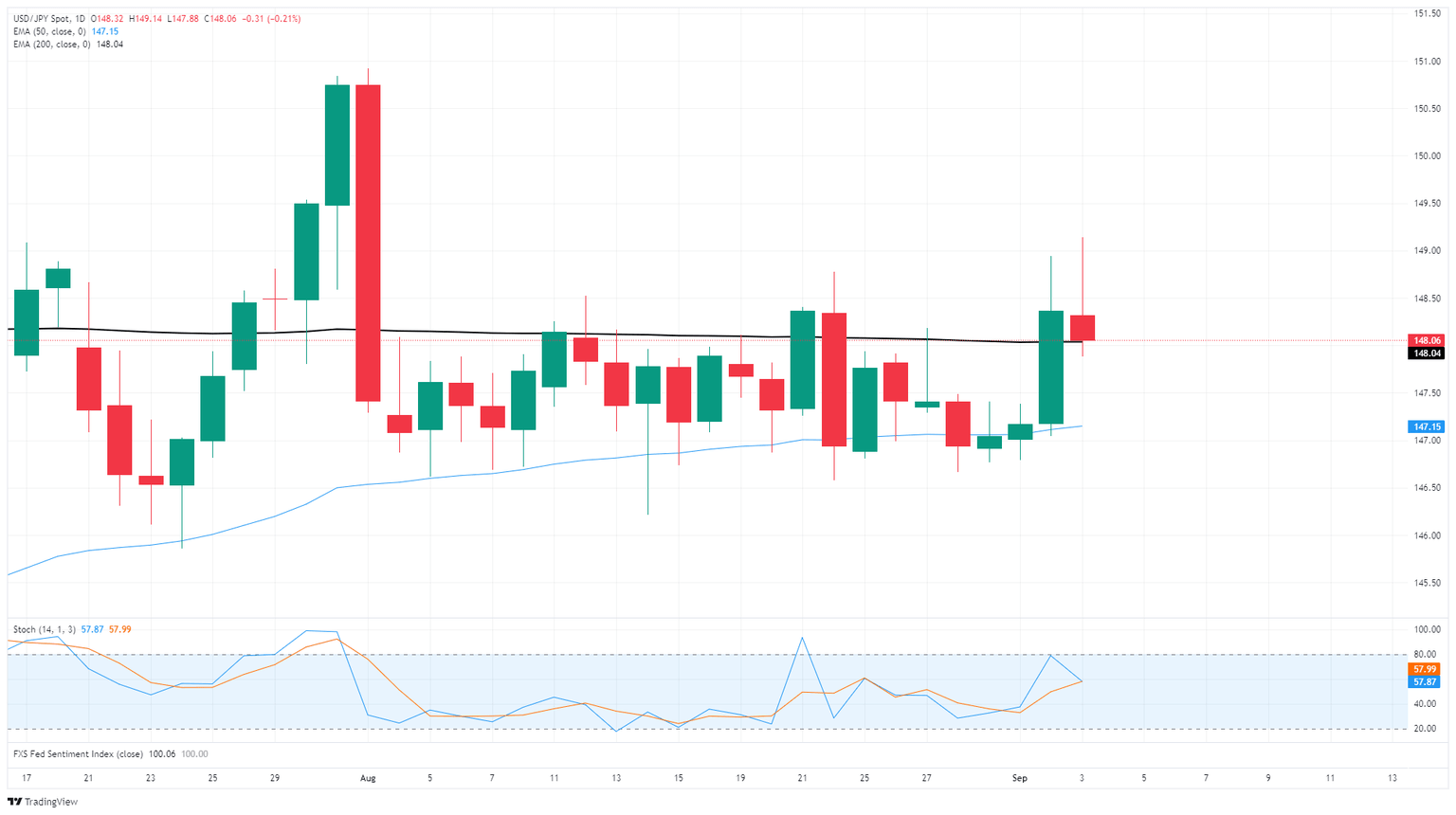
USD/JPY two-stepped near the 148.00 handle on Wednesday, testing higher but remaining capped below the 200-day Exponential Moving Average (EMA) near 148.22. The pair briefly hit a five-week high of 149.14, but traders are struggling to develop or maintain momentum ahead of this Friday’s critical Nonfarm Payrolls (NFP) jobs report.
US ADP Employment Change figures from August and the ISM’s latest Purchasing Managers Index (PMI) will land on markets on Thursday. ADP data has a tenuous relationship with Friday’s upcoming NFP official jobs data release, and has performed poorly as a preview of the final NFP figure. However, investors still tend to keep an eye on ADP's advance numbers for any potential major shifts underfoot. ISM’s Services PMI is expected to show a general improvement in firms’ economic outlook heading into the fourth quarter.
All data roads lead to NFP
NFP is always a bumper data release, but this week’s jobs data dump will take on added importance. Markets are clamoring for an interest rate cut from the Federal Reserve (Fed) this month, with expectations that Fed policymakers will shrug off a recent upswing in inflation data and deliver a quarter-point rate trim on September 17 in the face of weakening US labor data.
USD/JPY daily chart
Japanese Yen FAQs
The Japanese Yen (JPY) is one of the world’s most traded currencies. Its value is broadly determined by the performance of the Japanese economy, but more specifically by the Bank of Japan’s policy, the differential between Japanese and US bond yields, or risk sentiment among traders, among other factors.
One of the Bank of Japan’s mandates is currency control, so its moves are key for the Yen. The BoJ has directly intervened in currency markets sometimes, generally to lower the value of the Yen, although it refrains from doing it often due to political concerns of its main trading partners. The BoJ ultra-loose monetary policy between 2013 and 2024 caused the Yen to depreciate against its main currency peers due to an increasing policy divergence between the Bank of Japan and other main central banks. More recently, the gradually unwinding of this ultra-loose policy has given some support to the Yen.
Over the last decade, the BoJ’s stance of sticking to ultra-loose monetary policy has led to a widening policy divergence with other central banks, particularly with the US Federal Reserve. This supported a widening of the differential between the 10-year US and Japanese bonds, which favored the US Dollar against the Japanese Yen. The BoJ decision in 2024 to gradually abandon the ultra-loose policy, coupled with interest-rate cuts in other major central banks, is narrowing this differential.
The Japanese Yen is often seen as a safe-haven investment. This means that in times of market stress, investors are more likely to put their money in the Japanese currency due to its supposed reliability and stability. Turbulent times are likely to strengthen the Yen’s value against other currencies seen as more risky to invest in.
Author
Joshua Gibson
FXStreet
Joshua joins the FXStreet team as an Economics and Finance double major from Vancouver Island University with twelve years' experience as an independent trader focusing on technical analysis.