USD/JPY Price Forecast: Bulls maintain control above 154.50 despite weakening momentum
- USD/JPY trades lower as Yen strength builds on hawkish BoJ commentary from Governor Ueda.
- Markets price in a December BoJ rate hike while the Fed is widely expected to cut rates next week.
- Technical structure remains bullish, but momentum indicators show signs of cooling.

USD/JPY trades on the defensive at the start of the week as the Japanese Yen (JPY) bulls regain control on the back of hawkish Bank of Japan (BoJ) signals. At the time of writing, the pair is hovering around 155.40, trimming a part of its earlier decline as the US Dollar (USD) steadies, tempering bearish momentum for now.
BoJ Governor Kazuo Ueda signalled on Monday that policymakers will actively weigh the pros and cons of a rate increase at the December 18-19 meeting. Ueda warned that delaying a rate hike too long could cause sharp inflation and force the central bank to make a rapid policy adjustment.
Elsewhere, traders in the US maintain a strong conviction that the Federal Reserve (Fed) will deliver a rate cut at the December 9-10 meeting. While the Dollar is attempting a modest rebound, the broader outlook remains tilted firmly to the downside.
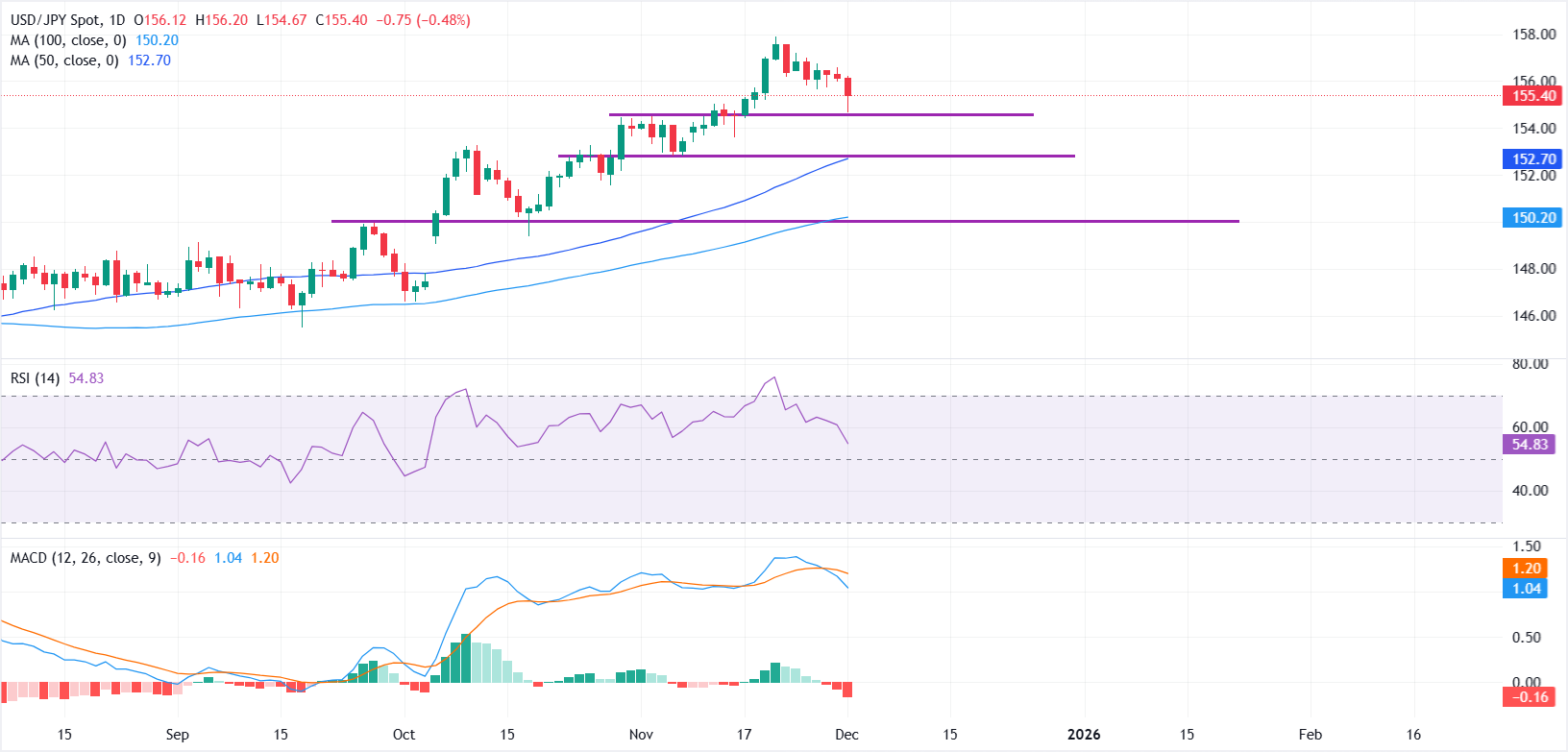
From a technical perspective, USD/JPY continues to trade within a well-defined uptrend on the daily chart, characterised by a clear sequence of higher highs and higher lows. The latest swing low found support above 154.50, reinforcing this bullish structure and confirming that buyers are still defending the trend.
The 50-day Simple Moving Average (SMA) rises above the 100-day SMA, and the price holds above both, reinforcing a firm uptrend. However, momentum indicators point to some cooling, reflecting a pause in bullish momentum.
The Moving Average Convergence Divergence (MACD) has turned lower, with the MACD line slipping beneath the Signal line around the zero region and the histogram back in negative territory. The Relative Strength Index (RSI) has eased to around 54, a neutral reading after unwinding from recent overbought levels.
On the downside, a decisive break below 154.50 would expose the next support zone at the rising 50-day SMA near 152.69, while the 100-day SMA around 150.20 is expected to provide a firmer cushion in the event of a deeper pullback.
On the upside, initial resistance sits at 156.00, which may cap the immediate recovery. A sustained move above this barrier would signal a continuation of the prevailing uptrend, paving the way for another higher high toward the 158.00 region.
Japanese Yen Price Today
The table below shows the percentage change of Japanese Yen (JPY) against listed major currencies today. Japanese Yen was the strongest against the British Pound.
| USD | EUR | GBP | JPY | CAD | AUD | NZD | CHF | |
|---|---|---|---|---|---|---|---|---|
| USD | -0.14% | 0.20% | -0.53% | 0.13% | 0.02% | 0.08% | 0.08% | |
| EUR | 0.14% | 0.34% | -0.34% | 0.27% | 0.16% | 0.22% | 0.22% | |
| GBP | -0.20% | -0.34% | -0.66% | -0.07% | -0.17% | -0.12% | -0.12% | |
| JPY | 0.53% | 0.34% | 0.66% | 0.60% | 0.49% | 0.56% | 0.55% | |
| CAD | -0.13% | -0.27% | 0.07% | -0.60% | -0.11% | -0.05% | -0.05% | |
| AUD | -0.02% | -0.16% | 0.17% | -0.49% | 0.11% | 0.06% | 0.06% | |
| NZD | -0.08% | -0.22% | 0.12% | -0.56% | 0.05% | -0.06% | -0.00% | |
| CHF | -0.08% | -0.22% | 0.12% | -0.55% | 0.05% | -0.06% | 0.00% |
The heat map shows percentage changes of major currencies against each other. The base currency is picked from the left column, while the quote currency is picked from the top row. For example, if you pick the Japanese Yen from the left column and move along the horizontal line to the US Dollar, the percentage change displayed in the box will represent JPY (base)/USD (quote).
Author

Vishal Chaturvedi
FXStreet
I am a macro-focused research analyst with over four years of experience covering forex and commodities market. I enjoy breaking down complex economic trends and turning them into clear, actionable insights that help traders stay ahead of the curve.

















