USD/JPY jumps to multi-month high post-US PMIs
- The USD/JPY climbed its highest level since November 2022, approaching 144.00.
- US Manufacturing PMI from June fell to a five-month low
- Negative market sentiment and soft Japanese inflation figures weigh on the JPY.

The USD/JPY pair surged to a multi-month high, reaching its highest level since November 2022, near 143.90. This significant jump came in the wake of the US Manufacturing PMI for June, which plummeted to a five-month low and fueled a negative market sentiment. This, coupled with disappointing Japanese inflation figures, exerted downward pressure on the JPY. The pair is set to close the week with a gain of more than 1.25% – and it is the second week in a row it has risen.
Bond yields and Wall St indexes fall following US PMIs
According to a recent S&P Global report, the US PMIs for June delivered a mixed performance. The Manufacturing PMI fell to a five-month low of 46.3, missing expectations of 48.3. On a positive note, the Services PMI slightly exceeded market expectations, registering 54.1 compared to the anticipated 54. Additionally, the Global Composite PMI came in lower than expected at 53 instead of the projected 54.4.
Consequently, a risk-averse sentiment in the markets was cultivated, leading to a decline in US bond yields and a negative impact on major Wall Street indexes, which benefited the USD. The 10-year bond yield dropped to 3.75%, while the 2-year yield fell to 4.70%, and the 5-year yield reached 4%. The S&P 500 index (SPX) experienced a 0.6% loss, the Dow Jones Industrial Average (DJI) declined by 0.51%, and the Nasdaq Composite (NDX) suffered a 0.92% decrease.
On the Japanese side, soft inflation figures reported during the early Asian session seem to be applying additional pressure on the Yen. In that sense, the National Consumer Price Index dropped to 3.2% YoY vs. the 4.1% expected, while Core Inflation, Excluding Food and Energy prices, dropped to 4.3% in the same period of time vs. the 4.4% expected. While the Bank of Japan (BoJ) is set to maintain an ultra-dovish monetary policy, the only hope for the Yen is now the intervention of the government and BoJ in order to bolster the Japanese currency.
USD/JPY Levels to watch
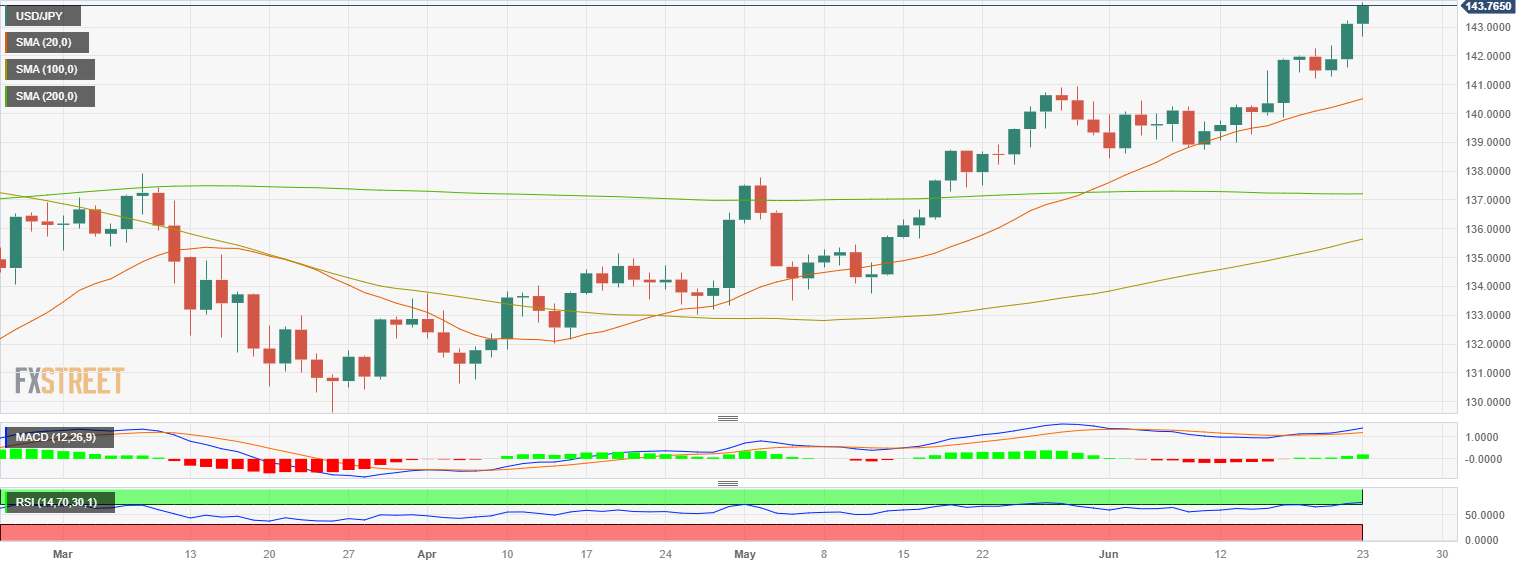
According to the daily chart, the USD/JPY holds a (very) bullish outlook for the short term as the Relative Strength Index (RSI) and Moving Average Convergence Divergence (MACD) suggest that the buyers are in control but continue to show overbought conditions. In addition, the 100 and 200-day Simple Moving Average (SMA) are about to perform a bullish cross giving further insight into the positive outlook of the pair.
On the upside, the psychological mark at 145.00 is key for USD/JPY to gain further traction. If cleared, the price could see a more pronounced move towards the 145.70 area and the 146.50 zone. On the other hand, the daily low at 142.70 acts as a key support level for the pair. If broken, the 141.60 area and 141.20 zone could come into play.
Author

Patricio Martín
FXStreet
Patricio is an economist from Argentina passionate about global finance and understanding the daily movements of the markets.
















