Indian Rupee maintains position as US-India trade framework boosts sentiment
- USD/INR steadies as US and India unveil an interim framework to cut tariffs and deepen economic ties.
- The Indian Rupee gains as Goldman Sachs sees effective US tariffs on Indian imports about 20% lower than the earlier 34%.
- Markets watch foreign inflows as investors buy nearly $900 million in Indian equities after January’s $4 billion outflows.

USD/INR depreciates as the Indian Rupee (INR) finds support from the United States (US)–India interim trade framework. New Delhi and Washington on Friday unveiled an interim framework aimed at lowering tariffs, reshaping energy ties, and deepening economic cooperation. The announcement follows a breakthrough in prolonged negotiations earlier last week and helped lift the Indian Rupee to its strongest weekly gain in more than three years, according to Reuters.
Analysts at Goldman Sachs noted that the effective tariff rate imposed by the US on Indian imports could be around 20% lower than the earlier 34%. However, the US-India joint statement did not refer to India’s purchases of Russian oil and did not include any formal commitment from New Delhi to halt them.
Market participants are also monitoring signs of a revival in foreign portfolio inflows. Foreign investors have been net buyers of nearly $900 million in Indian equities so far in February, marking a sharp reversal from the roughly $4 billion outflow recorded last month.
US Dollar declines as market caution emerges ahead of looming labor data
- The US Dollar Index (DXY), which measures the value of the US Dollar (USD) against six major currencies, loses ground for the second successive session and is trading near 97.60 at the time of writing.
- Traders will closely watch the delayed release of the US January employment report on Wednesday. The US economy is expected to add 70,000 jobs, while the Unemployment Rate is forecast to hold steady at 4.4%.
- Markets currently expect the Fed to keep interest rates unchanged in March, with potential rate cuts anticipated in June and possibly September. San Francisco Fed President Mary Daly said in a LinkedIn post on Friday that the economy may remain in a low-hiring, low-firing environment, though it could also shift toward a no-hiring, higher-firing phase.
- Michigan Consumer Sentiment Index unexpectedly rose to a six-month high. The index increased to 57.3 in February, marking a third straight monthly gain and exceeding expectations of 55.0.
- Fed Governor Phillip Jefferson said future policy decisions will be guided by incoming data and assessments of the economic outlook, adding on Friday that the labor market is gradually stabilizing. Meanwhile, Atlanta Fed President Raphael Bostic noted that inflation has remained elevated for too long, stressing in a Bloomberg interview on Friday that the Fed cannot lose sight of inflationary risks.
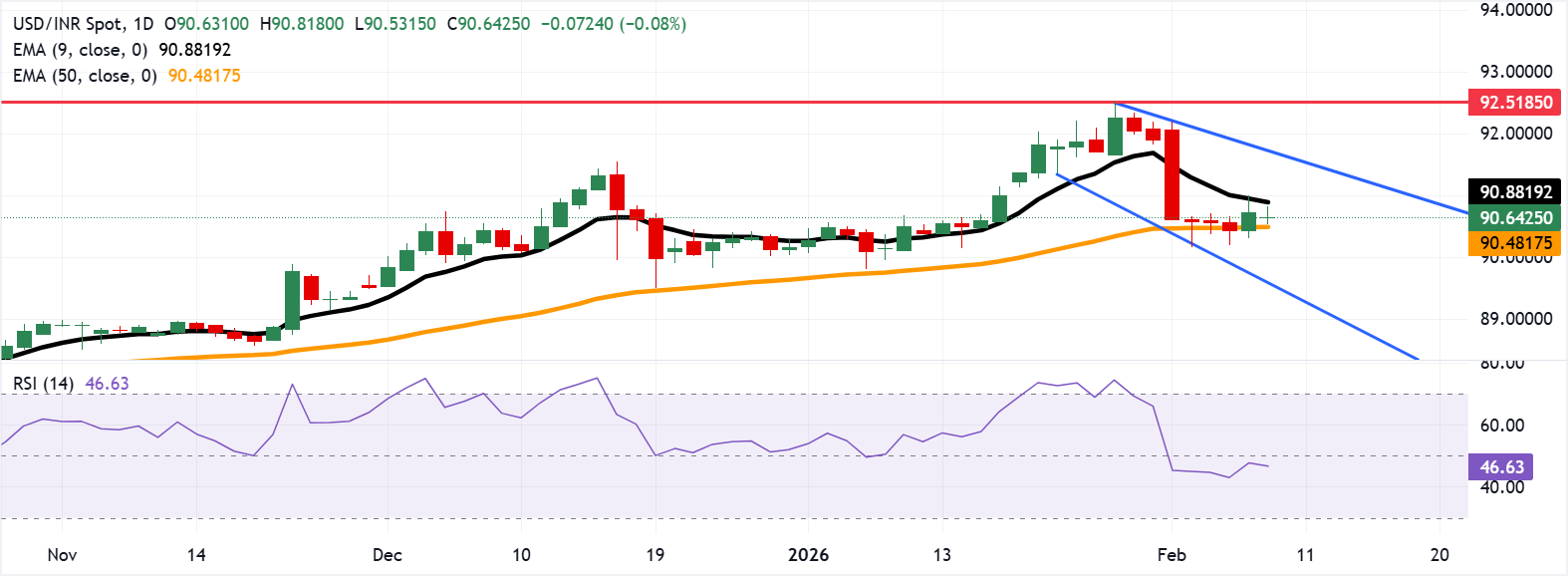
USD/INR falls toward 90.50 amid bearish momentum
USD/INR is trading around 90.60 at the time of writing. Daily chart analysis points to an ongoing bearish bias, with the pair trading within a descending channel pattern. The 14-day Relative Strength Index (RSI) is at 47, indicating the market is neither overbought nor oversold, with a slight bearish bias since it is below the 50 mid-point.
The immediate support lies at the 50-day Exponential Moving Average (EMA) of 90.48. A break below the medium-term price momentum will expose the lower boundary of the descending channel around 89.70. On the upside, the immediate resistance is seen at the nine-day EMA of 90.86. Further advances would lead the pair to approach the upper channel boundary around 91.80, followed by the January 28 all-time high of 92.51.
US Dollar Price Today
The table below shows the percentage change of US Dollar (USD) against listed major currencies today. US Dollar was the strongest against the British Pound.
| USD | EUR | GBP | JPY | CAD | AUD | NZD | INR | |
|---|---|---|---|---|---|---|---|---|
| USD | -0.32% | 0.12% | -0.33% | -0.09% | -0.22% | -0.01% | 0.03% | |
| EUR | 0.32% | 0.45% | 0.00% | 0.24% | 0.12% | 0.32% | 0.33% | |
| GBP | -0.12% | -0.45% | -0.45% | -0.24% | -0.34% | -0.14% | -0.07% | |
| JPY | 0.33% | 0.00% | 0.45% | 0.23% | 0.11% | 0.31% | 0.32% | |
| CAD | 0.09% | -0.24% | 0.24% | -0.23% | -0.13% | 0.08% | 0.09% | |
| AUD | 0.22% | -0.12% | 0.34% | -0.11% | 0.13% | 0.20% | 0.21% | |
| NZD | 0.01% | -0.32% | 0.14% | -0.31% | -0.08% | -0.20% | 0.02% | |
| INR | -0.03% | -0.33% | 0.07% | -0.32% | -0.09% | -0.21% | -0.02% |
The heat map shows percentage changes of major currencies against each other. The base currency is picked from the left column, while the quote currency is picked from the top row. For example, if you pick the US Dollar from the left column and move along the horizontal line to the Japanese Yen, the percentage change displayed in the box will represent USD (base)/JPY (quote).
Indian Rupee FAQs
The Indian Rupee (INR) is one of the most sensitive currencies to external factors. The price of Crude Oil (the country is highly dependent on imported Oil), the value of the US Dollar – most trade is conducted in USD – and the level of foreign investment, are all influential. Direct intervention by the Reserve Bank of India (RBI) in FX markets to keep the exchange rate stable, as well as the level of interest rates set by the RBI, are further major influencing factors on the Rupee.
The Reserve Bank of India (RBI) actively intervenes in forex markets to maintain a stable exchange rate, to help facilitate trade. In addition, the RBI tries to maintain the inflation rate at its 4% target by adjusting interest rates. Higher interest rates usually strengthen the Rupee. This is due to the role of the ‘carry trade’ in which investors borrow in countries with lower interest rates so as to place their money in countries’ offering relatively higher interest rates and profit from the difference.
Macroeconomic factors that influence the value of the Rupee include inflation, interest rates, the economic growth rate (GDP), the balance of trade, and inflows from foreign investment. A higher growth rate can lead to more overseas investment, pushing up demand for the Rupee. A less negative balance of trade will eventually lead to a stronger Rupee. Higher interest rates, especially real rates (interest rates less inflation) are also positive for the Rupee. A risk-on environment can lead to greater inflows of Foreign Direct and Indirect Investment (FDI and FII), which also benefit the Rupee.
Higher inflation, particularly, if it is comparatively higher than India’s peers, is generally negative for the currency as it reflects devaluation through oversupply. Inflation also increases the cost of exports, leading to more Rupees being sold to purchase foreign imports, which is Rupee-negative. At the same time, higher inflation usually leads to the Reserve Bank of India (RBI) raising interest rates and this can be positive for the Rupee, due to increased demand from international investors. The opposite effect is true of lower inflation.
Author

Akhtar Faruqui
FXStreet
Akhtar Faruqui is a Forex Analyst based in New Delhi, India. With a keen eye for market trends and a passion for dissecting complex financial dynamics, he is dedicated to delivering accurate and insightful Forex news and analysis.