USD/INR plummets as Middle East war de-escalation drags oil price sharply
- The Indian Rupee rebounds strongly against the US Dollar as both the US and Iran signal readiness to end the war.
- Iran wants guarantees of no repetitive aggression from the US in return for peace.
- FIIs continue to dump their stake in the Indian stock market.

The Indian Rupee (INR) bounces back against the US Dollar (USD) on Wednesday after a holiday due to the Shri Mahavir Jayanti the previous day. The USD/INR pair plummets to near 93.00 from the all-time high of 95.22 posted on Monday, as a significant de-escalation in the Middle East war, following comments from both the United States (US) and Iran signaling their willingness to end the war, has improved the appeal of risk-sensitive assets.
US and Iran are willing to end Middle East war
On Tuesday, Iran’s President Masoud Pezeshkian told European Union (EU) Council President António Costa that his country is ready to end the war with the US, but it needs certain guarantees, especially no repetition of aggression, the Iranian state news agency reported.
Increasing hopes of the end of the Iran war have weighed heavily on oil prices despite issues regarding the closure of the Strait of Hormuz remaining intact. The WTI oil price has declined by almost 5% in the European trade on Wednesday, a scenario that is favorable for currencies from economies like India that rely heavily on oil imports to meet their energy needs.
Meaningful signs of US-Iran war de-escalation have diminished demand for safe-haven assets, such as the US Dollar. As of writing, the US Dollar Index (DXY), which tracks the Greenback’s value against six major currencies, trades 0.3% lower to near 99.50. The USD Index also fell almost 0.8% on Tuesday after posting a fresh 10-month high at around 100.65.
FIIs keep offloading their stake in Indian stock market
Currencies from economies like India, which are in their developing stage, rely heavily on foreign investments for a strong financial system. The consistent outflow of foreign funds from the Indian stock market has battered the Indian Rupee significantly in the past months.
In March, Foreign Institutional Investors (FIIs) offloaded their stake worth Rs. 1,22,539.89 crore from the Indian stock market due to the war in the Middle East, assuming that higher oil prices in the wake of the war would be a drag on Nifty 50 Q4FY2025-26 earnings.
US data eyed
On Wednesday, investors will focus on the US ADP Employment Change and the ISM Manufacturing PMI data for March, and Retail Sales data for February, which will be published in the North American session. Economists expect US private sector to have created 40K fresh jobs, lower than 63K in February.
The ISM is expected to report that the Manufacturing PMI will tick higher to 52.5 from the previous reading of 52.4. US Retail Sales are estimated to have grown 0.5% after declining 0.2% in January.
Technical Analysis: USD/INR falls to near 20-day EMA
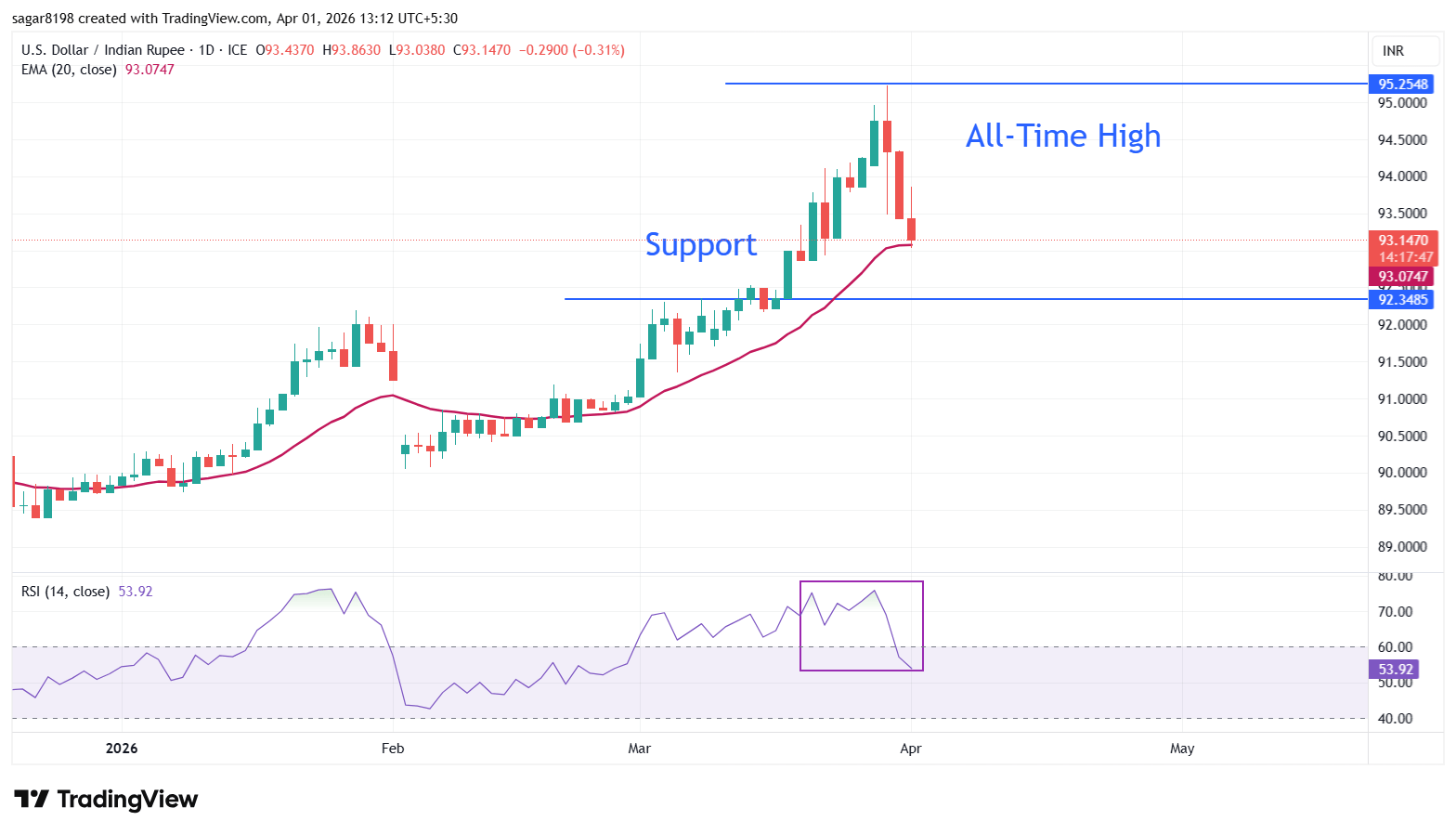
USD/INR corrects sharply from the all-time high of 95.22 to near 93.00 on Wednesday. However, the continuation of higher highs and higher lows from the 90s area suggests that the bullish structure has not broken yet. The price has extended its decline to near the ascending 20-day Exponential Moving Average (EMA), which trades around 93.10.
The 14-day Relative Strength Index (RSI) falls below 60.00 after remaining inside the 60.00-80.00 zone for a longer period, indicating the suspension of the bullish momentum with the upside bias remaining intact.
Initial support emerges at 20-day EMA, which is around 93.10, followed by previous peak levels in the 92.00-92.35 range. A downside break below the range would dent the overall bullish structure and open the way towards the March 5 low of 91.35. On the upside, the all-time high of 95.22 will be the major barrier for the spot price. A decisive break above the same would boost the odds of an extension of the advance toward 96.00.
Indian economy FAQs
The Indian economy has averaged a growth rate of 6.13% between 2006 and 2023, which makes it one of the fastest growing in the world. India’s high growth has attracted a lot of foreign investment. This includes Foreign Direct Investment (FDI) into physical projects and Foreign Indirect Investment (FII) by foreign funds into Indian financial markets. The greater the level of investment, the higher the demand for the Rupee (INR). Fluctuations in Dollar-demand from Indian importers also impact INR.
India has to import a great deal of its Oil and gasoline so the price of Oil can have a direct impact on the Rupee. Oil is mostly traded in US Dollars (USD) on international markets so if the price of Oil rises, aggregate demand for USD increases and Indian importers have to sell more Rupees to meet that demand, which is depreciative for the Rupee.
Inflation has a complex effect on the Rupee. Ultimately it indicates an increase in money supply which reduces the Rupee’s overall value. Yet if it rises above the Reserve Bank of India’s (RBI) 4% target, the RBI will raise interest rates to bring it down by reducing credit. Higher interest rates, especially real rates (the difference between interest rates and inflation) strengthen the Rupee. They make India a more profitable place for international investors to park their money. A fall in inflation can be supportive of the Rupee. At the same time lower interest rates can have a depreciatory effect on the Rupee.
India has run a trade deficit for most of its recent history, indicating its imports outweigh its exports. Since the majority of international trade takes place in US Dollars, there are times – due to seasonal demand or order glut – where the high volume of imports leads to significant US Dollar- demand. During these periods the Rupee can weaken as it is heavily sold to meet the demand for Dollars. When markets experience increased volatility, the demand for US Dollars can also shoot up with a similarly negative effect on the Rupee.
Author

Sagar Dua
FXStreet
Sagar Dua is associated with the financial markets from his college days. Along with pursuing post-graduation in Commerce in 2014, he started his markets training with chart analysis.

















