USD/INR jumps to four-week highs despite Fed rate cut hope
- The Indian Rupee weakens in Thursday’s early European session.
- Higher crude oil prices weigh on the INR; rising US rate cut bets and Fed’s dovish view might cap the downside.
- Investors await the US weekly Initial Jobless Claims and Philly Fed Manufacturing Index, which are due on Thursday.


The Indian Rupee (INR) attracts some sellers on Thursday despite the weaker US Dollar (USD). The extended recovery in crude oil prices exerts some pressure on the INR as India is the world’s third-largest oil consumer. However, the downside for the local currency might be limited as rising odds of a September rate cut by the US Federal Reserve (Fed) could weigh on the Greenback and pressure US bond yields to come down.
Later on Thursday, investors will monitor the weekly Initial Jobless Claims and the Philly Fed Manufacturing Index. Also, the Fed’s Lorie Logan is scheduled to speak. The dovish comments from the Fed officials might continue to undermine the USD in the near term.
Daily Digest Market Movers: Indian Rupee extends downside amid global factors
- The International Monetary Fund (IMF) on Tuesday raised its economic forecasts this year for China, India, and Europe. India’s economy is estimated to grow 7% from the 6.8% the IMF had projected in April, owing to stronger consumer spending in rural areas.
- Fed Governor Christopher Waller said on Wednesday that the US central bank is ‘getting closer’ to an interest rate cut as inflation's improved trajectory and a labor market in better balance.
- Richmond Fed President Thomas Barkin said he is "very encouraged" that easing in inflation has begun to broaden and he would like to see it continue.
- The US Building Permits increased by 3.4% to 1.446 million in June from 1.399 million in May, while Housing Starts for the same period rose by 3.0% to 1.353 million from 1.314 million.
- US Industrial Production climbed 0.6% MoM in June from the previous reading of 1.0%, beating the estimation of a 0.3% increase.
Technical analysis: USD/INR remains in consolidative mode in the near term
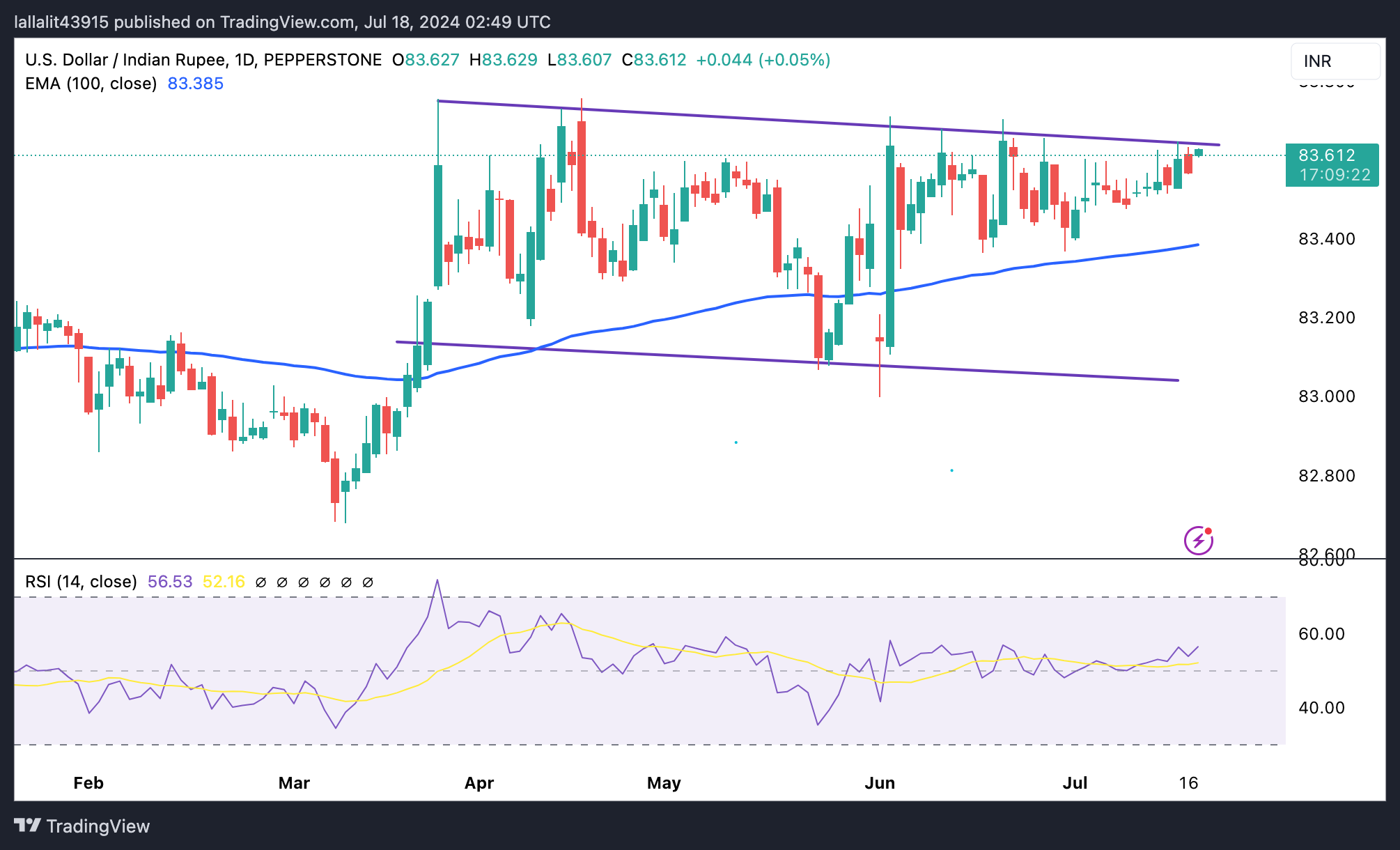
The Indian Rupee trades on a softer note on the day. The trend of the USD/INR pair appears to be bullish as the pair makes higher highs and higher lows. Additionally, USD/INR holds above the key 100-day Exponential Moving Average (EMA) on the daily chart. The 14-day Relative Strength Index (RSI) points higher above 57.35, suggesting that further upside could be on the horizon.
In the shorter term, the pair has remained confined within its month-long trading range since March 21.
A decisive break above the upper boundary of the trading range at 83.65 will pave the way to the all-time high of 83.75. Further north, the next hurdle to watch is the 84.00 psychological level.
On the other hand, the initial downside target will emerge near the 100-day EMA at 83.38. Extended losses will see a drop to the lower limit of the trading range and round figure at 83.00, followed by 82.82, a low of January 12.
US Dollar price today
The table below shows the percentage change of US Dollar (USD) against listed major currencies today. US Dollar was the strongest against the Japanese Yen.
| USD | EUR | GBP | CAD | AUD | JPY | NZD | CHF | |
| USD | 0.08% | 0.12% | -0.06% | -0.14% | 0.34% | 0.14% | 0.19% | |
| EUR | -0.07% | 0.04% | -0.13% | -0.22% | 0.29% | 0.05% | 0.10% | |
| GBP | -0.11% | -0.04% | -0.17% | -0.26% | 0.20% | 0.02% | 0.07% | |
| CAD | 0.06% | 0.13% | 0.17% | -0.09% | 0.37% | 0.19% | 0.24% | |
| AUD | 0.16% | 0.22% | 0.26% | 0.09% | 0.51% | 0.28% | 0.33% | |
| JPY | -0.35% | -0.28% | -0.27% | -0.38% | -0.50% | -0.25% | -0.16% | |
| NZD | -0.14% | -0.05% | -0.02% | -0.17% | -0.28% | 0.20% | 0.04% | |
| CHF | -0.19% | -0.09% | -0.06% | -0.23% | -0.32% | 0.19% | -0.04% |
The heat map shows percentage changes of major currencies against each other. The base currency is picked from the left column, while the quote currency is picked from the top row. For example, if you pick the Euro from the left column and move along the horizontal line to the Japanese Yen, the percentage change displayed in the box will represent EUR (base)/JPY (quote).
Indian Rupee FAQs
The Indian Rupee (INR) is one of the most sensitive currencies to external factors. The price of Crude Oil (the country is highly dependent on imported Oil), the value of the US Dollar – most trade is conducted in USD – and the level of foreign investment, are all influential. Direct intervention by the Reserve Bank of India (RBI) in FX markets to keep the exchange rate stable, as well as the level of interest rates set by the RBI, are further major influencing factors on the Rupee.
The Reserve Bank of India (RBI) actively intervenes in forex markets to maintain a stable exchange rate, to help facilitate trade. In addition, the RBI tries to maintain the inflation rate at its 4% target by adjusting interest rates. Higher interest rates usually strengthen the Rupee. This is due to the role of the ‘carry trade’ in which investors borrow in countries with lower interest rates so as to place their money in countries’ offering relatively higher interest rates and profit from the difference.
Macroeconomic factors that influence the value of the Rupee include inflation, interest rates, the economic growth rate (GDP), the balance of trade, and inflows from foreign investment. A higher growth rate can lead to more overseas investment, pushing up demand for the Rupee. A less negative balance of trade will eventually lead to a stronger Rupee. Higher interest rates, especially real rates (interest rates less inflation) are also positive for the Rupee. A risk-on environment can lead to greater inflows of Foreign Direct and Indirect Investment (FDI and FII), which also benefit the Rupee.
Higher inflation, particularly, if it is comparatively higher than India’s peers, is generally negative for the currency as it reflects devaluation through oversupply. Inflation also increases the cost of exports, leading to more Rupees being sold to purchase foreign imports, which is Rupee-negative. At the same time, higher inflation usually leads to the Reserve Bank of India (RBI) raising interest rates and this can be positive for the Rupee, due to increased demand from international investors. The opposite effect is true of lower inflation.
Author
Lallalit Srijandorn
FXStreet
Lallalit Srijandorn is a Parisian at heart. She has lived in France since 2019 and now becomes a digital entrepreneur based in Paris and Bangkok.