USD/INR attracts some buyers as hotter US CPI, hawkish Fed boost the US Dollar
- The Indian Rupee loses traction in Friday’s early European session.
- Indian foreign outflows, rising crude oil prices weigh on the INR; likely RBI’s intervention might cap its downside.
- The US PPI and preliminary reading of the Michigan Consumer Sentiment Index data will be the highlights on Friday.

The Indian Rupee (INR) weakens on Friday amid the firmer US Dollar (USD). Furthermore, sustained Indian foreign fund outflows and elevated crude oil prices continue to undermine the local currency. The hotter-than-expected US inflation data and hawkish comments by Federal Reserve (Fed) officials lift the Greenback and also contribute to the INR’s downside.
Nonetheless, the possible foreign exchange intervention from the Reserve Bank of India (RBI) helps limit the INR’s losses. Looking ahead, market players will shift their attention to the US Producer Price Index (PPI) for September, along with the preliminary reading of the Michigan Consumer Sentiment Index for October. On the Indian docket, the Industrial Production and Manufacturing Output will be released on Friday.
Daily Digest Market Movers: Indian Rupee remains weak amid multiple headwinds
- FTSE Russell said on Tuesday that Indian sovereign bonds will be added to its Emerging Markets Government Bond Index (EMGBI), following a similar move by JP Morgan and Bloomberg Index Services.
- The US Consumer Price Index (CPI) for September rose by 2.4% YoY, compared to 2.5% in August, exceeding estimates of 2.3%. Core CPI climbed by 3.3% YoY in September, surpassing forecasts and August's 3.2%.
- New York Fed President John C. Williams said on Thursday that the monetary policy will continue to shift towards a more neutral stance in the coming months, aligning with ongoing progress toward price stability.
- Chicago Fed President Austan Goolsbee noted on Thursday that he was not overly concerned with a higher-than-expected September inflation report and stuck by his view that the Fed has moved past its singular focus on price pressures.
- Atlanta Fed President Raphael Bostic stated that the Fed could stand pat at an upcoming policy meeting if the data warrants. "I am totally comfortable with skipping a meeting if the data suggests that's appropriate," said Bostic.
Technical Analysis: USD/INR maintains the bullish trend in the longer term
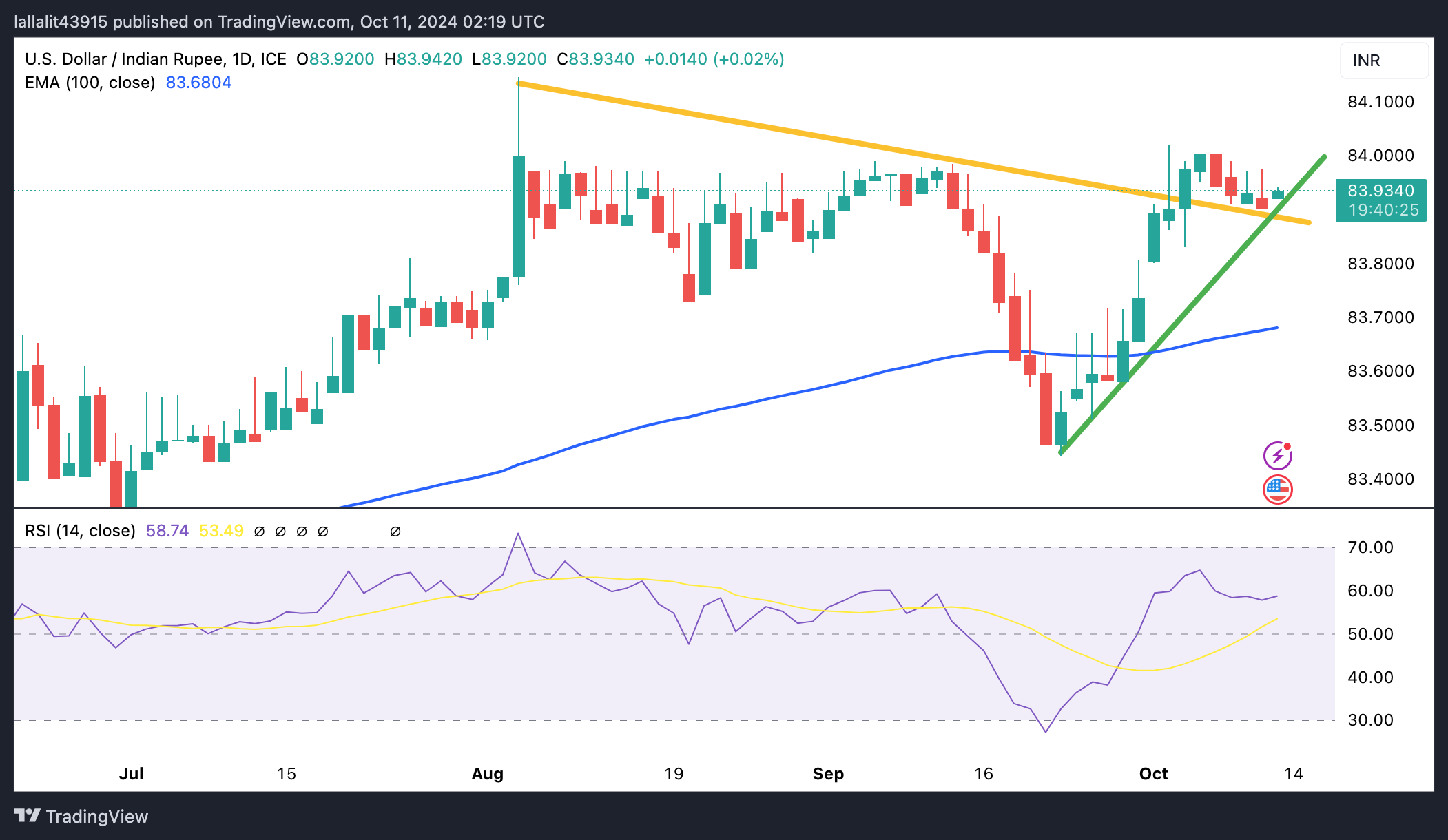
The Indian Rupee trades on a softer note on the day. The constructive outlook of the USD/INR pair remains in play as the pair holds above the descending trend line and the key 100-day Exponential Moving Average (EMA) on the daily timeframe. The upward momentum is supported by the 14-day Relative Strength Index (RSI), which stands above the midline near 59.15, supporting the buyers in the near term.
The 84.00 psychological level acts as a key resistance level for USD/INR. A decisive break above this level could lead the way to the all-time high of 84.15, en route to 84.50.
On the downside, the initial support level emerges near the resistance-turned-support level at 83.90. The next contention level is located around the 100-day EMA at 83.68. The additional downside filter to watch is 83.00, representing the round mark and the low of May 24.
Indian Rupee FAQs
The Indian Rupee (INR) is one of the most sensitive currencies to external factors. The price of Crude Oil (the country is highly dependent on imported Oil), the value of the US Dollar – most trade is conducted in USD – and the level of foreign investment, are all influential. Direct intervention by the Reserve Bank of India (RBI) in FX markets to keep the exchange rate stable, as well as the level of interest rates set by the RBI, are further major influencing factors on the Rupee.
The Reserve Bank of India (RBI) actively intervenes in forex markets to maintain a stable exchange rate, to help facilitate trade. In addition, the RBI tries to maintain the inflation rate at its 4% target by adjusting interest rates. Higher interest rates usually strengthen the Rupee. This is due to the role of the ‘carry trade’ in which investors borrow in countries with lower interest rates so as to place their money in countries’ offering relatively higher interest rates and profit from the difference.
Macroeconomic factors that influence the value of the Rupee include inflation, interest rates, the economic growth rate (GDP), the balance of trade, and inflows from foreign investment. A higher growth rate can lead to more overseas investment, pushing up demand for the Rupee. A less negative balance of trade will eventually lead to a stronger Rupee. Higher interest rates, especially real rates (interest rates less inflation) are also positive for the Rupee. A risk-on environment can lead to greater inflows of Foreign Direct and Indirect Investment (FDI and FII), which also benefit the Rupee.
Higher inflation, particularly, if it is comparatively higher than India’s peers, is generally negative for the currency as it reflects devaluation through oversupply. Inflation also increases the cost of exports, leading to more Rupees being sold to purchase foreign imports, which is Rupee-negative. At the same time, higher inflation usually leads to the Reserve Bank of India (RBI) raising interest rates and this can be positive for the Rupee, due to increased demand from international investors. The opposite effect is true of lower inflation.
Author

Lallalit Srijandorn
FXStreet
Lallalit Srijandorn is a Parisian at heart. She has lived in France since 2019 and now becomes a digital entrepreneur based in Paris and Bangkok.