USD/INR remains firm as FIIs selling and Iran conflict weigh on Rupee
- The Indian Rupee resumes its downside journey against the US Dollar due to consistent FIIs selling in the Indian equity market.
- Iran conflicts have dampened demand for riskier assets.
- Investors await the Fed policy on Wednesday, in which it is expected to leave interest rates unchanged.

The Indian Rupee (INR) trades lower against the US Dollar (USD) on Tuesday. The USD/INR pair rebounds to near 92.90 after a correction on Monday as the Indian Rupee resumes its downside journey amid the continuous outflow of foreign funds from the Indian stock market.
The outflow of a significant chunk of investment by overseas investors from emerging economies, such as India, dampens sentiment for the domestic currency.
Consistent FIIs selling hurts Indian Rupee
So far in March, Foreign Institutional Investors (FIIs) have remained net sellers on all trading days, and have offloaded their stake worth Rs. 66,248.74 crore, according to data from NSE. FIIs are trimming their investment amid fears that rising oil prices due to tensions in the Middle East, which involve the United States (US), Israel, and Iran, would be a key drag on Nifty50 earnings in the last quarter of the current fiscal year.
Also, an absence of signs of de-escalation in the Middle East war has weakened investors’ risk appetite, which in turn has increased the safe-haven appeal of the US Dollar.
Earlier in the day, Israel Defence Forces (IDF) announced through a post on X that it had launched a series of airstrikes on the Iranian regime’s infrastructure and Hezbollah’s infrastructure in Beirut.
Meanwhile, broader strength in the US Dollar is also strengthening the USD/INR pair. As of writing, the US Dollar Index (DXY), which gauges the Greenback’s value against six major currencies, trades 0.25% higher, slightly above 100.00. On Monday, the DXY corrected sharply from its over nine-month high of 100.54 posted on Friday.
The outlook of the US Dollar remains firm as higher oil prices due to the closure of the Strait of Hormuz amid Iran conflicts have raised US inflation expectations, a scenario that discourages Federal Reserve (Fed) officials from easing monetary policy conditions.
The Fed is anticipated to hold interest rates steady on Wednesday
According to the CME FedWatch tool, traders are confident that the Fed will not cut interest rates before the September policy meeting. Also, the odds of an interest rate cut in the September meeting are almost 50%.
For official cues on the US interest rate outlook, investors will focus on the Fed’s monetary policy announcement and Chair Jerome Powell’s press conference on Wednesday. Market participants will also pay close attention to the Fed’s dot plot, which shows where policymakers expect interest rates to be in the medium and long term.
Technical Analysis: USD/INR remains close to lifetime highs near 93.00
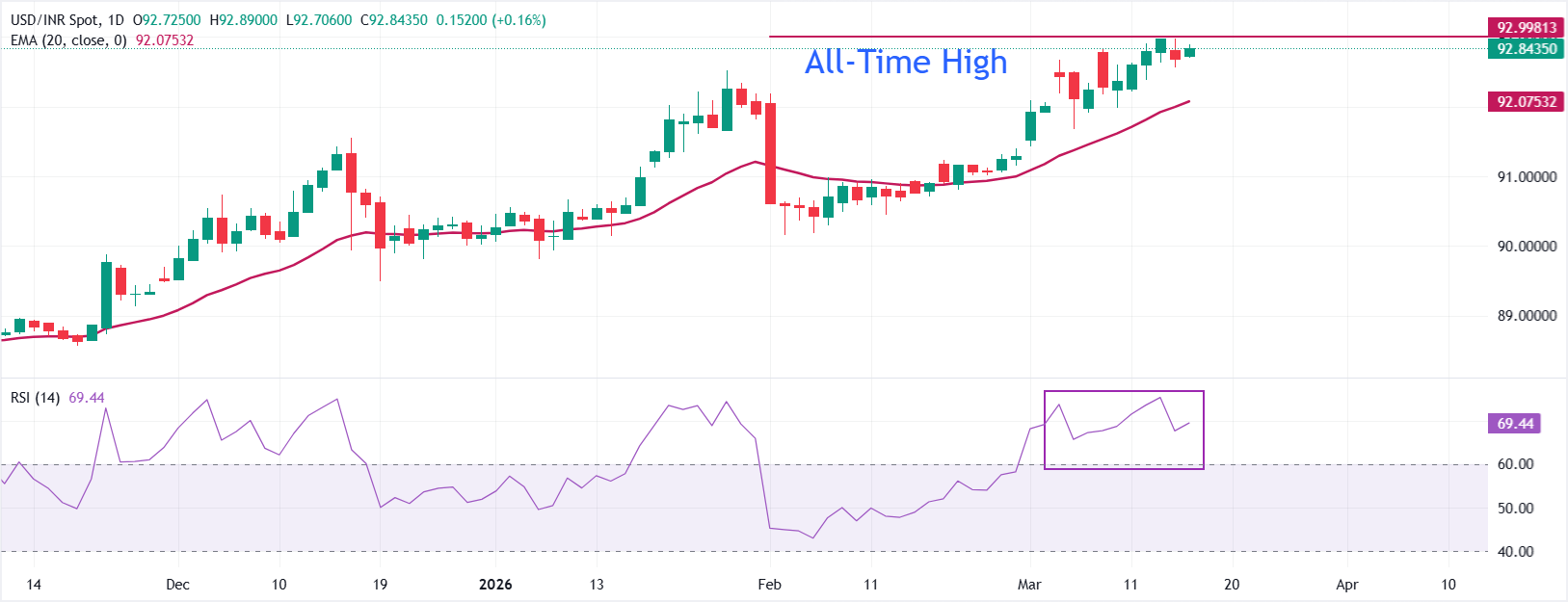
USD/INR trades higher at around 92.90 as of writing. The near-term bias is bullish as price holds above the rising 20-day Exponential Moving Average (EMA) near 92.08 while printing a sequence of higher closes. Momentum remains positive with the 14-day Relative Strength Index (RSI) staying inside the 60.00-80.00 zone, which signals firm buying pressure rather than exhaustion at this stage.
Initial support emerges at 92.60, where the latest pullback stalled above the dynamic floor from the 20-day EMA. A break below this area would expose 92.10 as the next downside level, guarding a deeper retracement toward 91.70. On the topside, immediate resistance stands at 93.00, and a sustained move above this barrier would open the way toward the 93.50 region as the next upside objective.
(The technical analysis of this story was written with the help of an AI tool.)
(This story was corrected at 10:10 GMT to say in the second heading that the Fed is anticipated to hold interest rates steady on Wednesday, not cut)
Fed FAQs
Monetary policy in the US is shaped by the Federal Reserve (Fed). The Fed has two mandates: to achieve price stability and foster full employment. Its primary tool to achieve these goals is by adjusting interest rates. When prices are rising too quickly and inflation is above the Fed’s 2% target, it raises interest rates, increasing borrowing costs throughout the economy. This results in a stronger US Dollar (USD) as it makes the US a more attractive place for international investors to park their money. When inflation falls below 2% or the Unemployment Rate is too high, the Fed may lower interest rates to encourage borrowing, which weighs on the Greenback.
The Federal Reserve (Fed) holds eight policy meetings a year, where the Federal Open Market Committee (FOMC) assesses economic conditions and makes monetary policy decisions. The FOMC is attended by twelve Fed officials – the seven members of the Board of Governors, the president of the Federal Reserve Bank of New York, and four of the remaining eleven regional Reserve Bank presidents, who serve one-year terms on a rotating basis.
In extreme situations, the Federal Reserve may resort to a policy named Quantitative Easing (QE). QE is the process by which the Fed substantially increases the flow of credit in a stuck financial system. It is a non-standard policy measure used during crises or when inflation is extremely low. It was the Fed’s weapon of choice during the Great Financial Crisis in 2008. It involves the Fed printing more Dollars and using them to buy high grade bonds from financial institutions. QE usually weakens the US Dollar.
Quantitative tightening (QT) is the reverse process of QE, whereby the Federal Reserve stops buying bonds from financial institutions and does not reinvest the principal from the bonds it holds maturing, to purchase new bonds. It is usually positive for the value of the US Dollar.
Author

Sagar Dua
FXStreet
Sagar Dua is associated with the financial markets from his college days. Along with pursuing post-graduation in Commerce in 2014, he started his markets training with chart analysis.