USD/INR declines as RBI's squeeze measures support Indian Rupee
- The Indian Rupee gains sharply against the US Dollar as the RBI takes qualitative measures to suport domestic currency.
- US President Trump said that Washington will continue attacking Iran in the next two to three weeks.
- FIIs continue to dump their stake in the Indian stock market.

The Indian Rupee (INR) extends its two-day recovery against the US Dollar (USD) on Thursday. The USD/INR pair declines to near 93.65 as the Indian currency attracts bids following the Reserve Bank of India (RBI) 's announcement of additional measures to curb speculative activity.
On Wednesday, the RBI stepped up its efforts to support the currency by barring banks from offering rupee non-deliverable forwards to resident and non-resident clients and preventing companies from rebooking canceled forward contracts, Reuters reported.
However, the qualitative measures adopted by the Indian central bank to support the domestic currency against the US Dollar are unlikely to limit its downside for long, as higher oil prices due to ongoing geopolitical tensions and the consistent outflow of foreign funds from the Indian stock market have remained key drags on the Indian Rupee.
Oil prices recover as Middle East risks revive
Market sentiment remains unfavorable for risk-sensitive assets again, as comments from United States (US) President Donald Trump, in his scheduled address to the nation, signaled that Washington will intensify military action against Iran. “We are going to hit them extremely hard over the next two to three weeks, and bring them back to the Stone Ages,” Trump said.
The risk-off impulse has improved the safe-haven demand of the US Dollar. As of writing, the US Dollar Index (DXY), which tracks the Greenback's value against six major currencies, trades 0.6% higher to near 100.10.
Also, US President Trump didn’t rule out attacking Iran’s electricity infrastructure if it doesn’t accept a deal. “If there is no deal, we are going to hit each and every one of their electric generating plants very hard and probably simultaneously,” Trump said.
The revival of risks that the Middle East war is far from a ceasefire has boosted global oil prices. WTI oil price rallies almost 6.5%, slightly above $100 in the Asian trade. Higher oil prices are an unfavorable scenario for the Indian Rupee, given that the Indian economy relies heavily on oil imports to meet its energy needs.
FIIs continue to dump their stake in Indian stock market
Amid the risk-off impulse and higher oil prices due to Middle East conflicts, Foreign Institutional Investors (FIIs) keep offloading their stake in the Indian stock market. FIIs remained net sellers on the first day of the Financial Year (FY) 2026-27 and sold shares worth Rs. 8,331.15 crore. In March, FIIs cut their stake worth Rs. 1,22,539.89 crore.
Technical Analysis: USD/INR declines toward 20-day EMA
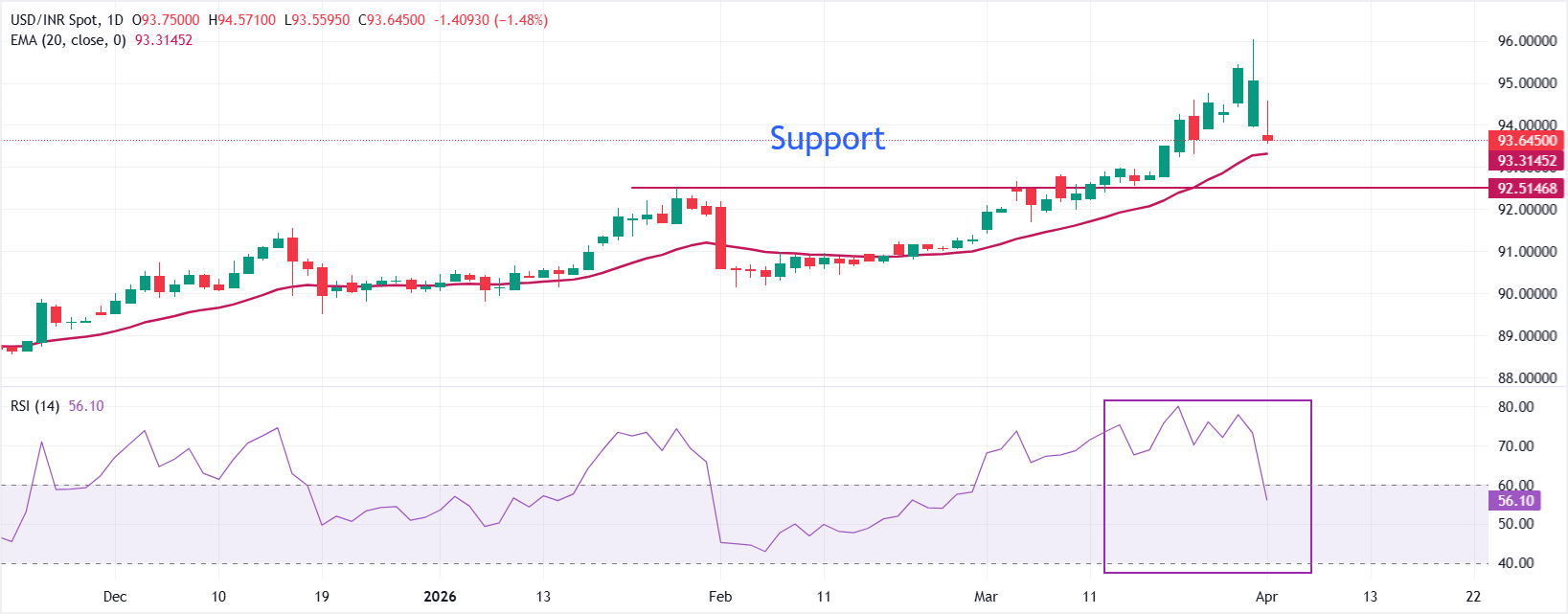
USD/INR trades lower at around 93.65 as of writing. The near-term bias turns neutral with a fading bullish tone as price retreats from the recent 96.00 peak and slides towards the rising 20-day Exponential Moving Average (EMA), which is around 93.31.
The pullback unfolds after an extended momentum phase, with the RSI easing sharply from overbought readings above 80 back toward the mid-50s, signaling that upside pressure has cooled without yet confirming a bearish reversal.
Initial downside support aligns at the 20-day EMA around 93.31, and a daily close below this area would open a deeper correction toward the January high of 92.51 and then 92.20. On the topside, immediate resistance emerges at 94.00, followed by the intraday high at 94.57/ A recovery above 94.57 would reassert bullish control and expose the all-time high of 96.00 again.
(The technical analysis of this story was written with the help of an AI tool.)
Author

Sagar Dua
FXStreet
Sagar Dua is associated with the financial markets from his college days. Along with pursuing post-graduation in Commerce in 2014, he started his markets training with chart analysis.

















