USD/INR trades with mild gains amid roiling geopolitical tensions
- The Indian Rupee edges lower in Tuesday’s early European session.
- Higher crude oil prices undermine the INR, but US Dollar sales from foreign banks might cap its downside.
- The Fed interest rate decision will take center stage on Wednesday.

The Indian Rupee (INR) softens on Tuesday. A rise in crude oil prices amid the escalating geopolitical tensions in the Middle East weighs on the local currency. It’s worth noting that India is the world's third-largest oil consumer and higher crude oil prices tend to have a negative impact on the INR value.
Nonetheless, the US Dollar (USD) sales from foreign banks and the concerns about slowing growth in the US economy from the US President Donald Trump administration's trade policies might help limit the INR’s losses. Additionally, the foreign exchange intervention from the Reserve Bank of India (RBI) could prevent the Indian Rupee from significant depreciation.
Markets widely expect the Federal Reserve (Fed) will stay on hold when it concludes its two-day meeting on Wednesday, leaving the benchmark interest rate unchanged in a range of 4.25% to 4.50%. The primary focus will be on the Fed's policy guidance. Economists anticipate policymakers’ updated projections to also show two quarter-percentage-point reductions this year.
Indian Rupee weakens ahead of Fed rate decision
- "Given the current sentiment, the USDINR pair is expected to trade within the 86.80–87.40 range in the near to medium term," Amit Pabari, managing director of CR Forex Advisors, said. "A breakout beyond this band could trigger an additional move of 30–50 paise in the same direction, keeping market participants on high alert for potential volatility.”
- India’s Wholesale Price Index (WPI) inflation rose to 2.38% in February from the previous reading of 2.31%, the Ministry of Commerce and Industry reported on Monday. This figure came in hotter than the expectation of 2.36%.
- Retail Sales in the United States rose 0.2% MoM in February, compared to a fall of 1.2% (revised from -0.9%) in January, according to the US Census Bureau on Monday. This figure came in weaker than the market expectation for an increase of 0.7%.
- Retail Sales climbed 3.1% YoY in February versus 3.9% (revised from 4.2%) prior.
- According to the CME FedWatch tool, the markets have priced in nearly 75% odds of a quarter-point reduction to the policy rate by June.
USD/INR’s uptrend remains intact in the longer term
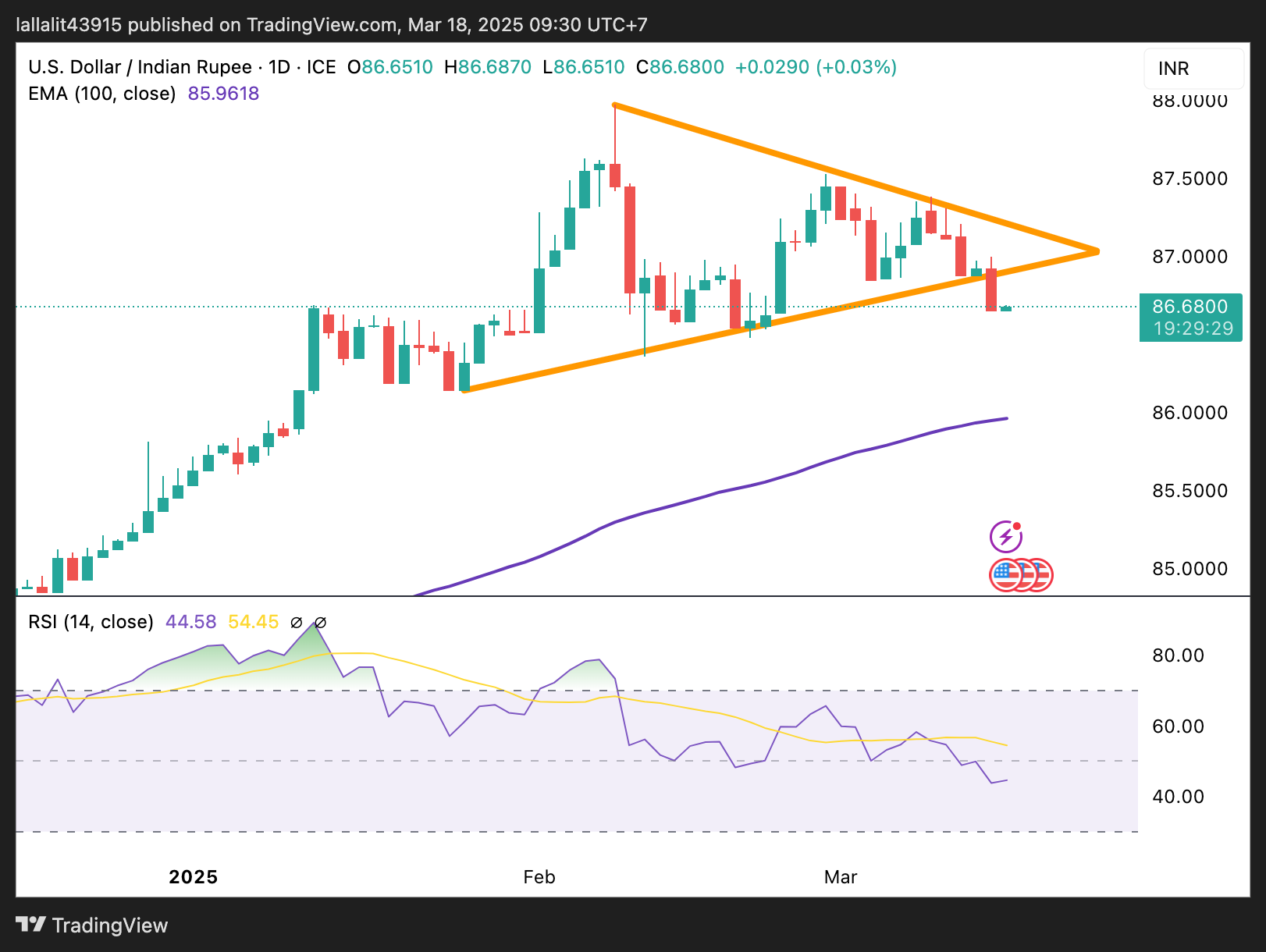
The Indian Rupee trades on a weaker note on the day. The USD/INR pair has broken out of a symmetrical triangle on the daily chart. In the longer term, the uptrend of the pair remains in play, with the price being above the key 100-day Exponential Moving Average (EMA). However, in the near term, further downside looks favorable as the 14-day Relative Strength Index (RSI) stands below the midline near 43.65.
The first upside barrier for USD/INR emerges near the support-turned-resistance level at 86.90. Green candlesticks and consistent trading above the mentioned level could see a rally to 87.38, the high of March 11, en route to 87.53, the high of February 28.
On the downside, the initial support level is located at 86.48, the low of February 21. A drop below this level could open the door for a move toward 86.14, the low of January 27.
Indian economy FAQs
The Indian economy has averaged a growth rate of 6.13% between 2006 and 2023, which makes it one of the fastest growing in the world. India’s high growth has attracted a lot of foreign investment. This includes Foreign Direct Investment (FDI) into physical projects and Foreign Indirect Investment (FII) by foreign funds into Indian financial markets. The greater the level of investment, the higher the demand for the Rupee (INR). Fluctuations in Dollar-demand from Indian importers also impact INR.
India has to import a great deal of its Oil and gasoline so the price of Oil can have a direct impact on the Rupee. Oil is mostly traded in US Dollars (USD) on international markets so if the price of Oil rises, aggregate demand for USD increases and Indian importers have to sell more Rupees to meet that demand, which is depreciative for the Rupee.
Inflation has a complex effect on the Rupee. Ultimately it indicates an increase in money supply which reduces the Rupee’s overall value. Yet if it rises above the Reserve Bank of India’s (RBI) 4% target, the RBI will raise interest rates to bring it down by reducing credit. Higher interest rates, especially real rates (the difference between interest rates and inflation) strengthen the Rupee. They make India a more profitable place for international investors to park their money. A fall in inflation can be supportive of the Rupee. At the same time lower interest rates can have a depreciatory effect on the Rupee.
India has run a trade deficit for most of its recent history, indicating its imports outweigh its exports. Since the majority of international trade takes place in US Dollars, there are times – due to seasonal demand or order glut – where the high volume of imports leads to significant US Dollar- demand. During these periods the Rupee can weaken as it is heavily sold to meet the demand for Dollars. When markets experience increased volatility, the demand for US Dollars can also shoot up with a similarly negative effect on the Rupee.
Author

Lallalit Srijandorn
FXStreet
Lallalit Srijandorn is a Parisian at heart. She has lived in France since 2019 and now becomes a digital entrepreneur based in Paris and Bangkok.