USD/INR rises amid cautious mood, India election’s uncertainty
- The Indian Rupee (INR) trades in negative territory for the third consecutive day on Wednesday.
- The combination of a firmer USD, the Fed's hawkish comments, and a cautious mood lift the USD/INR pair.
- Investors will closely monitor India’s Q4 GDP and US Core PCE inflation data, which are due on Thursday.

Indian Rupee (INR) extends the decline amid the cautious mood on Wednesday. The modest rebound of the US Dollar (USD) and the hawkish message from the US Federal Reserve (Fed) support the pair. Meanwhile, uncertainty surrounding India’s upcoming election is likely to weigh on the INR. Nomura analysts forecast a victory for Prime Minister Narendra Modi's Bharatiya Janata Party (BJP) could lift the Indian Rupee.
Investors prefer to wait on the sidelines ahead of key economic data from both India and the US later this week. The first reading of the US Gross Domestic Product (GDP) for Q1 will be due on Thursday. On Friday, the US Core Personal Consumption Expenditures Price Index (Core PCE) for April will be closely watched. If the report shows hotter-than-expected inflation in the US, this could dampen the rate cut expectation from the Fed, supporting the USD. On the Indian docket, India’s GDP number for the March quarter of the last financial year (Q4FY24) will be published on Friday.
Daily Digest Market Movers: Indian Rupee remains weak ahead of key data and India's general election outcome
- Foreign investors withdrew $2.8 billion from Indian equities in May, citing fears over the upcoming election.
- The benchmark Indian equity indices, the BSE Sensex and Nifty 50, were down 0.3% and 0.2%, respectively, on Tuesday after reaching new highs in the previous session.
- India's Gross Domestic Product (GDP) for the March quarter of the last financial year (Q4 FY24) is estimated to see an annual growth of below 7%, compared to 8.4% during the October-December quarter of FY24 (Q3 FY24).
- The International Monetary Fund (IMF) and Nomura forecast India's GDP to grow 7% in 2024.
- The US Conference Board’s Consumer Confidence rose to 102.0 in May from 97.5 in April, above the consensus of 95.9. The figure improved after three months of decline.
- Fed Governor Michelle Bowman said on Tuesday that the central bank would have supported either waiting to slow the QT pace or a more tapered slowing in balance sheet runoff.
- Fed Minneapolis President Neel Kashkari said that the central bank should wait for significant progress on inflation before cutting interest rates, per CNBC.
Technical analysis: USD/INR’s bearish outlook persists on the daily chart
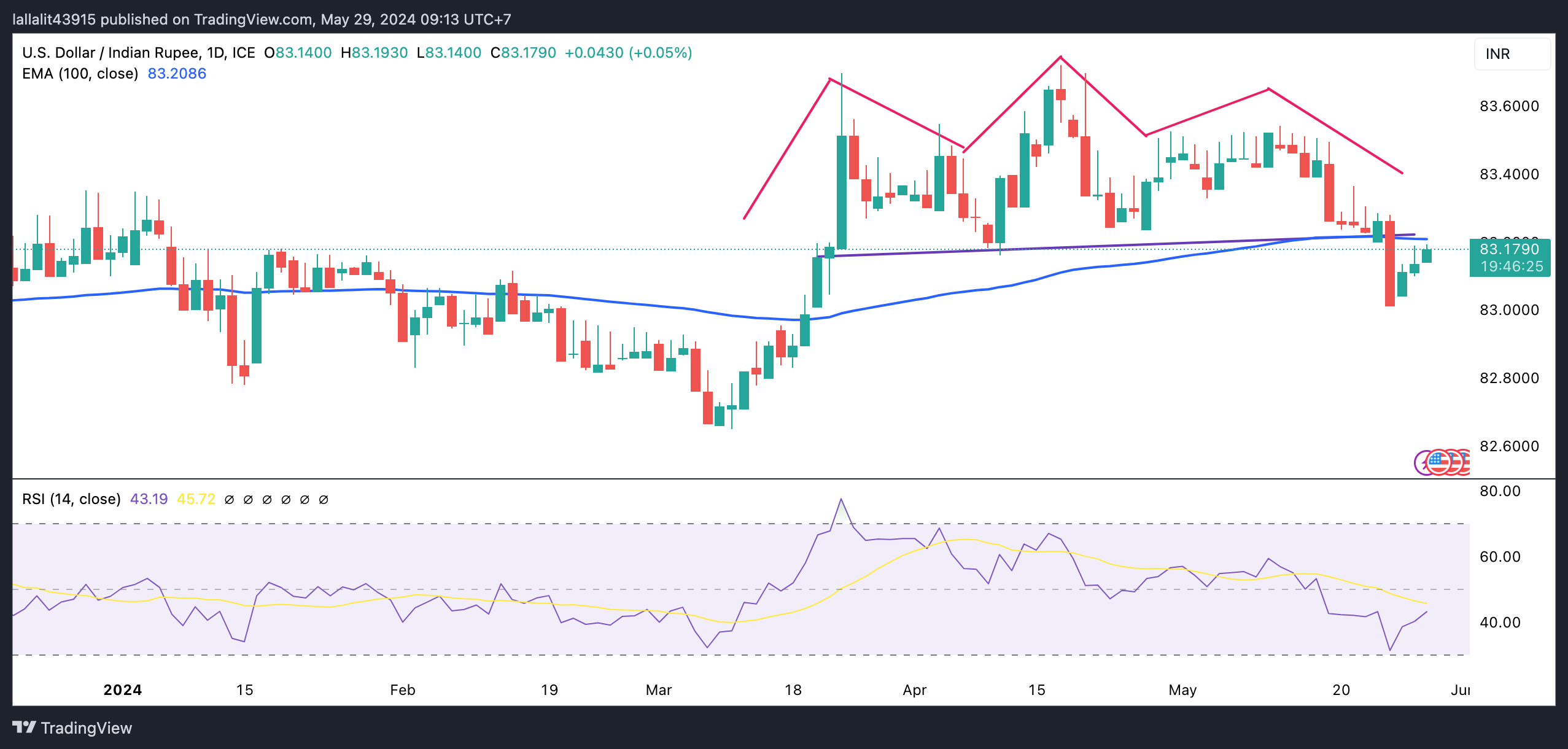
The Indian Rupee trades weaker on the day. However, the USD/INR pair remains bearish on the daily chart as it holds below the key 100-day Exponential Moving Average (EMA). The downward momentum is backed by the 14-day Relative Strength Index (RSI), which stands in bearish territory at around 43.85.
The confluence of the 100-day EMA and the support-turned-resistance level at 83.20 appears to be a tough nut to crack for USD/INR buyers. A decisive break above this level could see a rally to a high of May 13 at 83.54. The additional upside filter to watch is a high of April 17 at 83.72, and then the 84.00 psychological mark.
On the other hand, the crucial support level will emerge at the 83.00 barrier. A breach below the mentioned level will see a drop to a low of January 15 at 82.78, followed by a low of March 11 at 82.65.
US Dollar price in the last 7 days
The table below shows the percentage change of US Dollar (USD) against listed major currencies in the last 7 days. US Dollar was the strongest against the Japanese Yen.
| USD | EUR | GBP | CAD | AUD | JPY | NZD | CHF | |
| USD | 0.08% | -0.31% | 0.22% | 0.30% | 0.62% | -0.59% | 0.12% | |
| EUR | -0.08% | -0.43% | 0.14% | 0.22% | 0.53% | -0.67% | 0.06% | |
| GBP | 0.31% | 0.40% | 0.52% | 0.61% | 0.92% | -0.27% | 0.45% | |
| CAD | -0.22% | -0.13% | -0.53% | 0.09% | 0.40% | -0.81% | -0.08% | |
| AUD | -0.30% | -0.22% | -0.62% | -0.09% | 0.31% | -0.90% | -0.18% | |
| JPY | -0.62% | -0.52% | -0.91% | -0.40% | -0.30% | -1.22% | -0.48% | |
| NZD | 0.58% | 0.66% | 0.28% | 0.80% | 0.89% | 1.20% | 0.73% | |
| CHF | -0.14% | -0.06% | -0.45% | 0.07% | 0.16% | 0.48% | -0.73% |
The heat map shows percentage changes of major currencies against each other. The base currency is picked from the left column, while the quote currency is picked from the top row. For example, if you pick the Euro from the left column and move along the horizontal line to the Japanese Yen, the percentage change displayed in the box will represent EUR (base)/JPY (quote).
RBI FAQs
The role of the Reserve Bank of India (RBI), in its own words, is '..to maintain price stability while keeping in mind the objective of growth.” This involves maintaining the inflation rate at a stable 4% level primarily using the tool of interest rates. The RBI also maintains the exchange rate at a level that will not cause excess volatility and problems for exporters and importers, since India’s economy is heavily reliant on foreign trade, especially Oil.
The RBI formally meets at six bi-monthly meetings a year to discuss its monetary policy and, if necessary, adjust interest rates. When inflation is too high (above its 4% target), the RBI will normally raise interest rates to deter borrowing and spending, which can support the Rupee (INR). If inflation falls too far below target, the RBI might cut rates to encourage more lending, which can be negative for INR.
Due to the importance of trade to the economy, the Reserve Bank of India (RBI) actively intervenes in FX markets to maintain the exchange rate within a limited range. It does this to ensure Indian importers and exporters are not exposed to unnecessary currency risk during periods of FX volatility. The RBI buys and sells Rupees in the spot market at key levels, and uses derivatives to hedge its positions.
Author

Lallalit Srijandorn
FXStreet
Lallalit Srijandorn is a Parisian at heart. She has lived in France since 2019 and now becomes a digital entrepreneur based in Paris and Bangkok.