USD/INR gains ground as US Dollar remains stronger ahead of Fed policy
- Indian Rupee may regain its ground amid possible RBI intervention to stabilize the volatility.
- USD/INR may encounter resistance, supported by India's limited dependence on exports, which helps buffer the impact of aggressive US tariffs.
- Geopolitical risks are rising, as India conducts strikes on targets in Pakistan and Pakistan-administered Kashmir under "Operation Sindoor."

The Indian Rupee (INR) loses ground against the US Dollar (USD) during Wednesday's European trading session amid rising geopolitical tensions between India and Pakistan. However, the USD/INR pair depreciates as the INR gains ground due to possible intervention by the Reserve Bank of India (RBI) to stabilize the market volatility. Dhiraj Nim, a currency expert at ANZ Bank, stated that the Reserve Bank of India (RBI) may take strong intervention measures today if market conditions turn highly volatile.
India launched strikes on nine targets in Pakistan and Pakistan-administered Kashmir under "Operation Sindoor," two weeks after a deadly militant attack on tourists in Indian-administered Kashmir. The Indian defence ministry framed the operation as a response to the April 22 attack that killed 25 Indians and one Nepali national. Pakistan, denying involvement, condemned the strikes as “unprovoked,” with Prime Minister Shehbaz Sharif vowing retaliation, according to the BBC.
The USD/INR pair also rises due to importer hedging demand and potential dollar-buying interventions from the RBI, which is expected to continue strengthening its foreign exchange reserves.
The upside of the USD/INR pair could be limited as the Indian Rupee (INR) tracks gains in domestic assets, with India's relatively low reliance on exports helping cushion the impact of aggressive US tariffs. Additionally, limited capital outflows have supported the INR, as increased Oil output from OPEC+ and mounting US growth concerns have weighed on crude and fuel prices, key components of India’s import bill.
Recent data showed India’s inflation rate dropped to its lowest level in over five years in March, falling well below the Reserve Bank of India’s (RBI) 4% mid-point target. Meanwhile, GDP growth moderated to 6.5% in the last fiscal year, down from 8.2% previously, prompting the central bank to prioritize growth concerns.
Indian Rupee struggles as US Dollar improves ahead of Fed policy
- The US Dollar (USD) appreciates, with traders turning cautious ahead of the Federal Reserve’s (Fed) interest rate decision expected later in the North American session.
- The Federal Reserve is widely expected to keep interest rates unchanged. Markets are closely watching Chair Jerome Powell’s comments, particularly amid tariff-related uncertainty and mounting pressure from President Donald Trump for rate cuts.
- US Treasury Secretary Scott Bessent and Trade Representative Jamieson Greer are set to meet with Chinese Vice Premier He Lifeng in Geneva over the weekend, marking the first high-level talks since the US imposed tariffs that escalated into a global trade dispute.
- China’s Ministry of Commerce stated that, after carefully evaluating US proposals and considering global expectations, national interests, and industry feedback, Beijing has agreed to engage in the upcoming negotiations.
- US economic data showed strength in the services sector: the ISM Services PMI rose to 51.6 in April, beating forecasts of 50.6 and up from 50.8 in March. The New Orders Index increased to 52.3 from 50.4, while the Services Employment Index rose to 49 from 46.2.
- A nationwide mock drill is scheduled for Wednesday, with all states and Union territories set to activate air-raid sirens and conduct training on evacuation procedures, as well as the cleaning and maintenance of bunkers and trenches, in preparation for a potential "hostile attack." This large-scale emergency preparedness exercise—reportedly the first of its kind since 1971—will take place in most regions at 4 PM.
- The drill comes in response to a directive from the Union Home Ministry, issued on Monday, urging states and Union territories to bolster readiness amid "new and complex threats" arising from heightened tensions with Pakistan following the April 22 Pahalgam terror attack, which claimed 26 lives.
- The HSBC India Composite PMI came in at 59.7 in April 2025, just below the flash estimate of 60.0 but higher than March’s 59.5, signaling the 45th straight month of private sector expansion. Meanwhile, the Services PMI was revised down to 58.7 from the preliminary reading of 59.1. Despite the downward revision, it remained above both the March figure and market expectations of 58.5, extending the services sector’s growth streak to 45 consecutive months.
- Traders anticipate India’s 10-year government bond yield to remain in the 6.30%–6.40% range this week, with attention centered on bond purchases and geopolitical developments between India and Pakistan.
- The recent decline in yields is driven by expectations of further rate cuts and the Reserve Bank of India (RBI) maintaining surplus liquidity in the banking system through ongoing open market operations (OMOs), according to Reuters.
- This week, the RBI plans to purchase bonds worth ₹750 billion ($8.88 billion), with two additional rounds of ₹250 billion each scheduled later this month. Year-to-date, the central bank has acquired ₹3.65 trillion in bonds via OMOs and ₹388 billion through secondary market purchases. This unexpected liquidity injection is likely to aid policy transmission and boost growth amid global uncertainties, said Radhika Rao, executive director and senior economist at DBS Bank.
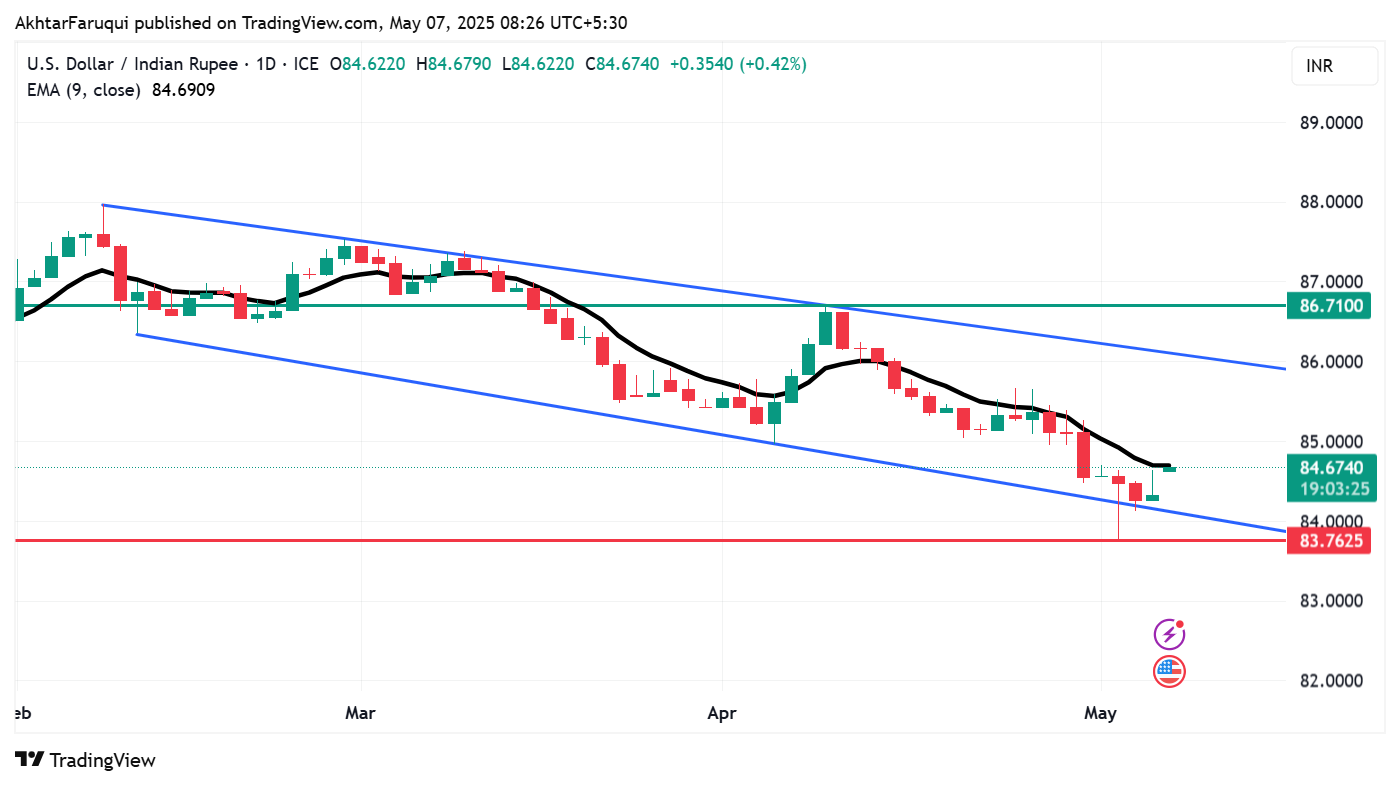
USD/INR trades near 84.50 after reaction at nine-day EMA resistance
The Indian Rupee gains ground, with the USD/INR pair hovering around 84.60 on Wednesday. Daily chart technicals suggest a continued bearish outlook, as the pair remains within a descending channel pattern.
On the downside, support is seen near the lower boundary of the descending channel at approximately 84.10. A clear break below this level could accelerate the downward move, potentially pushing the pair toward its eight-month low at 83.76.
To the upside, initial resistance is located around the nine-day Exponential Moving Average (EMA) near 84.69. A sustained move above this level could boost short-term bullish momentum, targeting the descending channel’s upper boundary near 86.20, with additional resistance at the two-month high of 86.71.
USD/INR: Daily Chart
Economic Indicator
Fed Interest Rate Decision
The Federal Reserve (Fed) deliberates on monetary policy and makes a decision on interest rates at eight pre-scheduled meetings per year. It has two mandates: to keep inflation at 2%, and to maintain full employment. Its main tool for achieving this is by setting interest rates – both at which it lends to banks and banks lend to each other. If it decides to hike rates, the US Dollar (USD) tends to strengthen as it attracts more foreign capital inflows. If it cuts rates, it tends to weaken the USD as capital drains out to countries offering higher returns. If rates are left unchanged, attention turns to the tone of the Federal Open Market Committee (FOMC) statement, and whether it is hawkish (expectant of higher future interest rates), or dovish (expectant of lower future rates).
Read more.Next release: Wed May 07, 2025 18:00
Frequency: Irregular
Consensus: 4.5%
Previous: 4.5%
Source: Federal Reserve
Author

Akhtar Faruqui
FXStreet
Akhtar Faruqui is a Forex Analyst based in New Delhi, India. With a keen eye for market trends and a passion for dissecting complex financial dynamics, he is dedicated to delivering accurate and insightful Forex news and analysis.