USD/INR slips as lower Oil prices and Equity rally lift Rupee, RBI data adds to positive backdrop
- USD/INR slides to two-week low amid broad US Dollar weakness and strong Rupee demand.
- Rupee supported by FII inflows, equity market gains, and falling Crude Oil prices.
- DXY holds near a three-year low as Trump’s Fed criticism and soft US GDP fuel rate cut bets.

The Indian Rupee (INR) strengthens further on Friday, riding a wave of US Dollar (USD) weakness, as the Greenback slides further amid political noise and soft economic prints. US President Donald Trump’s fresh criticism of Federal Reserve (Fed) Chair Jerome Powell, paired with weaker-than-expected US Q1 Gross Domestic Product (GDP) data released on Thursday, is weighing heavily on the Greenback. As a result, the US Dollar Index (DXY) remains pinned near a three-year low, boosting demand for emerging market currencies such as the Rupee.
USD/INR remains under pressure, trading near a two-week low around 85.50 during the American trading session. The US Dollar Index (DXY) is holding above 97.00 after May’s Core Personal Consumption Expenditures (PCE) Price Index came in stronger than expected. Despite the firm reading, broader concerns around US fiscal policy and political pressure on the Fed continue to cap upside, keeping the DXY pinned near three-year lows.
President Trump’s pointed criticism of Fed Chair Powell has sparked renewed doubts about the central bank's independence, prompting traders to increase interest rate cut bets. There’s growing chatter that Trump could try to influence policy through a “shadow chair”—an unofficial figure position to influence the Fed's policy direction until Jerome Powell’s term ends in May 2026.
Markets were quick to react, with traders on Thursday boosting bets on interest rate cuts. According to CME Group data, the probability of three cuts this year has climbed to around 60%, up from just two cuts expected earlier in the week.
Market Movers: Rupee rallies on US Dollar weakness, subdued Oil prices, and FII inflows
- The Indian Rupee is staging a solid recovery following the ceasefire between Iran and Israel. On Friday, the Rupee appreciated by 23 paise to 85.49 against the US Dollar, supported by strong foreign institutional investor (FII) inflows and a risk-on tone in domestic equity markets. The rupee has gained 1.3% on the week, its best performance in two and a half years.
- On the Equity front, Indian equity benchmarks ended higher for the fourth consecutive session on Friday, with the Nifty50 closing at 25,637—its highest level since September 2024—led by broad-based buying except in IT and realty sectors. The Sensex gained 303 points to end at 84,058.
- Lower Crude Oil prices are also aiding the Rupee’s recovery by lowering import costs and easing the trade deficit, especially after the Iran-Israel ceasefire eased geopolitical tensions. Both WTI and Brent Crude have dropped around 12% this week, with WTI trading near $65.20 and Brent around $67.05 at the time of writing.
- According to data released by the Reserve Bank of India (RBI) on Friday, India recorded a current account surplus of USD 13.5 billion, or 1.3% of GDP, in the January–March quarter of FY 2024–25. This marks a sharp improvement from a surplus of USD 4.6 billion in the same period last year, driven primarily by strong services exports and an increase in remittance inflows. However, on a full-year basis, the current account remained in deficit at USD 23.3 billion, equivalent to 0.6% of GDP, the RBI noted in its report India’s Balance of Payments during Q4 2024–25.
- While the current account position showed improvement in the March quarter, India’s external debt rose notably over the same period. The country’s total external debt increased by 10% to USD 736.3 billion as of March 2025, up from USD 668.8 billion the previous year. As a share of GDP, external debt climbed to 19.1% from 18.5% at the end of the previous financial year.
- Trade negotiations between India and the US have reportedly stalled over disagreements on import duties for auto parts, steel, and agricultural products, said Indian officials with direct knowledge. This setback dims hopes of reaching a deal before President Trump’s July 9 deadline to impose reciprocal tariffs. While US officials have repeatedly stated they are close to finalizing a trade agreement with India, no official announcement has been made so far, keeping markets in wait-and-watch mode.
- US President Donald Trump may extend the looming deadlines for reimposing higher tariffs on imports from several countries, the White House said on Thursday. The tariffs, initially scheduled to take effect on July 8 and 9, are no longer viewed as fixed. White House Press Secretary Karoline Leavitt told reporters the dates are “not critical” and that while an extension is possible, the final decision will be made by the President.
- President Trump’s sweeping budget bill is heading for a key test in the Senate, with voting expected to begin as early as Friday. The challenge comes after the Senate parliamentarian ruled that proposed Medicaid changes in the bill don’t meet the criteria for the fast-track budget process Republicans are using. President Trump is pushing hard for Senate approval of his major budget package before the July 4 deadline. This deadline is not legally binding, but is a political goal set by President Trump.
- The US Personal Consumption Expenditures (PCE) Price Index rose 0.1% MoM in May, matching both April’s reading and market expectations. However, the Core PCE—the Fed’s preferred inflation gauge—picked up slightly, rising 0.2% on the month, above the 0.1% seen in the prior two months and ahead of forecasts. On an annual basis, headline PCE accelerated to 2.3% from an upwardly revised 2.2%, while core inflation ticked up to 2.7% from 2.6%, also beating estimates
- Meanwhile, personal income dropped 0.4% to $25.698 trillion, following a downwardly revised 0.7% rise the previous month. The data came in significantly below market forecasts, which had expected a smaller 0.3% decline, signaling a potential cooling in the momentum of household spending and income.
- The Greenback remains under heavy pressure following Trump’s latest criticism of the Fed, alongside mounting concerns over the US’s trade and fiscal outlook. The US Dollar Index (DXY) has fallen more than 10% year-to-date and is on track for its steepest first-half decline since the start of the free-floating currency era in the early 1970s.
Technical analysis: USD/INR breaks rising wedge, eyes deeper pullback
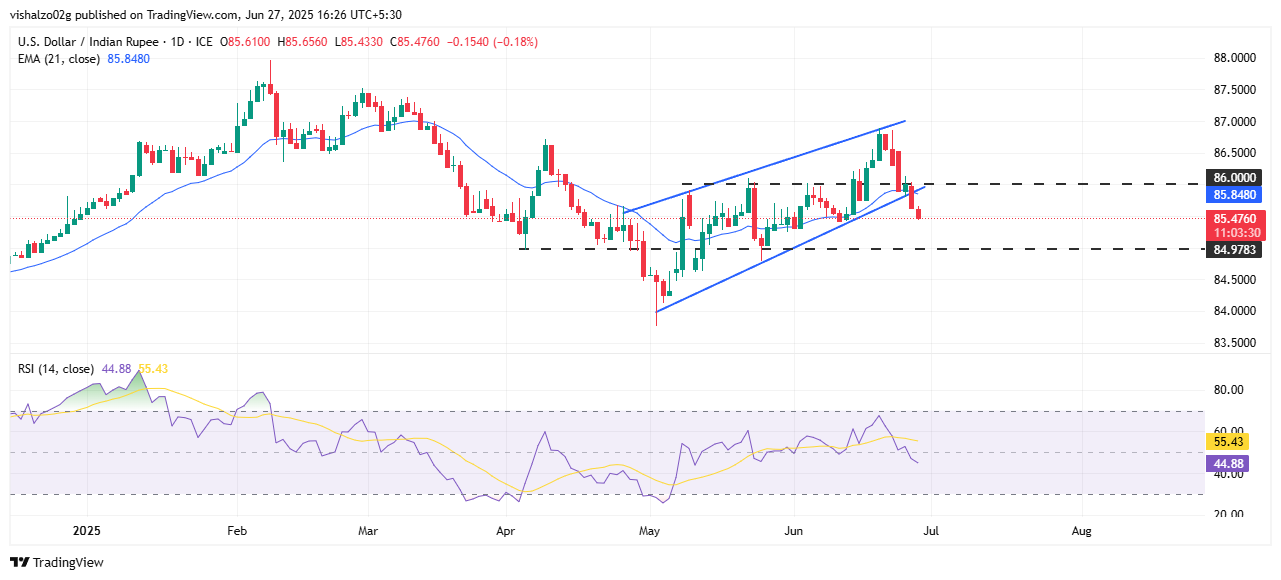
The USD/INR pair has decisively broken below the lower boundary of the rising channel it had been respecting since early May, indicating that bears have the upper hand. The pair is currently trading around 85.48, slipping below the 21-day Exponential Moving Average (EMA) at 85.84—a bearish technical signal.
The break below the psychological support at 86.00 has opened the door for a test of the next horizontal support near 85.00, marked by previous consolidation levels. A strong daily close below the current level of 85.50 could accelerate downside momentum toward 85.00 and possibly 84.50 in the coming sessions.
The Relative Strength Index (RSI) has dropped to 44.88 and continues to slope downward. This confirms waning bullish momentum and hints at more downside ahead unless buyers reclaim the 85.85–86.00 zone.
RBI FAQs
The role of the Reserve Bank of India (RBI), in its own words, is "..to maintain price stability while keeping in mind the objective of growth.” This involves maintaining the inflation rate at a stable 4% level primarily using the tool of interest rates. The RBI also maintains the exchange rate at a level that will not cause excess volatility and problems for exporters and importers, since India’s economy is heavily reliant on foreign trade, especially Oil.
The RBI formally meets at six bi-monthly meetings a year to discuss its monetary policy and, if necessary, adjust interest rates. When inflation is too high (above its 4% target), the RBI will normally raise interest rates to deter borrowing and spending, which can support the Rupee (INR). If inflation falls too far below target, the RBI might cut rates to encourage more lending, which can be negative for INR.
Due to the importance of trade to the economy, the Reserve Bank of India (RBI) actively intervenes in FX markets to maintain the exchange rate within a limited range. It does this to ensure Indian importers and exporters are not exposed to unnecessary currency risk during periods of FX volatility. The RBI buys and sells Rupees in the spot market at key levels, and uses derivatives to hedge its positions.
Author

Vishal Chaturvedi
FXStreet
I am a macro-focused research analyst with over four years of experience covering forex and commodities market. I enjoy breaking down complex economic trends and turning them into clear, actionable insights that help traders stay ahead of the curve.

















