USD/INR drifts lower as likely RBI intervention helps limit Indian Rupee's decline
- The Indian Rupee trades on a stronger note in Friday’s Asian session.
- A deeper Fed rate cut expectation and the potential RBI intervention underpin the INR.
- Higher crude oil, weakness in its Asian peers and India’s foreign outflows might weigh on the local currency.

The Indian Rupee (INR) gains traction on Friday. Traders increasingly expect the US Federal Reserve (Fed) to cut interest rates in September, which continue undermining the US Dollar (USD). Furthermore, the likely intervention by the Reserve Bank of India (RBI) could prevent the local currency from depreciating.
Nonetheless, further rebound of crude oil prices might exert some selling pressure on the INR as India is the world's third-biggest oil importer and consumer. The weakness in its Asian peers and India’s foreign outflows might contribute to the Indian Rupee’s downside. In the absence of any top-tier data releases from India and the US on Friday, traders will focus on risk sentiment and the USD dynamic for the time being.
Daily Digest Market Movers: Indian Rupee strengthens, potential upside seems limited
- The RBI’s Monetary Policy Committee (MPC) voted by a 4-2 majority to leave policy rates unchanged and decided to maintain its ‘Withdrawal of Accommodation" stance.
- The Indian central bank retains the real Gross Domestic Product (GDP) growth projection for FY25 at 7.2%, with "risks evenly balanced," and maintains the Consumer Price Index (CPI) inflation forecast for FY25 at 4.5%.
- RBI Governor Shaktikanta Das said that inflation is receding gradually across economies, while medium-term global growth faces significant challenges. However, food price pressures cannot be ignored due to their potential spillover effects.
- RBI’s Das further stated that it was premature to discuss the recession in the US, but the central bank will monitor all incoming data, both domestic and external.
- The number of Americans filing new applications for unemployment benefits increased by 233,000 for the week ending August 3 versus 250,000 prior (revised from 249,000). This figure came in below the market consensus of 240K, according to the US Department of Labor (DoL) report on Thursday.
- Investors pare bets the Fed will start cutting interest rates in September with a bigger-than-usual 50 basis points (bps) reduction to nearly 58% odds, down from 70% before the data release, according to the CME FedWatch Tool.
Technical analysis: USD/INR’s broader outlook remains positive
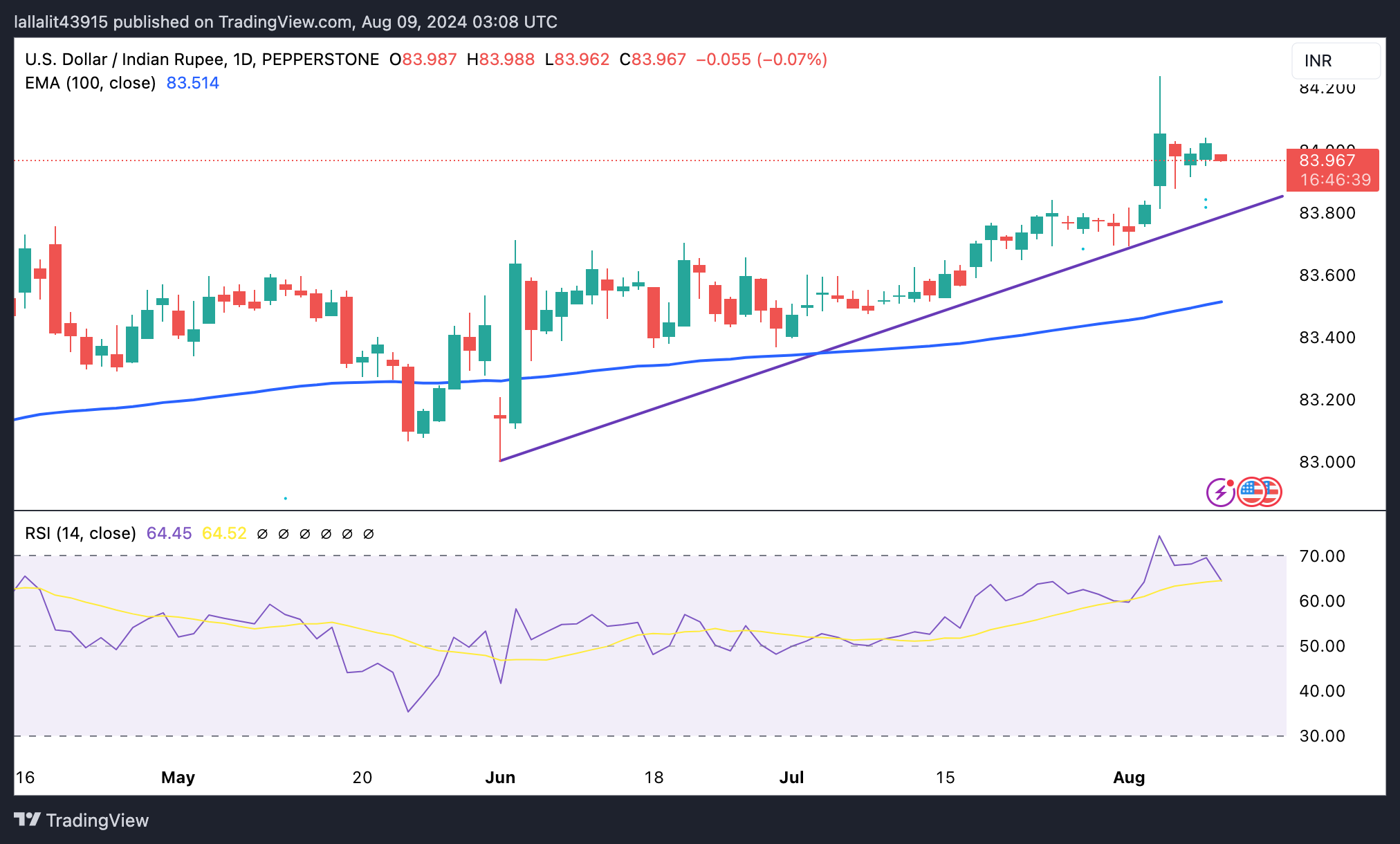
Indian Rupee trades firmer on the day. According to the daily chart, the bullish outlook for the USD/INR pair remains in play, with the price holding above the key 100-day Exponential Moving Average (EMA) and the uptrend line since June 3. The 14-day Relative Strength Index (RSI) reflects ongoing bullish strength as it stands above the midline near 65.80.
The first upside target for USD/INR emerges at the 84.00 psychological barrier. Extended gains could pave the way to the all-time high of 84.24. A bullish breakout above this level could see a rally to 84.50.
On the flip side, the uptrend line around 83.80 acts as a key contention level for the pair. A breach of the mentioned level could drag the pair lower to the 100-day EMA at 83.51.
US Dollar price today
The table below shows the percentage change of US Dollar (USD) against listed major currencies today. US Dollar was the weakest against the New Zealand Dollar.
| USD | EUR | GBP | CAD | AUD | JPY | NZD | CHF | |
| USD | -0.07% | -0.09% | -0.05% | -0.08% | -0.18% | -0.37% | -0.07% | |
| EUR | 0.07% | -0.02% | 0.02% | -0.01% | -0.09% | -0.29% | 0.01% | |
| GBP | 0.09% | 0.01% | 0.03% | 0.00% | -0.07% | -0.29% | 0.03% | |
| CAD | 0.06% | -0.01% | -0.04% | -0.02% | -0.09% | -0.30% | 0.00% | |
| AUD | 0.08% | 0.00% | -0.01% | 0.03% | -0.10% | -0.30% | 0.01% | |
| JPY | 0.17% | 0.09% | 0.08% | 0.10% | 0.08% | -0.19% | 0.12% | |
| NZD | 0.38% | 0.30% | 0.28% | 0.33% | 0.30% | 0.20% | 0.31% | |
| CHF | 0.06% | -0.02% | -0.04% | 0.00% | -0.03% | -0.12% | -0.31% |
The heat map shows percentage changes of major currencies against each other. The base currency is picked from the left column, while the quote currency is picked from the top row. For example, if you pick the Euro from the left column and move along the horizontal line to the Japanese Yen, the percentage change displayed in the box will represent EUR (base)/JPY (quote).
Indian Rupee FAQs
The Indian Rupee (INR) is one of the most sensitive currencies to external factors. The price of Crude Oil (the country is highly dependent on imported Oil), the value of the US Dollar – most trade is conducted in USD – and the level of foreign investment, are all influential. Direct intervention by the Reserve Bank of India (RBI) in FX markets to keep the exchange rate stable, as well as the level of interest rates set by the RBI, are further major influencing factors on the Rupee.
The Reserve Bank of India (RBI) actively intervenes in forex markets to maintain a stable exchange rate, to help facilitate trade. In addition, the RBI tries to maintain the inflation rate at its 4% target by adjusting interest rates. Higher interest rates usually strengthen the Rupee. This is due to the role of the ‘carry trade’ in which investors borrow in countries with lower interest rates so as to place their money in countries’ offering relatively higher interest rates and profit from the difference.
Macroeconomic factors that influence the value of the Rupee include inflation, interest rates, the economic growth rate (GDP), the balance of trade, and inflows from foreign investment. A higher growth rate can lead to more overseas investment, pushing up demand for the Rupee. A less negative balance of trade will eventually lead to a stronger Rupee. Higher interest rates, especially real rates (interest rates less inflation) are also positive for the Rupee. A risk-on environment can lead to greater inflows of Foreign Direct and Indirect Investment (FDI and FII), which also benefit the Rupee.
Higher inflation, particularly, if it is comparatively higher than India’s peers, is generally negative for the currency as it reflects devaluation through oversupply. Inflation also increases the cost of exports, leading to more Rupees being sold to purchase foreign imports, which is Rupee-negative. At the same time, higher inflation usually leads to the Reserve Bank of India (RBI) raising interest rates and this can be positive for the Rupee, due to increased demand from international investors. The opposite effect is true of lower inflation.
Author

Lallalit Srijandorn
FXStreet
Lallalit Srijandorn is a Parisian at heart. She has lived in France since 2019 and now becomes a digital entrepreneur based in Paris and Bangkok.