USD/INR jumps as month-end US Dollar demand drags Indian Rupee down to near record low
- The Indian Rupee weakens in Monday’s early European session.
- A broadly stronger US Dollar weighs on the INR, but routine interventions by the RBI might cap the pair’s downside.
- Investors await the US December Consumer Confidence, which is due later on Monday.

The Indian Rupee (INR) remains weak to near an all-time low on Monday, pressured by a decline in the offshore Chinese Yuan and month-end importer US Dollar (USD) bids. The persistent strength of the Greenback, driven by the Federal Reserve's (Fed) hawkish tilt, undermines emerging market currencies like the local currency.
On the other hand, the Reserve Bank of India (RBI) could step into the foreign exchange market by selling the USD. This might help limit the INR’s losses for the time being. Looking ahead, the US December Consumer Confidence and Chicago Fed National Activity Index are due later on Monday. On Tuesday, Durable Goods Orders will be released.
Indian Rupee seems vulnerable amid hawkish Fed expectations
- India's foreign exchange reserves fell in nine out of the past 10 weeks, hitting a multi-month low. The reserves had been falling ever since reserves touched an all-time high of USD 704.89 billion in September, and now last week the forex stood at USD 654.857 billion, according to the RBI data.
- "Higher trade deficit along with slow growth figures puts rupee on test with outflows from domestic equity markets. For USD/INR, positionally 84.70 now acts as a good base while the door remains open for 85.50 levels," said Kunal Sodhani, vice president at Shinhan Bank India.
- The Commerce Department reported on Friday that the US Personal Consumption Expenditures (PCE) Price Index advanced 2.4% YoY in November after rising 2.3% in October. The reading came in softer than the expectations of 2.5%.
- The US Core PCE, excluding the volatile food and energy components, climbed 2.8% YoY in November after advancing by the same margin in October, but below the 2.9% expected.
USD/INR retains longer-term bullish view
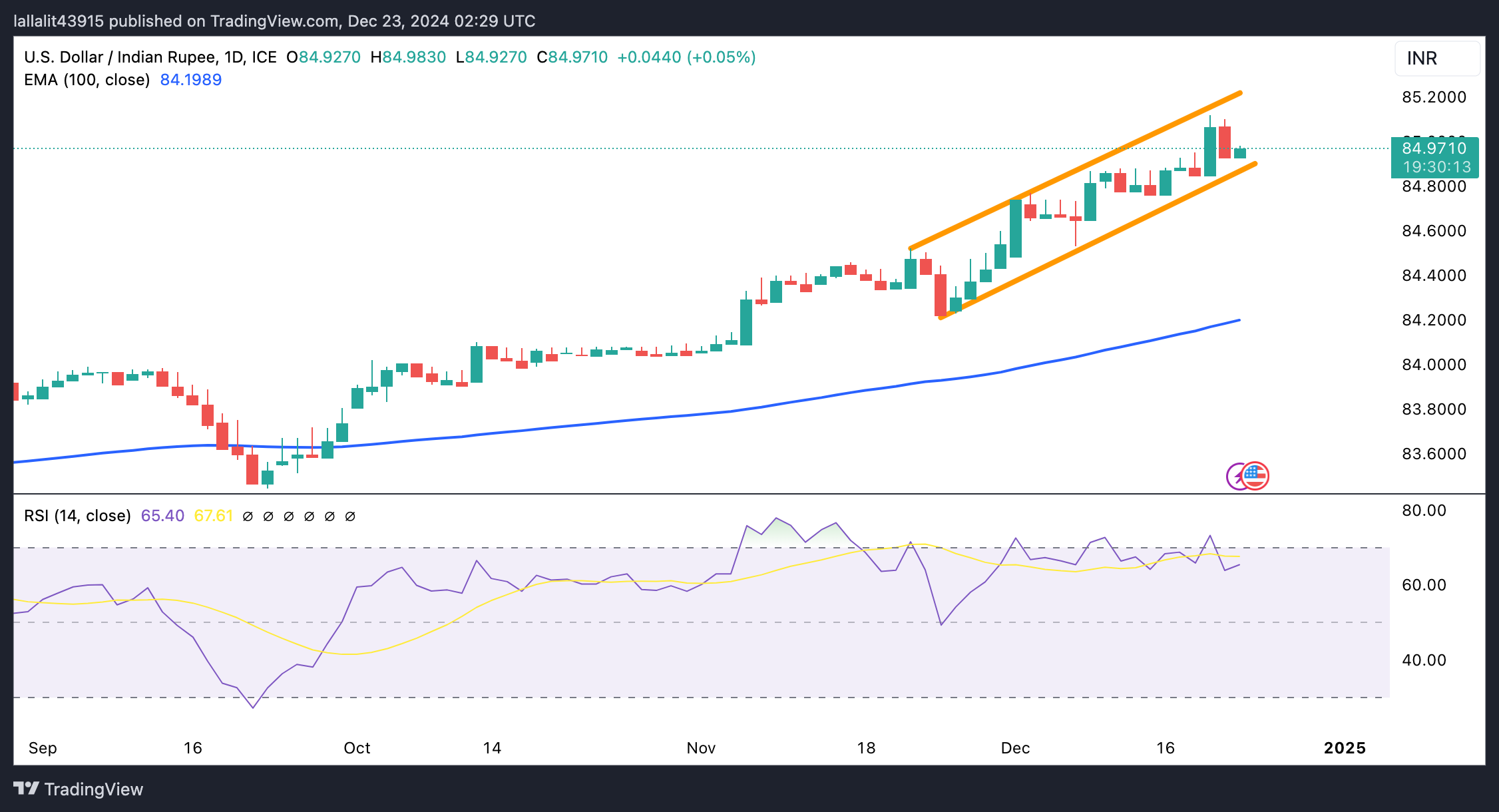
The Indian Rupee trades on a weaker note on the day. The strong uptrend of the USD/INR pair remains intact as the pair holds above the key 100-day Exponential Moving Average (EMA) on the daily timeframe. The path of least resistance is to the upside as the pair, with the 14-day Relative Strength Index (RSI) standing above the midline near 65.40.
Bullish candlesticks that could take USD/INR could take to the ascending channel at 85.20. Extended gains could see a rally to 85.50.
On the flip side, the lower boundary of the channel at 84.88 acts as an initial support level for the pair. A breach of this level could pave the way to 84.19, the 100-day EMA.
RBI FAQs
The role of the Reserve Bank of India (RBI), in its own words, is "..to maintain price stability while keeping in mind the objective of growth.” This involves maintaining the inflation rate at a stable 4% level primarily using the tool of interest rates. The RBI also maintains the exchange rate at a level that will not cause excess volatility and problems for exporters and importers, since India’s economy is heavily reliant on foreign trade, especially Oil.
The RBI formally meets at six bi-monthly meetings a year to discuss its monetary policy and, if necessary, adjust interest rates. When inflation is too high (above its 4% target), the RBI will normally raise interest rates to deter borrowing and spending, which can support the Rupee (INR). If inflation falls too far below target, the RBI might cut rates to encourage more lending, which can be negative for INR.
Due to the importance of trade to the economy, the Reserve Bank of India (RBI) actively intervenes in FX markets to maintain the exchange rate within a limited range. It does this to ensure Indian importers and exporters are not exposed to unnecessary currency risk during periods of FX volatility. The RBI buys and sells Rupees in the spot market at key levels, and uses derivatives to hedge its positions.
Author

Lallalit Srijandorn
FXStreet
Lallalit Srijandorn is a Parisian at heart. She has lived in France since 2019 and now becomes a digital entrepreneur based in Paris and Bangkok.