USD/INR remains firm as higher oil prices, Fed policy awaited
- The Indian Rupee underperforms against the US Dollar amid elevated oil prices.
- US-Iran diplomacy stalemate keeps oil prices higher.
- FIIs continue to exert selling pressure in the Indian stock market.

The Indian Rupee (INR) holds onto weekly losses against the US Dollar (USD) at open on Monday. The USD/INR pair trades firmly near 94.30 as elevated oil prices, strong demand for US Dollars by importers, and escalating sell-off by overseas investors in the Indian stock market are acting as major headwinds for the Indian Rupee.
Iran delivers new proposal on Hormuz reopening
The WTI Oil price is marginally positive around $93.60 in the Asian trade on Monday as the United States (US)-Iran diplomacy remains at a stalemate, following Washington’s refusal to visit Islamabad for another round of peace talks.
Following the cancellation of US envoys Steve Witkoff and Jared Kushner's visit to Islamabad, President Donald Trump clarified that Washington is available on the phone and doesn’t want to waste time taking an 18-hour flight for unproductive talks, Axios reported.
US President Trump added that the counteroffer by Iran's foreign minister Seyed Abbas Araghchi, received through Pakistan, was not good enough, and Washington has all the cards. Trump confirmed that the diplomatic stalemate doesn’t mean the war will resume.
Earlier in the day, a report by Axios showed that Iran has given a new proposal to the US on reopening of the Strait of Hormuz, a vital passage to almost 20% of global energy supply, and the ending of the war, with nuclear negotiations postponed for a later stage.
Currencies from economies, such as India, which rely heavily on oil imports to meet their energy needs, tend to underperform in a high oil price environment.
Meanwhile, stubbornly high oil prices have increased demand for US Dollars by Indian importers, which is also weighing heavily on the Indian Rupee.
FIIs remain dumping their stake in Indian stock market
There seems to be a significant increase in the selling pressure by Foreign Institutional Investors (FIIs) in the Indian stock market amid stalled US-Iran peace talks. On Friday, FIIs offloaded their stake worth Rs. 8,827.87 crore, which was higher than the combined selling amount of Rs. 8,311.99 crore being recorded in the first four trading days of the previous week.
Foreign investors remain cautious over the India Inc. earnings outlook, amid fears that higher oil prices would hit the operating margins of various companies badly.
Investors await the Fed's policy
This week, investors will pay close attention to the Federal Reserve's (Fed) monetary policy announcement on Wednesday, in which it is expected to leave interest rates unchanged in the range of 3.50%-3.75% for the third time in a row. The Fed is expected to warn of upside inflation risks and downside economic risks amidst elevated energy prices.
Technical Analysis: USD/INR trades firmly above 20-day EMA
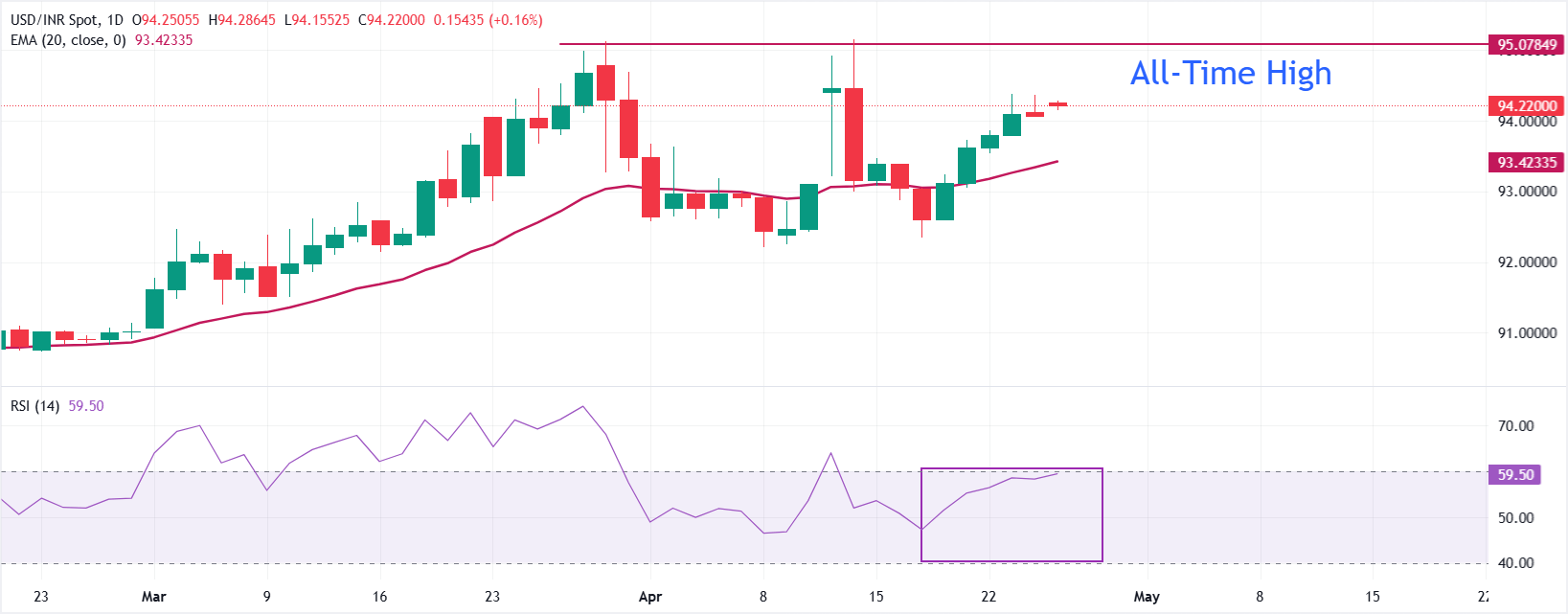
USD/INR trades firmly at around 94.30 as of writing, keeping a bullish near-term bias as spot holds above the 20-day exponential moving average (EMA) at 93.42. The pair is pressing near recent highs, and the Relative Strength Index (RSI) around 59 suggests positive but not extreme momentum, hinting that buyers still have the upper hand while conditions remain short of overbought territory.
On the downside, initial support is located at the 20-day EMA near 93.42, which acts as the primary dynamic floor and would need to give way to signal a deeper correction. As long as USD/INR holds above this level, pullbacks are likely to be viewed as corrective within the broader uptrend, with bulls looking to defend that moving average on dips and extend the advance towards the all-time high around 95.20.
(The technical analysis of this story was written with the help of an AI tool.)
Economic Indicator
Fed Interest Rate Decision
The Federal Reserve (Fed) deliberates on monetary policy and makes a decision on interest rates at eight pre-scheduled meetings per year. It has two mandates: to keep inflation at 2%, and to maintain full employment. Its main tool for achieving this is by setting interest rates – both at which it lends to banks and banks lend to each other. If it decides to hike rates, the US Dollar (USD) tends to strengthen as it attracts more foreign capital inflows. If it cuts rates, it tends to weaken the USD as capital drains out to countries offering higher returns. If rates are left unchanged, attention turns to the tone of the Federal Open Market Committee (FOMC) statement, and whether it is hawkish (expectant of higher future interest rates), or dovish (expectant of lower future rates).
Read more.Next release: Wed Apr 29, 2026 18:00
Frequency: Irregular
Consensus: 3.75%
Previous: 3.75%
Source: Federal Reserve
Author

Sagar Dua
FXStreet
Sagar Dua is associated with the financial markets from his college days. Along with pursuing post-graduation in Commerce in 2014, he started his markets training with chart analysis.














