Gold plunges to one-year low near $3,850 as Fed hawks take charge
- Gold plunges to $3,874 after touching a fresh yearly low of $3,852.
- US Dollar approaches 19-month highs as Fed officials advocate further tightening.
- December Fed 25 bps hike odds reach 87% as traders await US PPI.
Gold (XAU/USD) tanks nearly 2.8% on Thursday as market participants priced in higher odds of a 50 bps December rate hike by the Federal Reserve (Fed). The XAU/USD trades at $3,874 after touching a yearly low of $3,852.
Hawkish Fed rhetoric arrives alongside higher Oil prices
Bullion prices remain on the back foot as more Fed officials turned hawkish, underpinning the Greenback.
The Cleveland Fed's Beth Hammack said the inflation outlook is worsening, though she supports a gradual approach to raising interest rates. The Chicago Fed's Austan Goolsbee said that inflation has been “well above target,” while the San Francisco Fed's Mary Daly recognized that further tightening is needed and that inflation pressure “is up, not down.”
US jobs data was slightly weaker than expected as Initial Jobless Claims for the week ending November 7 increased by 200K above estimates of 195K and the previous reading of 191K. Still, the labour market is solid, as Continuing Jobless Claims dipped from 1.717 million to 1.697 million.
Other data showed that Existing Home Sales dipped -5.5% from 3.97 million to 3.75 million, compared with September’s print.
The US Dollar Index (DXY), which tracks the performance of the buck’s value against six currencies, is up 0.34% to 103.48, near 19-month highs.
In the meantime, US President Donald Trump posted on social media that the US does not need a deal with Iran, leaving the door open for further strikes, contradicting what did he said two days ago about no need for new strikes.
West Texas Intermediate (WTI), the US crude Oil benchmark, rose 2.7% to $88.79 per barrel, fueling speculation that gasoline prices will increase and raising the chances that the Federal Reserve will raise rates.
Money markets had priced in an 85% chance of a 25-basis-point rate hike in December and a slim 15% chance of a 50-basis-point move, according to the CME FedWatch Tool. Just a week ago, the market had zero chance of a 50 bps hike.
Ahead, the US economic docket will feature the October Producer Price Index (PPI) data on Friday.
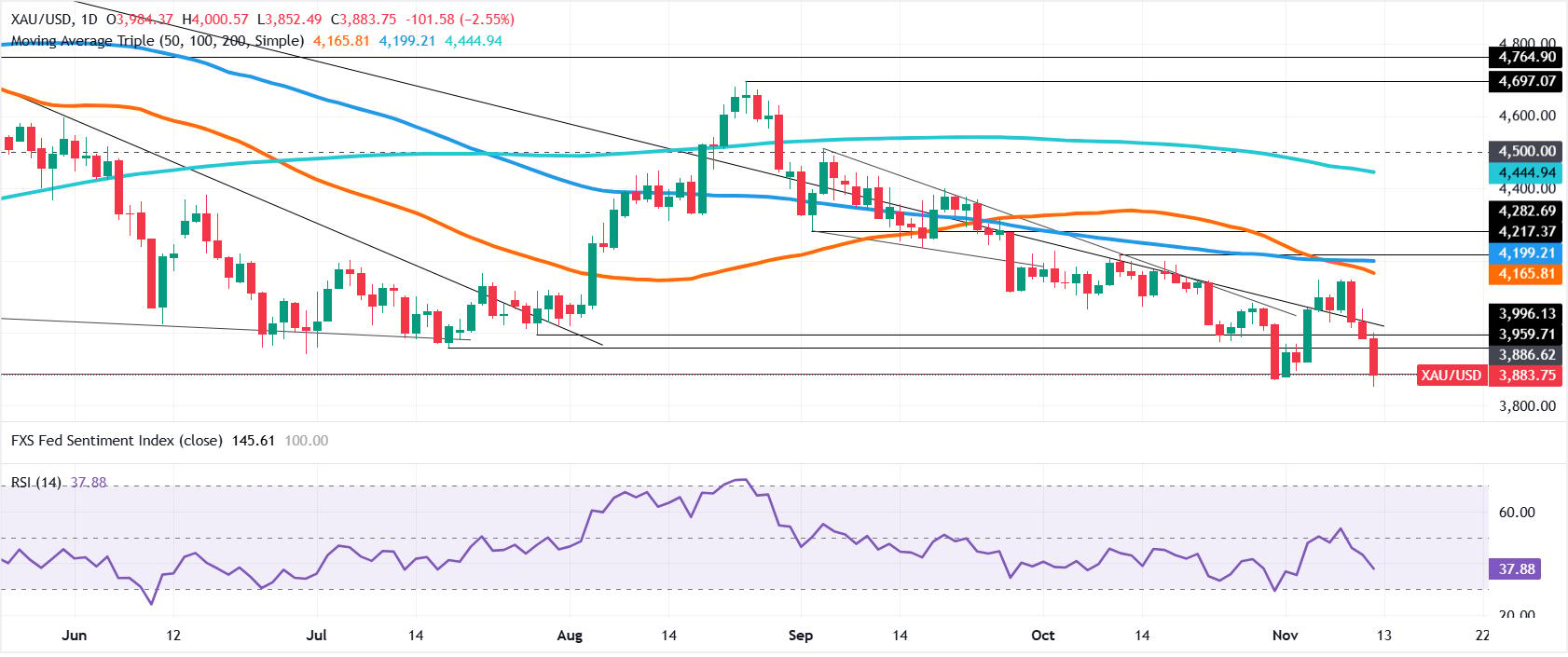
XAU/USD technical outlook: Gold collapses over 2.5% beneath $3,900
Despite a decline, Gold has recovered some ground but trades below $3,900 after touching a year-to-date (YTD) low of $3,852. Momentum, as measured by the Relative Strength Index (RSI), along with price action, signals further downside.
XAU/USD's first support is $3,852. Below that, the next support is $3,800, followed by key psychological levels, but the next area of interest is the April 22, 2025, swing high-turned-support at $3,500.
Conversely, the first key resistance is the $3,900 mark, followed by the high of the day at $4,000. On further strength, the next resistance is $4,100, ahead of the confluence of the 50-day Simple Moving Average (SMA) at $4,165 and the 100-day SMA at $4,199.
Gold FAQs
Gold has played a key role in human’s history as it has been widely used as a store of value and medium of exchange. Currently, apart from its shine and usage for jewelry, the precious metal is widely seen as a safe-haven asset, meaning that it is considered a good investment during turbulent times. Gold is also widely seen as a hedge against inflation and against depreciating currencies as it doesn’t rely on any specific issuer or government.
Central banks are the biggest Gold holders. In their aim to support their currencies in turbulent times, central banks tend to diversify their reserves and buy Gold to improve the perceived strength of the economy and the currency. High Gold reserves can be a source of trust for a country’s solvency. Central banks added 1,136 tonnes of Gold worth around $70 billion to their reserves in 2022, according to data from the World Gold Council. This is the highest yearly purchase since records began. Central banks from emerging economies such as China, India and Turkey are quickly increasing their Gold reserves.
Gold has an inverse correlation with the US Dollar and US Treasuries, which are both major reserve and safe-haven assets. When the Dollar depreciates, Gold tends to rise, enabling investors and central banks to diversify their assets in turbulent times. Gold is also inversely correlated with risk assets. A rally in the stock market tends to weaken Gold price, while sell-offs in riskier markets tend to favor the precious metal.
The price can move due to a wide range of factors. Geopolitical instability or fears of a deep recession can quickly make Gold price escalate due to its safe-haven status. As a yield-less asset, Gold tends to rise with lower interest rates, while higher cost of money usually weighs down on the yellow metal. Still, most moves depend on how the US Dollar (USD) behaves as the asset is priced in dollars (XAU/USD). A strong Dollar tends to keep the price of Gold controlled, whereas a weaker Dollar is likely to push Gold prices up.
Author

Christian Borjon Valencia
FXStreet
Markets analyst, news editor, and trading instructor with over 14 years of experience across FX, commodities, US equity indices, and global macro markets.