Dogecoin Price Forecast: DOGE tests three-year low as selling pressure deepens
- Dogecoin decline persists, as the meme coin drops to levels last seen in October 2023.
- Traders are increasingly betting to keep their long positions despite a persistent downtrend in futures Open Interest.
- Dogecoin’s oversold condition suggests that sellers have the immediate upper hand, but tables could turn if bulls stage a comeback.

Dogecoin (DOGE) trades lower around $0.0650 on Thursday, as bears tighten their grip. The path of least resistance remains downward not only for the largest meme coin by market capitalization but also for crypto majors Bitcoin (BTC), Ethereum (ETH) and Ripple (XRP).
DOGE is down about 2.6% on the day, aligning with levels last seen in October 2023. The bearish setup follows persistent deterioration in its technicals, marked by weak momentum indicators and declining moving averages.
More broadly, interest in crypto-related investment products has taken a heavy hit recently, with the $6.3 billion Binance hack weighing on price action. The crypto Fear and Greed Index was at 28 in the Fear territory on Thursday, down only marginally from 29 the day before, undermining risk appetite.
Dogecoin derivatives face mounting pressure despite positive weighted funding rate
The Dogecoin derivatives market has weakened significantly, as perpetual futures Open Interest (OI) averaged $888 million on Thursday, down from $923 million the day before.
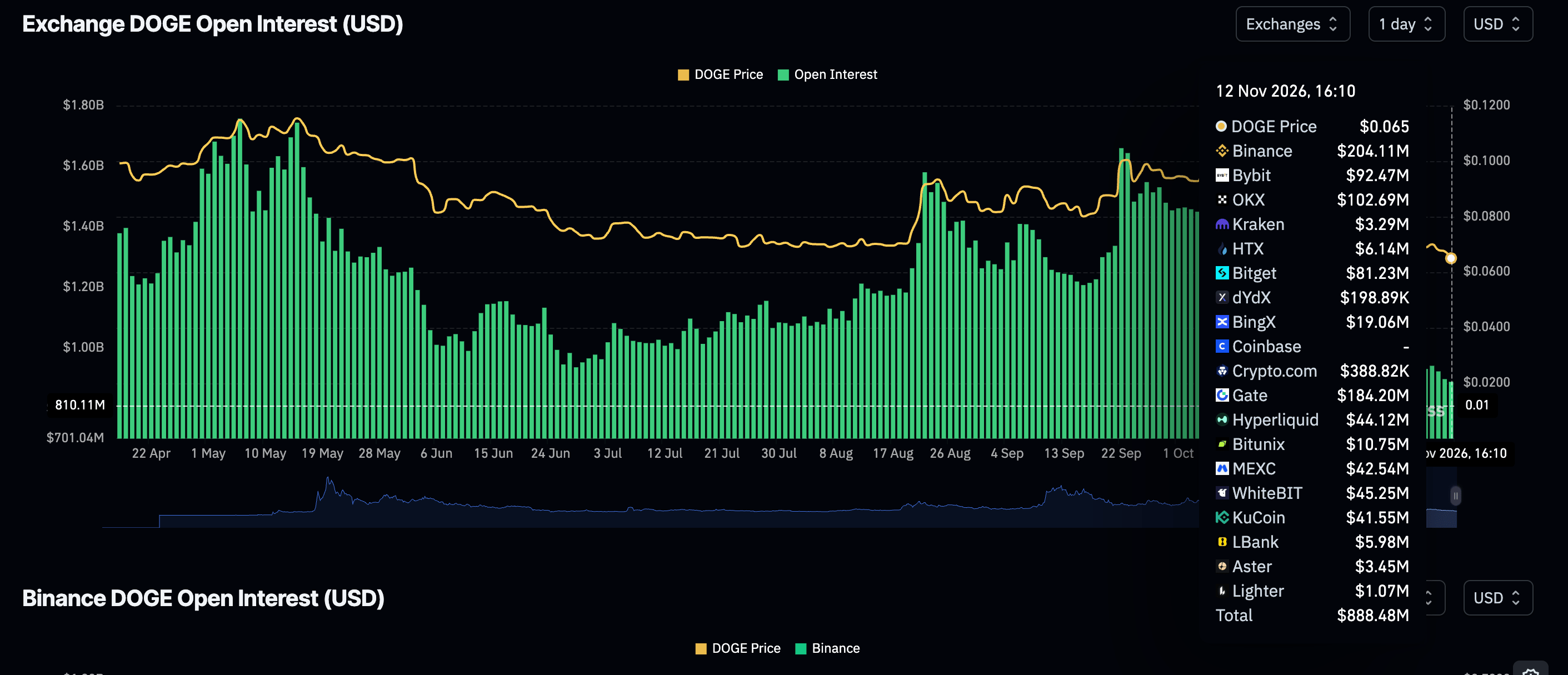
The same OI, which measures the notional value of futures contracts yet to be settled, stood at $1 billion on November 1 and $1.5 billion on October 1, suggesting that investor interest has persistently faded alongside Dogecoin's price drop.
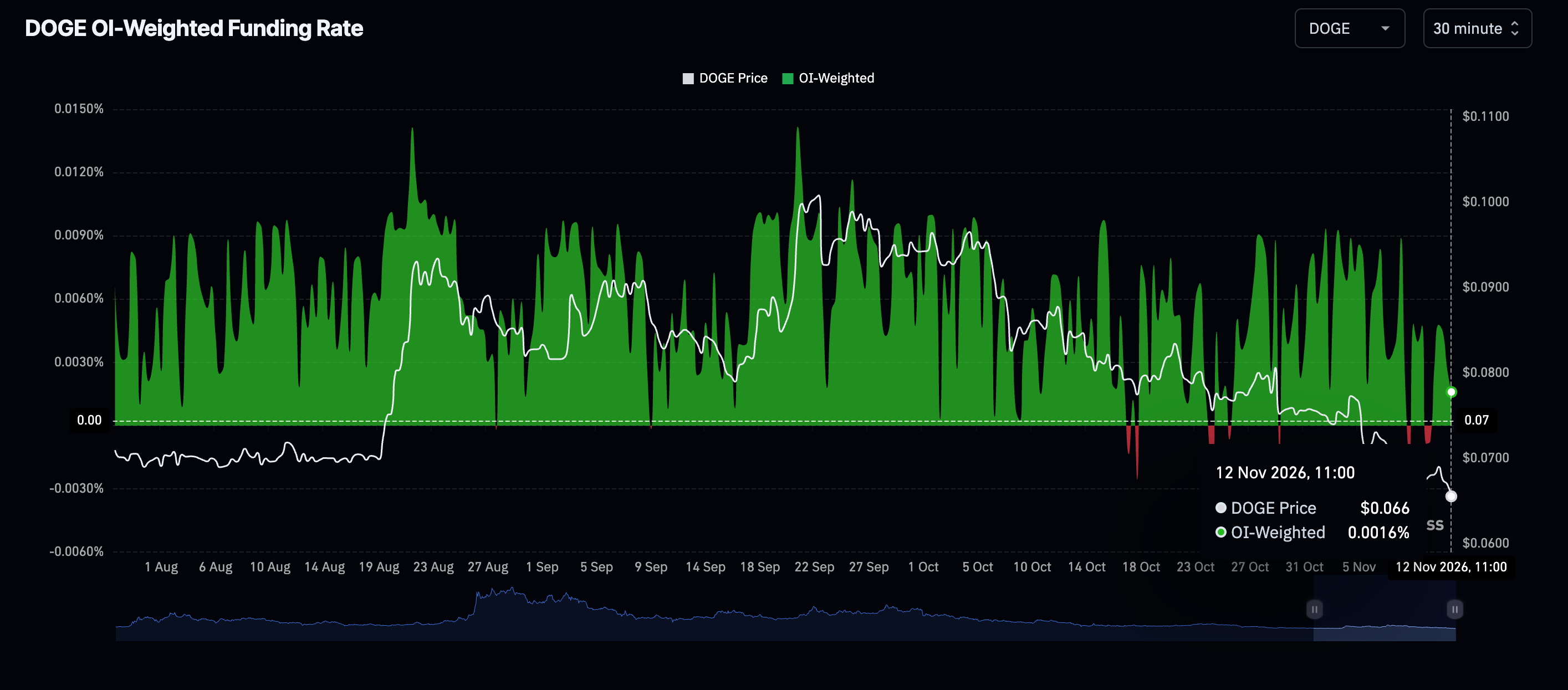
Conversely, Dogecoin OI-weighted funding rate remains positive at 0.0016%, suggesting long traders are willing to pay premium fees to hold their positions. Therefore, if DOGE holds above the short-term $0.0640 support, traders may increase exposure, raising recovery odds.
Technical analysis: Dogecoin tests multi-year lows
Dogecoin trades at $0.0648, extending its decline well below all key Exponential Moving Averages (EMAs) and reinforcing a bearish near-term bias. The 50-day, 100-day and 200-day EMAs at $0.0784, $0.0812 and $0.0885, respectively, sit overhead as layered trend resistance, while the SuperTrend at $0.0769 caps any recovery attempts.
Momentum remains weak, with the Relative Strength Index (RSI) at 27 in oversold territory and the Moving Average Convergence Divergence (MACD) below zero and in a negative crossover, suggesting persistent selling pressure even as the pair risks short-lived corrective bounces.
Initial resistance lies at the SuperTrend barrier around $0.0769, followed by the 50-day EMA at $0.0784 and then the 100-day EMA at $0.0812, where any rebound would likely struggle. A more significant hurdle is the 200-day EMA near $0.0885, which would need to be reclaimed to soften the broader bearish structure.
On the downside, the current price zone around $0.0648 acts as immediate structural support. A decisive break lower would expose further weakness, with oversold RSI and a negative MACD hinting that any relief rally from this area could remain limited while price holds beneath the clustered EMA and SuperTrend resistance.
(The technical analysis of this story was written with the help of an AI tool. Know more.)
Open Interest, funding rate FAQs
Higher Open Interest is associated with higher liquidity and new capital inflow to the market. This is considered the equivalent of increase in efficiency and the ongoing trend continues. When Open Interest decreases, it is considered a sign of liquidation in the market, investors are leaving and the overall demand for an asset is on a decline, fueling a bearish sentiment among investors.
Funding fees bridge the difference between spot prices and prices of futures contracts of an asset by increasing liquidation risks faced by traders. A consistently high and positive funding rate implies there is a bullish sentiment among market participants and there is an expectation of a price hike. A consistently negative funding rate for an asset implies a bearish sentiment, indicating that traders expect the cryptocurrency’s price to fall and a bearish trend reversal is likely to occur.
Author

John Isige
FXStreet
John Isige is a seasoned cryptocurrency journalist and markets analyst committed to delivering high-quality, actionable insights tailored to traders, investors, and crypto enthusiasts. He enjoys deep dives into emerging Web3 tren