|

USD Index Price Analysis: A drop to 101.00 appears in store

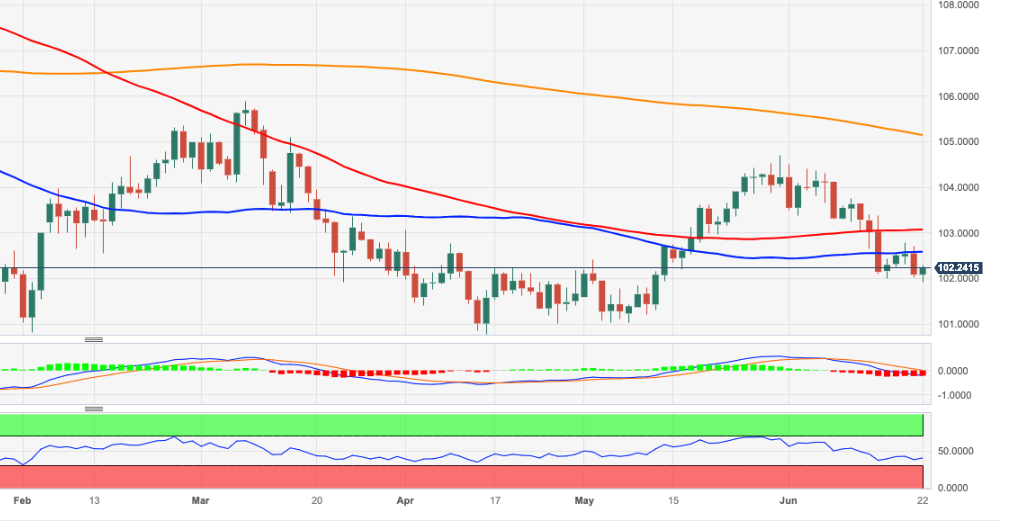
  • DXY remains under pressure and briefly pierces 102.00.
  • Extra losses could see the 101.00 zone revisited in the near term.

DXY now regains some composure following the earlier pullback to the sub-102.00 region, or new multi-week lows, on Thursday.                                                                                           

Despite the ongoing rebound, the index remains well under pressure. That said, there is the palpable probability that a deeper pullback could drag DXY to the area of lows seen in April and May around 101.00. Dow from here emerges the 2023 low around 100.80 recorded on April 14.

Looking at the broader picture, while below the 200-day SMA at 105.14 the outlook for the index is expected to remain negative.

DXY daily chart
Dollar Index Spot

Overview
Today last price102.29
Today Daily Change38
Today Daily Change %0.20
Today daily open102.09
 
Trends
Daily SMA20103.46
Daily SMA50102.63
Daily SMA100103.07
Daily SMA200104.88
 
Levels
Previous Daily High102.71
Previous Daily Low102.02
Previous Weekly High103.76
Previous Weekly Low102.01
Previous Monthly High104.7
Previous Monthly Low101.03
Daily Fibonacci 38.2%102.29
Daily Fibonacci 61.8%102.45
Daily Pivot Point S1101.83
Daily Pivot Point S2101.58
Daily Pivot Point S3101.14
Daily Pivot Point R1102.53
Daily Pivot Point R2102.97
Daily Pivot Point R3103.22

Author

Pablo Piovano

Born and bred in Argentina, Pablo has been carrying on with his passion for FX markets and trading since his first college years.


More from Pablo Piovano
Share:

Editor's Picks

AUD/USD consolidates above 0.7000; remains close to monthly top

AUD/USD holds steady above 0.7000 during the Asian session on Friday, trading just below the previous day's monthly low amid diverging forces. A hawkish RBA continues to support the Aussie, while the recent decline in US bond yields keeps the US Dollar depressed near a three-week low. However, oil-driven inflation fears reinforce Fed hike bets, which, along with geopolitical risks, could benefit the safe-haven buck and cap the currency pair.

USD/JPY bounces off one-month low; climbs to 157.00 amid reviving USD demand

USD/JPY rebounds from the 156.00 neighborhood, or a one-month low touched during Friday’s Asian session, with bulls looking to extend momentum beyond 157.00 amid the emergence of some US Dollar buying. Meanwhile, Japan's National CPI rose to a nine-month peak and reaffirmed BoJ rate-hike bets, which could support the Japanese Yen and cap gains for the currency pair.

Gold treads water around $4,000

Gold prices maintain its offered stance in place at the end of the week, hovering around the key $4,000 threshold per troy ounce. The persistent selling bias in the precious metal comes amid decent gains in the US Dollar and an acceptable rebound in US Treasury yields across the curve, all alongside further upside traction in crude oil prices.

Week ahead: Central bank and earnings bonanza could roil markets

After joining the rate-hike club in September, the Federal Reserve looks set to stand pat in October, waiting to assess more data before deciding to hike again. Whilst this isn’t an unusual move for a central bank, it somewhat contradicts Fed Chair Kevin Warsh’s new mantra of data dependency and zero forward guidance.

CFTC Report: WTI rally runs ahead of positioning
The week in one sentence: WTI prices surged while speculative longs were cut in the week to October 20, creating the clearest price/positioning divergence. Sterling and the Canadian Dollar led the constructive currency shift, while Yen longs also rebuilt. Speculators turned less constructive on the WTI, reducing their net exposure to around 89.3K contracts.
What November 3 means for the Fed's rate path and the US Dollar

The USD faces a decisive period ahead of the November 3 midterm elections. While markets anticipate another interest rate increase from the Fed in December, the battle for control of Congress could reshape fiscal policy expectations and, indirectly, the path of US monetary policy in 2027.