USD/CHF stabilizes near 0.8600 after volatility, tariffs and recession fears support USD
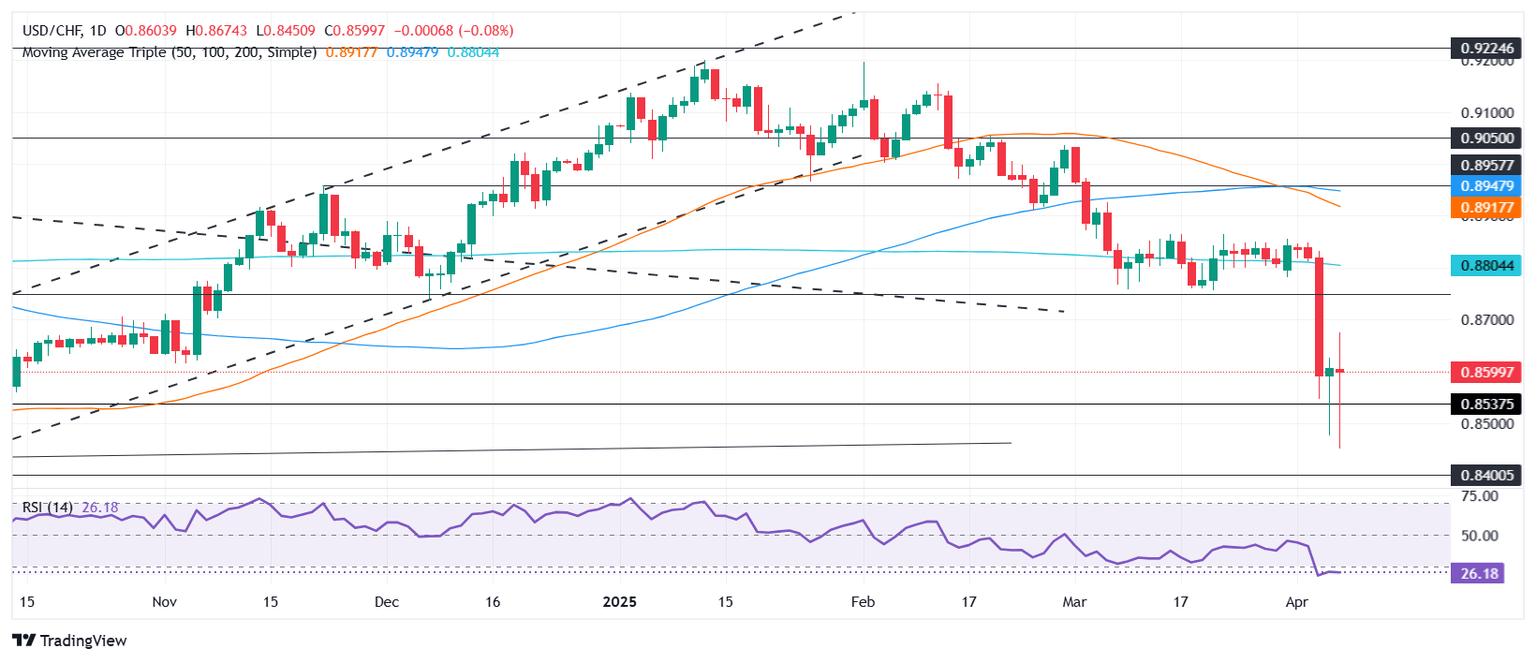
- USD/CHF whipsawed between 0.8450–0.8673 Monday before settling flat; volatility at highest since March 2020.
- Tariff threats and China’s retaliation stoke global recession fears, boosting demand for safe-haven USD.
- DXY climbs to 103.47; traders brace for key US CPI release that could challenge 100 bps of Fed cut bets.


The USD/CHF begins Tuesday’s Asian session slightly lower, following a wild trading day on Monday, which saw swings within the 0.8450–0.8673 range, and ended virtually unchanged. At the time of writing, the major trades at 0.8588, down 0.02%.
Pair trades near 0.8588 amid mixed sentiment, with investors eyeing US CPI for next directional catalyst
The market mood is mixed, with one of the three US indices posting a green day, while the Volatility Index (VIX) finished at 46.98, its highest level since March 2020. Tariffs continued to be the main driver, sparking fears among investors as a global recession looms, following China’s retaliation, which imposed reciprocal tariffs of 34% on imports from the US.
On Monday, Trump threatened to impose 50% tariffs on China’s products if they failed to lift levies on U.S. goods by April 8.
Rumors of a 90-day pause on tariffs, except for China, revealed by White House economic adviser Hassett, were later denied by Washington, which called the comments “fake news,” thereby increasing demand for the Greenback.
The US Dollar Index (DXY), which tracks the value of the US Dollar against a basket of six currencies that includes the CHF, rose 0.56% to 103.47.
The US economic schedule remains empty, though traders are eyeing the release of March’s Consumer Price Index (CPI) data. If headline and core figures surprise investors and rise above estimates and the previous month’s readings, this could hurt money markets' bets that the Federal Reserve would cut rates by almost 100 basis points, towards the year-end, according to Prime Market Terminal data.
USD/CHF Price Forecast: Technical outlook
The USD/CHF remains downwardly biased, even though the pair has shown signs of recovery. Following Monday’s trading, the pair is expected to consolidate within the 0.8450–0.8673 range, with neither buyers nor sellers in control.
The Relative Strength Index (RSI) remains bearish, with the index remaining at oversold conditions. However, as the slope turns slightly upward, a chance of a rebound is possible.
In that outcome, the USD/CHF first resistance would be the 0.8700 figure, followed by the 200-day Simple Moving Average (SMA) at 0.8798. On the other hand, the downtrend is expected to resume, with the first floor level at 0.8550, followed by the 0.8500 mark.
Swiss Franc FAQs
The Swiss Franc (CHF) is Switzerland’s official currency. It is among the top ten most traded currencies globally, reaching volumes that well exceed the size of the Swiss economy. Its value is determined by the broad market sentiment, the country’s economic health or action taken by the Swiss National Bank (SNB), among other factors. Between 2011 and 2015, the Swiss Franc was pegged to the Euro (EUR). The peg was abruptly removed, resulting in a more than 20% increase in the Franc’s value, causing a turmoil in markets. Even though the peg isn’t in force anymore, CHF fortunes tend to be highly correlated with the Euro ones due to the high dependency of the Swiss economy on the neighboring Eurozone.
The Swiss Franc (CHF) is considered a safe-haven asset, or a currency that investors tend to buy in times of market stress. This is due to the perceived status of Switzerland in the world: a stable economy, a strong export sector, big central bank reserves or a longstanding political stance towards neutrality in global conflicts make the country’s currency a good choice for investors fleeing from risks. Turbulent times are likely to strengthen CHF value against other currencies that are seen as more risky to invest in.
The Swiss National Bank (SNB) meets four times a year – once every quarter, less than other major central banks – to decide on monetary policy. The bank aims for an annual inflation rate of less than 2%. When inflation is above target or forecasted to be above target in the foreseeable future, the bank will attempt to tame price growth by raising its policy rate. Higher interest rates are generally positive for the Swiss Franc (CHF) as they lead to higher yields, making the country a more attractive place for investors. On the contrary, lower interest rates tend to weaken CHF.
Macroeconomic data releases in Switzerland are key to assessing the state of the economy and can impact the Swiss Franc’s (CHF) valuation. The Swiss economy is broadly stable, but any sudden change in economic growth, inflation, current account or the central bank’s currency reserves have the potential to trigger moves in CHF. Generally, high economic growth, low unemployment and high confidence are good for CHF. Conversely, if economic data points to weakening momentum, CHF is likely to depreciate.
As a small and open economy, Switzerland is heavily dependent on the health of the neighboring Eurozone economies. The broader European Union is Switzerland’s main economic partner and a key political ally, so macroeconomic and monetary policy stability in the Eurozone is essential for Switzerland and, thus, for the Swiss Franc (CHF). With such dependency, some models suggest that the correlation between the fortunes of the Euro (EUR) and the CHF is more than 90%, or close to perfect.
Author
Christian Borjon Valencia
FXStreet
Markets analyst, news editor, and trading instructor with over 14 years of experience across FX, commodities, US equity indices, and global macro markets.