USD/CHF Price Forecast: At two-month highs, with 0.8000 in focus
- USD/CHF rallies to two-month highs near 0.8000.
- Escalating tensions in the Middle East have crushed risk appetite and are buoying the safe-haven USD.
- Strong US labour data boosted Fed tightening hopes on Friday and sent the US Dollar surging.

The US Dollar is rallying for the second consecutive day against the Swiss Franc (CHF) on Monday, reaching levels near 0.8000 for the first time in the last two months. A risk-off mood amid the escalating tensions in the Middle East and growing bets of Federal Reserve (Fed) rate hikes is boosting the US Dollar across the board on Monday.
Investors remain reluctant to take risks amid news of reciprocal attacks between Israel and Iran, which have boosted concerns about the resumption of an all-out war in the region, and sent Oil prices nearly $5 higher.
The US Dollar, on the other hand, is drawing support from rising bets on Fed hikes this year, as a bright US Nonfarm Payrolls report culminated a string of solid US macroeconomic releases, highlighting the resilience of the US economy to the energy shock stemming from Iran’s war. In the current context of growing inflationary pressures globally, the CME Group’s Fed Watch Tool shows a nearly 70% chance that the Fed will raise rates before the year-end, up from 13% one month ago
Technical Analysis: USD, heading to 0.8000 and probably higher
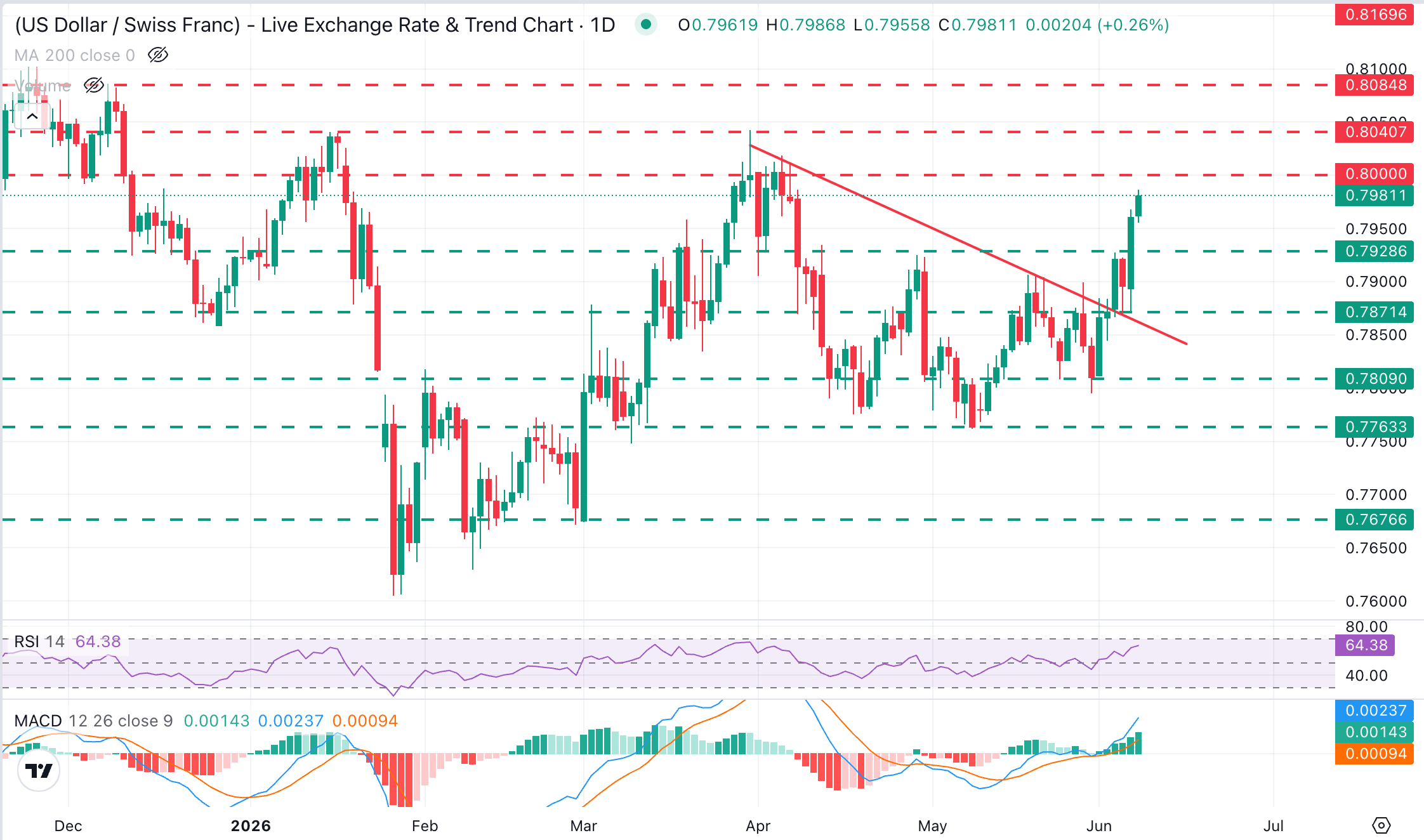
USD/CHF broke and confirmed above the near-term trendline resistance last week and is now heading higher. The Relative Strength Index (RSI) in the daily chart is near 65, and a positive Moving Average Convergence Divergence (MACD) line with a rising histogram hints at solid bullish momentum.
Bulls are heading to the psychological horizontal barrier at 0.8000, which, together with the year-to-date high, near 0.8040, is likely to pose significant resistance. Further up, the next target is the December 2025 high, at 0.8085.
Downside attempts, on the other hand, are likely to find support at the previous resistance area near 0.7930 ahead of Friday's low, at 0.7870
(The technical analysis of this story was written with the help of an AI tool.)
Risk sentiment FAQs
In the world of financial jargon the two widely used terms “risk-on” and “risk off'' refer to the level of risk that investors are willing to stomach during the period referenced. In a “risk-on” market, investors are optimistic about the future and more willing to buy risky assets. In a “risk-off” market investors start to ‘play it safe’ because they are worried about the future, and therefore buy less risky assets that are more certain of bringing a return, even if it is relatively modest.
Typically, during periods of “risk-on”, stock markets will rise, most commodities – except Gold – will also gain in value, since they benefit from a positive growth outlook. The currencies of nations that are heavy commodity exporters strengthen because of increased demand, and Cryptocurrencies rise. In a “risk-off” market, Bonds go up – especially major government Bonds – Gold shines, and safe-haven currencies such as the Japanese Yen, Swiss Franc and US Dollar all benefit.
The Australian Dollar (AUD), the Canadian Dollar (CAD), the New Zealand Dollar (NZD) and minor FX like the Ruble (RUB) and the South African Rand (ZAR), all tend to rise in markets that are “risk-on”. This is because the economies of these currencies are heavily reliant on commodity exports for growth, and commodities tend to rise in price during risk-on periods. This is because investors foresee greater demand for raw materials in the future due to heightened economic activity.
The major currencies that tend to rise during periods of “risk-off” are the US Dollar (USD), the Japanese Yen (JPY) and the Swiss Franc (CHF). The US Dollar, because it is the world’s reserve currency, and because in times of crisis investors buy US government debt, which is seen as safe because the largest economy in the world is unlikely to default. The Yen, from increased demand for Japanese government bonds, because a high proportion are held by domestic investors who are unlikely to dump them – even in a crisis. The Swiss Franc, because strict Swiss banking laws offer investors enhanced capital protection.
Author

Guillermo Alcala
FXStreet
Graduated in Communication Sciences at the Universidad del Pais Vasco and Universiteit van Amsterdam, Guillermo has been working as financial news editor and copywriter in diverse Forex-related firms, like FXStreet and Kantox.

















