USD/CHF plunges after Liberation Day, hits multi-month lows
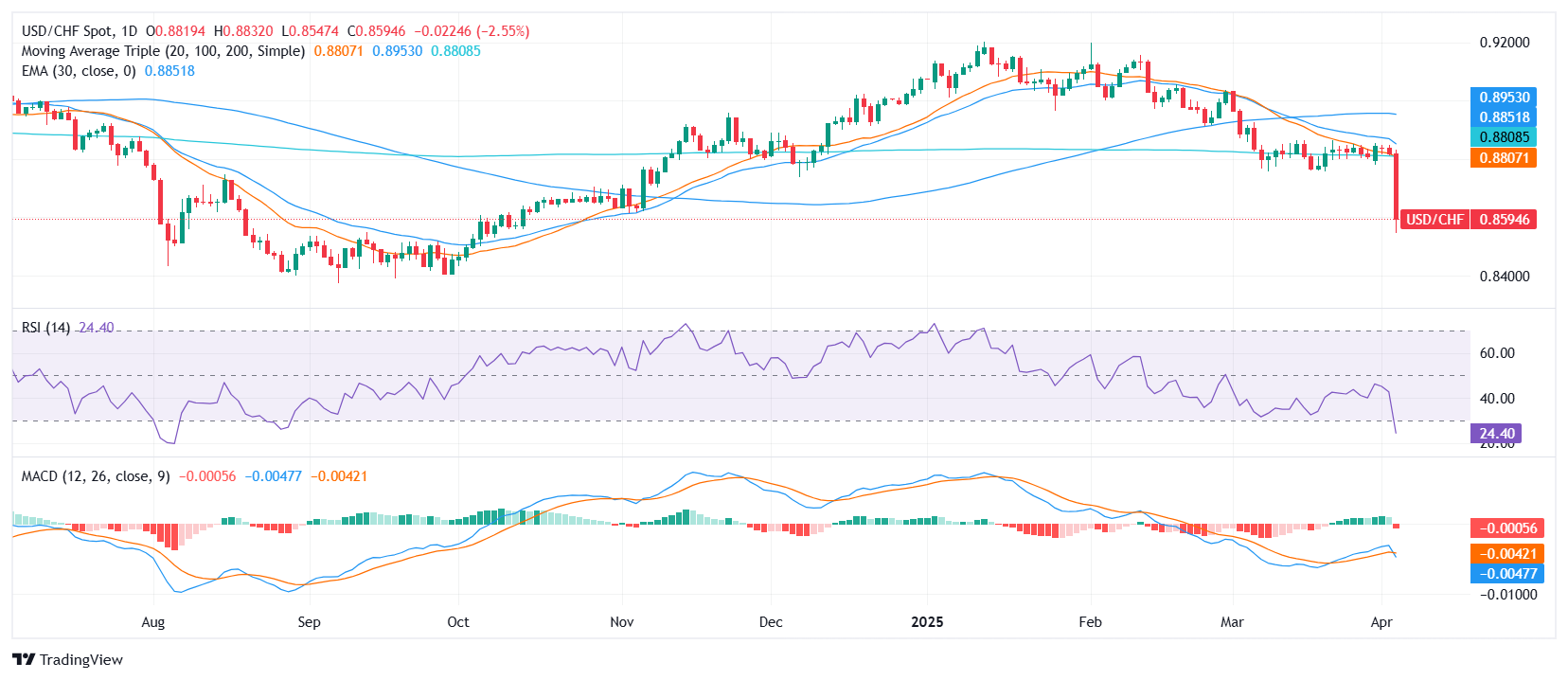
- USD/CHF plunges to the 0.8600 zone, hitting its lowest level since October 2024.
- US tariffs trigger global portfolio adjustments, intensifying bearish pressure on the Greenback.
- Technical indicators flag oversold conditions; a near-term correction may follow.

During Thursday’s session, the USD/CHF pair suffered a sharp decline, tumbling toward the 0.8600 region and marking its weakest levels in nearly six months. This bearish move came amid broad-based US Dollar (USD) weakness following President Donald Trump’s aggressive announcement of reciprocal import tariffs. The US Dollar Index (DXY) was dealt a heavy blow, breaking down decisively as traders fled US assets and reallocated portfolios away from the Greenback. Meanwhile, oversold signals from momentum indicators suggest the pair may be due for a rebound.
Tariff shock knocks the US Dollar
President Trump’s unveiling of a 10% baseline tariff on all incoming goods, alongside a 25% levy on auto imports, delivered a major shock to global markets. While initially welcomed for their clarity, the tariff measures turned out to be highly complex and country-specific, adding uncertainty to trade dynamics. Investors were quick to reprice risk, leading to an exodus from US equities and the US Dollar alike.
The ripple effect was seen across the board, with the DXY collapsing below 102 for the first time in months. US jobless claims added to the soft tone, printing at 219K—below forecasts and the prior revised 225K, pointing to continued labor market softness. Meanwhile, the ISM Services PMI for March disappointed at 50.8, missing expectations and suggesting slower growth momentum. Combined with rising fears of a recession, this data cocktail reinforced the notion that the Federal Reserve (Fed) may need to pivot sooner than previously thought.
Technical outlook: Oversold conditions emerge
From a technical perspective, USD/CHF is deeply oversold following a drop of over 2% in a single session. The Relative Strength Index (RSI) has plunged toward extreme territory, while the Moving Average Convergence Divergence (MACD) shows strong downside momentum. Despite these bearish signals, such readings often precede at least a short-term correction.
Support is seen near the psychological 0.8600 area, with deeper levels around 0.8565 and 0.8520 potentially in play if selling continues. On the flip side, resistance could emerge near 0.8650, followed by 0.8720 and the 20-day Simple Moving Average, which currently hovers in the upper 0.87s.
Author

Patricio Martín
FXStreet
Patricio is an economist from Argentina passionate about global finance and understanding the daily movements of the markets.