USD/CAD rises as Fed Powell confirms data-dependent stance, strong US ISM and JOLTS data
- USD/CAD rises as Fed Powell's comments at the ECB Forum raise expectations of a rate cut in September.
- Fed Chair Powell: "As long as the US economy is in a solid shape, the prudent thing to do is wait."
- The US ISM Manufacturing PMI and JOLTS job data beat expectations, reflecting a more resilient US economy.

The Canadian Dollar (CAD) is edging lower against the US Dollar (USD) on Tuesday, as traders digest the latest remarks from Federal Reserve (Fed) Chair Jerome Powell.
Central bank speakers gather at the European Central Bank (ECB) Forum in Sintra, Portugal, providing insight into monetary policy.
As of this writing, USD/CAD is hovering near 1.3640, as Powell remains committed to waiting for additional signs of inflation pressures before cutting rates.
"As long as the US economy is in solid shape, we think that the prudent thing to do is to wait and learn more and see what those effects might be," Powell said.
So far, Powell has adhered to the cautious script, but investors are aware that this could shift quickly if the data dictates otherwise.
Additionally, Powell stated that "It's going to depend on the data, and we are going meeting by meeting." "I wouldn't take any meeting off the table or put it directly on the table. It's going to depend on how the data evolves.”
These comments suggest that the Fed is not rushing to cut rates, increasing the potential for a September cut. With the US ISM Manufacturing and JOLTS data beating expectations, a resilient US data remains supportive of a more data-dependent Fed, providing a boost for USD/CAD.
ISM Manufacturing PMI and JOLTS employment numbers reflect a resilient US economy
Two closely watched US economic reports released in the United States on Tuesday have helped alleviate concerns about the US economy.
First is the Institute for Supply Management’s Manufacturing Purchasing Managers’ Index (ISM Manufacturing PMI).The forecast called for a 48.8 print, which falls in contraction territory, hinting at softness in the industrial sector. The June data came in above expectations at 49, rising from 48.5 in May.
The second is the Job Openings and Labor Turnover Survey (JOLTS), where economists had expected around 7.3 million open positions as of May 31. Instead, the latest report revealed that job vacancies rose by 7.769 million, reflecting a resilient US labour market.
Together, these two data points provide a solid snapshot of both the demand for goods and the demand for labor, two key components of the US economy.
USD/CAD technical analysis: Loonie remains supported above psychological support at 1.3600
The USD/CAD daily chart shows the loonie continues to trade under pressure on Tuesday.
Prices currently remain below the 20-day Simple Moving Average (SMA) at 1.3670 and the 50-day SMA around 1.3779.
The pair had recently broken above a descending channel but has since pulled back, suggesting the downward trend may continue.
Key support lies at the 1.3600 psychological level, a break of which could open the door for the June low of 1.3539. A further drop could potentially target the September low at 1.3419.
USD/CAD daily chart
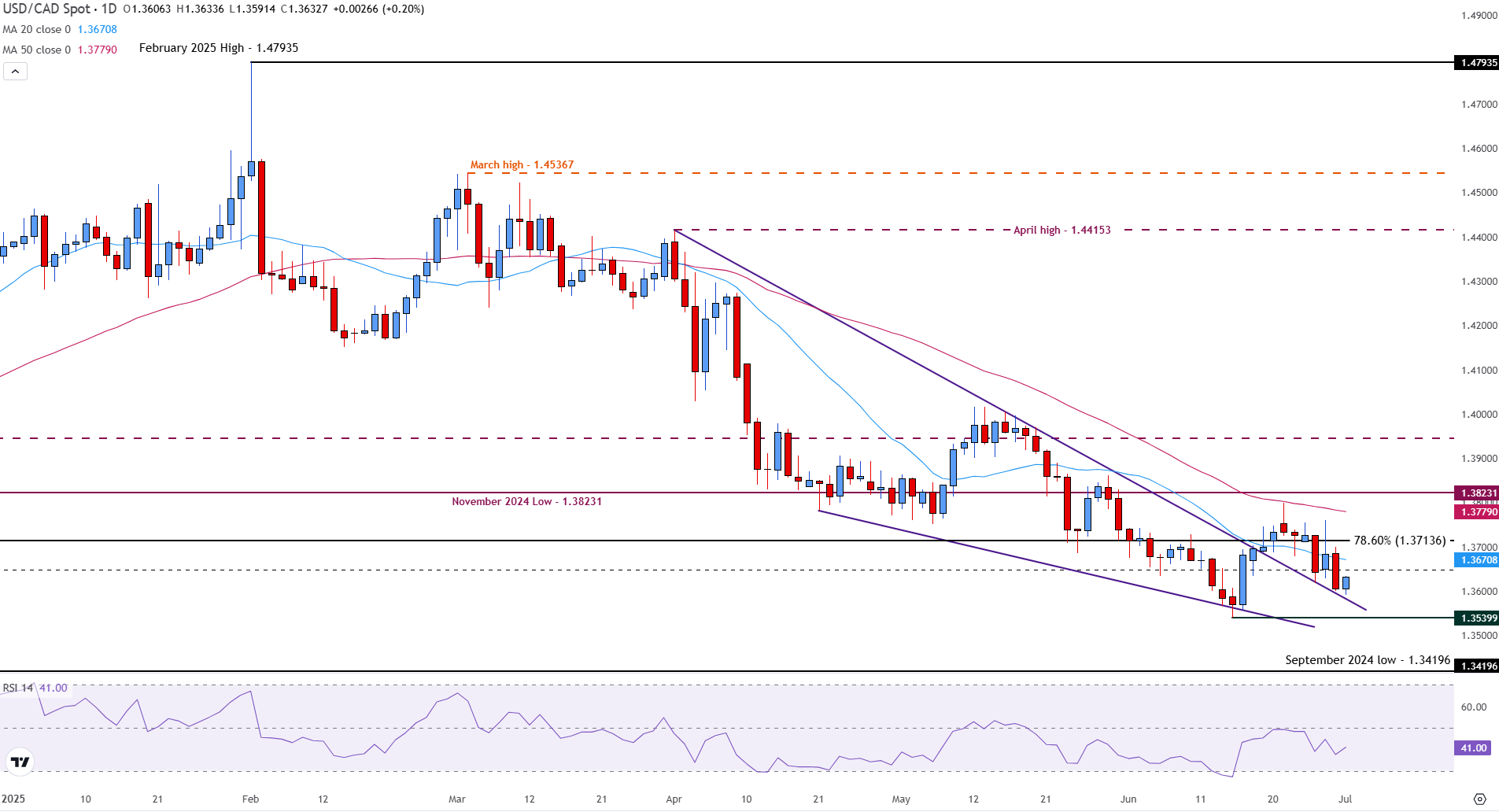
Key resistance levels to watch include the 78.6% Fibonacci level of the September-February uptrend, located at 1.3714. The 20-day and 50-day SMAs are situated above, followed by the November low at 1.3823.
The Relative Strength Index (RSI) at 40 is reinforcing bearish momentum without entering oversold territory.
A sustained move above 1.3670, particularly beyond the 50-day SMA, would be needed to shift the short-term outlook to bullish.
US Dollar FAQs
The US Dollar (USD) is the official currency of the United States of America, and the ‘de facto’ currency of a significant number of other countries where it is found in circulation alongside local notes. It is the most heavily traded currency in the world, accounting for over 88% of all global foreign exchange turnover, or an average of $6.6 trillion in transactions per day, according to data from 2022. Following the second world war, the USD took over from the British Pound as the world’s reserve currency. For most of its history, the US Dollar was backed by Gold, until the Bretton Woods Agreement in 1971 when the Gold Standard went away.
The most important single factor impacting on the value of the US Dollar is monetary policy, which is shaped by the Federal Reserve (Fed). The Fed has two mandates: to achieve price stability (control inflation) and foster full employment. Its primary tool to achieve these two goals is by adjusting interest rates. When prices are rising too quickly and inflation is above the Fed’s 2% target, the Fed will raise rates, which helps the USD value. When inflation falls below 2% or the Unemployment Rate is too high, the Fed may lower interest rates, which weighs on the Greenback.
In extreme situations, the Federal Reserve can also print more Dollars and enact quantitative easing (QE). QE is the process by which the Fed substantially increases the flow of credit in a stuck financial system. It is a non-standard policy measure used when credit has dried up because banks will not lend to each other (out of the fear of counterparty default). It is a last resort when simply lowering interest rates is unlikely to achieve the necessary result. It was the Fed’s weapon of choice to combat the credit crunch that occurred during the Great Financial Crisis in 2008. It involves the Fed printing more Dollars and using them to buy US government bonds predominantly from financial institutions. QE usually leads to a weaker US Dollar.
Quantitative tightening (QT) is the reverse process whereby the Federal Reserve stops buying bonds from financial institutions and does not reinvest the principal from the bonds it holds maturing in new purchases. It is usually positive for the US Dollar.
Author

Tammy Da Costa, CFTe®
FXStreet
Tammy is an economist and market analyst with a deep passion for financial markets, particularly commodities and geopolitics.