USD/CAD Price Forecast: Bulls retain control near 1.3880 area, highest since May 21
- USD/CAD sticks to positive bias for the third straight day amid the divergent Fed-BoC expectations.
- This week’s breakout through the 100-day SMA favors bulls and backs the case for additional gains.
- Any meaningful corrective pullback might now be seen as a buying opportunity and remain limited.

The USD/CAD pair trades with a positive bias for the third consecutive day on Thursday and hovers near the 1.3880 region, or its highest level since May 21, during the Asian session.
The hawkish FOMC Minutes released on Wednesday act as a tailwind for the US Dollar (USD). Furthermore, the Bank of Canada's (BoC) dovish tilt offsets a modest uptick in Crude Oil prices and continues to weigh on the Canadian Dollar (CAD), which is seen lending additional support to the USD/CAD pair.
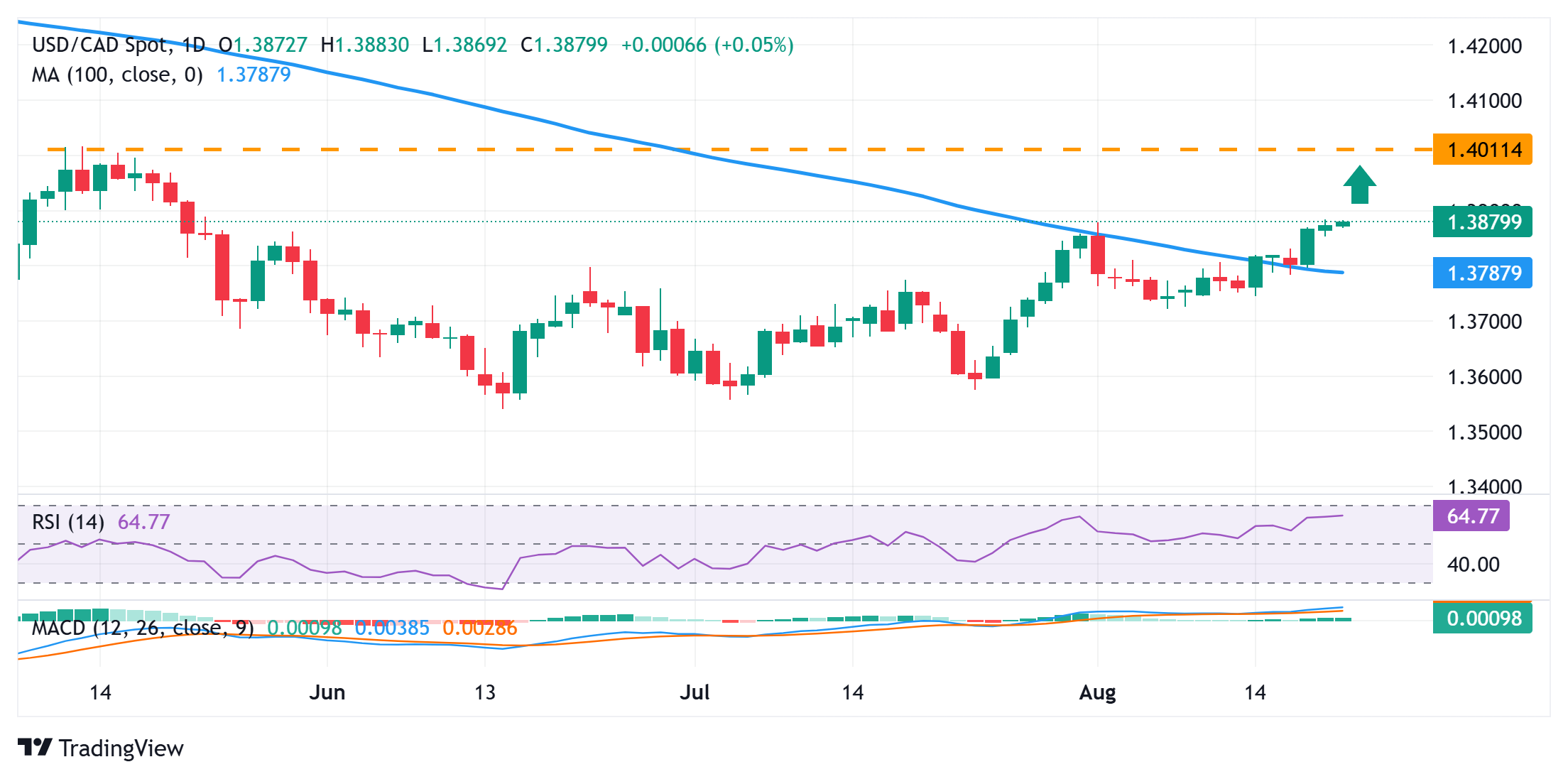
From a technical perspective, this week's breakout through the 100-day Simple Moving Average (SMA) and the 1.3800 round figure favors bullish traders. Moreover, oscillators on the daily chart are holding in positive territory and suggest that the path of least resistance for the USD/CAD pair remains to the upside.
Some follow-through buying beyond the 1.3900 mark will reaffirm the constructive outlook and lift spot prices further towards the 1.3950 intermediate hurdle en route to the 1.4000 psychological mark. This is followed by May swing high, around the 1.4015 region, which, if cleared, would be seen as a fresh trigger for bulls.
On the flip side, the overnight swing low, around the 1.3855-1.3850 region, now seems to protect the immediate downside. Any further pullback might now be seen as a buying opportunity and is more likely to remain limited near the 1.3800 mark. This is followed by the 100-day SMA, around the 1.3790 region.
A convincing break below the latter might prompt some technical selling and make the USD/CAD pair vulnerable to extend the fall towards the 1.3755-1.3750 horizontal zone, the 1.3720 region, and the 1.3700 mark. Failure to defend the said support levels could shift the near-term bias back in favor of bearish traders.
USD/CAD daily chart
Canadian Dollar FAQs
The key factors driving the Canadian Dollar (CAD) are the level of interest rates set by the Bank of Canada (BoC), the price of Oil, Canada’s largest export, the health of its economy, inflation and the Trade Balance, which is the difference between the value of Canada’s exports versus its imports. Other factors include market sentiment – whether investors are taking on more risky assets (risk-on) or seeking safe-havens (risk-off) – with risk-on being CAD-positive. As its largest trading partner, the health of the US economy is also a key factor influencing the Canadian Dollar.
The Bank of Canada (BoC) has a significant influence on the Canadian Dollar by setting the level of interest rates that banks can lend to one another. This influences the level of interest rates for everyone. The main goal of the BoC is to maintain inflation at 1-3% by adjusting interest rates up or down. Relatively higher interest rates tend to be positive for the CAD. The Bank of Canada can also use quantitative easing and tightening to influence credit conditions, with the former CAD-negative and the latter CAD-positive.
The price of Oil is a key factor impacting the value of the Canadian Dollar. Petroleum is Canada’s biggest export, so Oil price tends to have an immediate impact on the CAD value. Generally, if Oil price rises CAD also goes up, as aggregate demand for the currency increases. The opposite is the case if the price of Oil falls. Higher Oil prices also tend to result in a greater likelihood of a positive Trade Balance, which is also supportive of the CAD.
While inflation had always traditionally been thought of as a negative factor for a currency since it lowers the value of money, the opposite has actually been the case in modern times with the relaxation of cross-border capital controls. Higher inflation tends to lead central banks to put up interest rates which attracts more capital inflows from global investors seeking a lucrative place to keep their money. This increases demand for the local currency, which in Canada’s case is the Canadian Dollar.
Macroeconomic data releases gauge the health of the economy and can have an impact on the Canadian Dollar. Indicators such as GDP, Manufacturing and Services PMIs, employment, and consumer sentiment surveys can all influence the direction of the CAD. A strong economy is good for the Canadian Dollar. Not only does it attract more foreign investment but it may encourage the Bank of Canada to put up interest rates, leading to a stronger currency. If economic data is weak, however, the CAD is likely to fall.
Author

Haresh Menghani
FXStreet
Haresh Menghani is a detail-oriented professional with 10+ years of extensive experience in analysing the global financial markets.

















