|

USD/CAD Price Analysis: Prints mild losses around 1.2650 on immediate support break

  • USD/CAD markets heaviest losses in one week, fades bounce off intraday low.
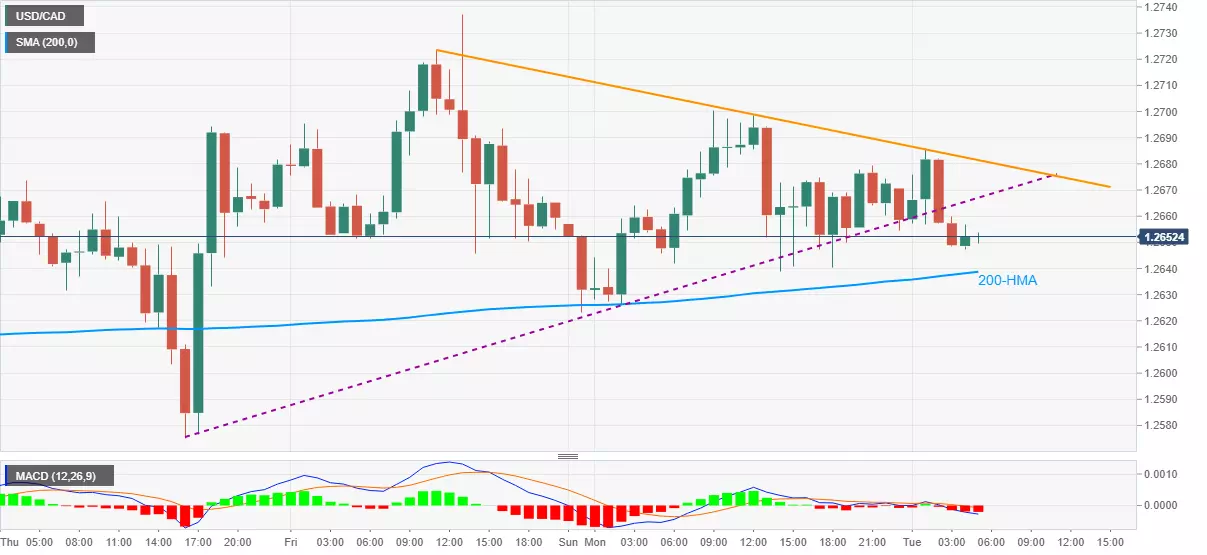
  • Bearish MACD, sustained break of three-day-old support line directs bears toward 200-HMA.
  • Descending trend line from Friday adds to the upside barriers.

USD/CAD remains depressed near 1.2650, down 0.21% intraday, after breaking an upward sloping trend line from the last Thursday during early Tuesday’s Asian session.

Although the bearish MACD cooperates with the trend line breakdown to keep the sellers hopeful, the 200-HMA level of 1.2638 seems to probe the pair’s further downside.

Should the USD/CAD bears take clues from the recent US dollar weakness, in contrast to the WTI strength, the quote may not only have to break the 1.2600 threshold but also refresh the monthly low of 1.2575 before revisiting the multi-month low marked in February around 1.2470.

On the flip side, corrective pullback beyond the previous support line, at 1.2665 now, may fizzle to cross a short-term resistance line near 1.2680, which if crossed will eye the monthly peak surrounding 1.2740.

Overall, USD/CAD stays bearish while the latest breakdown of the support line adds favor to the sellers.

USD/CAD hourly chart
Trend: Bearish

Additional important levels

Overview
Today last price1.265
Today Daily Change-26 pips
Today Daily Change %-0.21%
Today daily open1.2676
 
Trends
Daily SMA201.2655
Daily SMA501.2706
Daily SMA1001.285
Daily SMA2001.3103
 
Levels
Previous Daily High1.27
Previous Daily Low1.2623
Previous Weekly High1.274
Previous Weekly Low1.2575
Previous Monthly High1.287
Previous Monthly Low1.2468
Daily Fibonacci 38.2%1.2671
Daily Fibonacci 61.8%1.2653
Daily Pivot Point S11.2633
Daily Pivot Point S21.2589
Daily Pivot Point S31.2555
Daily Pivot Point R11.271
Daily Pivot Point R21.2744
Daily Pivot Point R31.2787

Author

Anil Panchal

Anil Panchal

FXStreet

Anil Panchal has nearly 15 years of experience in tracking financial markets. With a keen interest in macroeconomics, Anil aptly tracks global news/updates and stays well-informed about the global financial moves and their implications.


More from Anil Panchal
Share:

Editor's Picks

GBP/USD: Daily gains remain capped by 1.3650

GBP/USD leaves behind Monday’s pessimism and advances marginally on Tuesday. Cable’s humble gains, however, appear to have met quite a decent resistance in the 1.3650 zone for now, in a context of a slight selling pressure hovering around the Greenback.

EUR/USD struggles to regain pace; gyrates around 1.1670

EUR/USD clinches humble gains around 1.1670 following Tuesday’s close on Wall Street. Indeed, marginal losses in the US Dollar encourages spot to set aside two dauly pullbacks in a row and maintain the 1.1700 barrier on the cross-hairs for now. Moving forward, US inflation tracked by the PCE and another revision of Q2 GDP data should keep investors entertained on Wednesday.

Gold: Buyers still hold the grip

Gold navigates the middle of its daily range near $4,650 per troy ounce on Tuesday. The lack of clear direction in the yellow metal comes on the back of the widespread cautious tone among market participants, a mildly offered stance in the US Dollar and a marked decline in US Treasury yields across the curve.

Australia CPI expected to show inflation easing in July
The Australian Bureau of Statistics (ABS) will publish the July Consumer Price Index (CPI) on Wednesday at 01:30 GMT. The report is expected to show that inflation rose 3.2% from a year earlier, easing from the 3.8% posted in June. The monthly CPI, however, is forecast at 0.8% following the -0.1% print from the previous month.
Canada hits US goods with tariffs; The rate market sees a problem
On September 8, Canada begins charging its own importers 15%, 25% and 50% on roughly 700 lines of American goods. The measure is billed as dollar for dollar, and on the arithmetic of covered trade it is. What it is not is a tax on the United States.
Canada hits US goods with tariffs; The rate market sees a problem
On September 8, Canada begins charging its own importers 15%, 25% and 50% on roughly 700 lines of American goods. The measure is billed as dollar for dollar, and on the arithmetic of covered trade it is. What it is not is a tax on the United States.