USD/CAD price analysis: Consolidation holds below 1.3900 as Fed and trade policy risks loom
- USD/CAD holds steady near 1.3800 after hitting a six-month low.
- Trump’s softened stance on Powell and China brings brief USD relief.
- Technical outlook remains bearish despite modest intraday gains.

The USD/CAD pair trades modestly higher around 1.3800 during Wednesday’s North American session, bouncing within a tight range after testing six-month lows earlier in the week. The Canadian Dollar (CAD) is largely unchanged on the session as traders digest recent developments, including fresh PMI data and cautious optimism around easing trade tensions.
President Donald Trump’s remarks late Tuesday sparked a brief USD recovery after he ruled out firing Federal Reserve (Fed) Chair Jerome Powell and signaled a potential reduction in tariffs on China. While the comments helped lift the US Dollar in early Asian trade, the bounce faded as markets reassessed lingering risks to Fed credibility and US-China relations. Meanwhile, a preliminary S&P Global Composite PMI reading showed a slowdown in US business activity, with the index falling to 51.2 from 53.5 in March. The Services PMI fell sharply to 51.4, while manufacturing output edged up to 50.7.
On the Canadian side, the CAD remains stable, supported by firm equity markets and hopes that tariff volatility may subside. However, traders await Friday’s Canadian Retail Sales report for further direction.
USD/CAD Technical Analysis
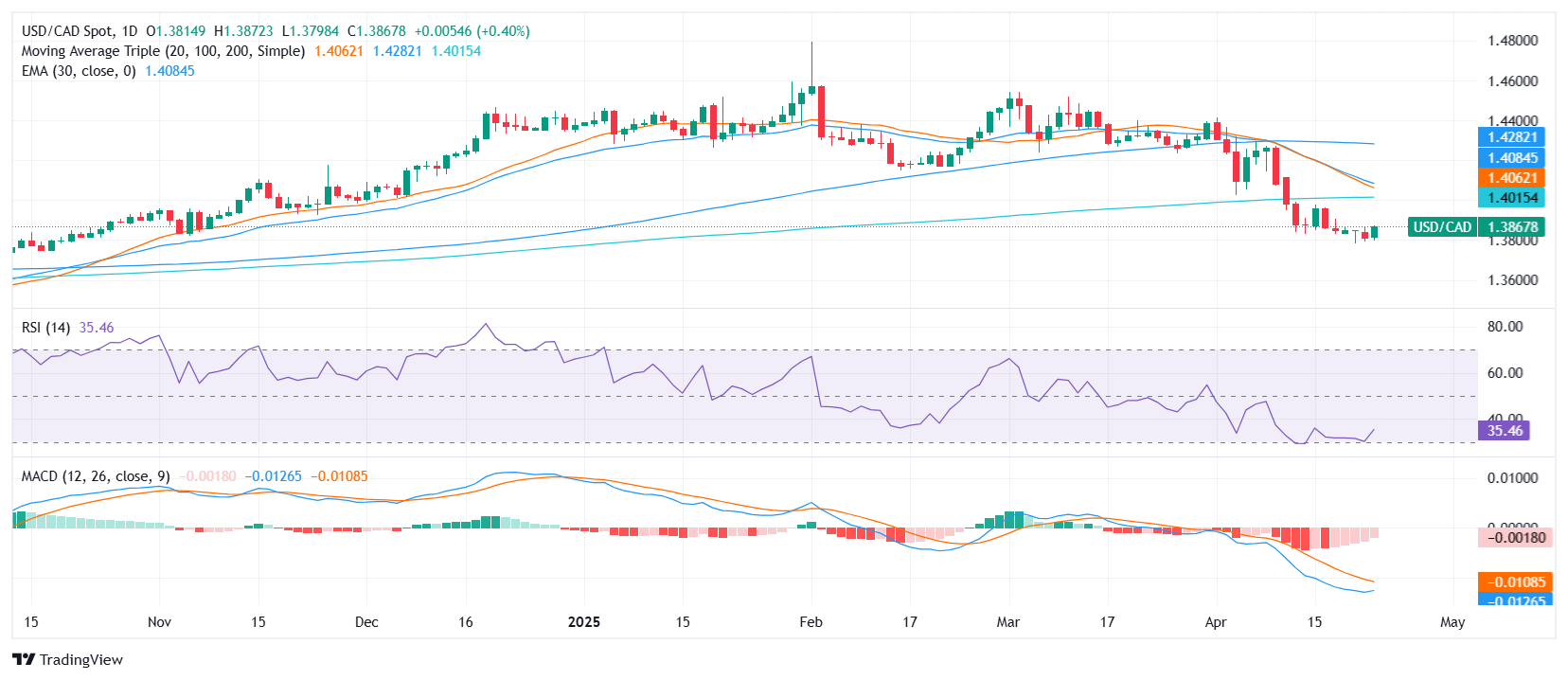
Technically, USD/CAD maintains a bearish structure despite today’s mild uptick. The pair trades within a daily range of 1.3798 to 1.3861. Momentum (10) at −0.02398 shows a buy bias, but the Moving Average Convergence Divergence (MACD) indicator still prints a sell signal, and the Bull Bear Power indicator remains neutral. The Relative Strength Index (RSI) sits at 33.94, hovering near oversold territory. Moving averages reinforce the downtrend: the 20-day SMA (1.4060), 100-day SMA (1.4274), and 200-day SMA (1.4008) all point lower, with added pressure from the 10-day EMA (1.3903) and 10-day SMA (1.3872). Resistance stands at 1.3872, 1.3903, and 1.4008, while immediate support is seen at 1.3813.
Unless fundamental momentum shifts decisively in favor of the USD, USD/CAD is likely to remain capped below 1.3900 with a bias toward retesting the 1.3745–1.3780 support zone.
Author

Patricio Martín
FXStreet
Patricio is an economist from Argentina passionate about global finance and understanding the daily movements of the markets.