USD/CAD dives as the Canadian Dollar rides on higher oil prices, soft USD
- USD/CAD made a U-turn after hitting a daily high of 1.3567 due to overall US Dollar weakness.
- The risk-on impulse and higher oil prices underpinned the Canadian Dollar.
- Canadian housing started increasing by 22% in April, with total units rising to 261,600.

USD/CAD makes a U-turn after hitting a daily high of 1.3567 due to overall US Dollar (USD) weakness, spurred by a risk-on impulse and higher oil prices underpinning the Canadian Dollar (CAD). In addition, the release of Canadian inflation looming keeps investors nervous after the Bank of Canada (BoC) left the door open for further rate increases at their minutes release. At the time of writing, the USD/CAD is trading at around 1.3480s, with losses of 0.50%.
Canadian Housing Starts Increase by 22% in April
Data from Canada underpinned the Loonie (CAD), which stages a recovery below the 1.3500 mark. The Canadian Wholesale Trader Sales dropped to -0.1%, above estimates for a -0.4% plunge. In addition, oil prices continued to extend their gains of more than 1.90%, a headwind for the USD/CAD.
Further data showed that Canadian housing starts increased by 22% in April, with total units rising to 261,600 units, from a revised 213,800 in March, as the Canadian Mortgage and Housing Corporation revealed. USD/CAD traders brace for the release of the Consumer Price Index (CPI) on Tuesday, estimated at 0.4% MoM and 4.3% annually based.
On the US front, the docket revealed the New York Empire State Manufacturing Index disappointed investors, plummeting to -31.3 vs. the -3.9 estimated. The data showed that nearly 50% of respondents to the survey said business conditions worsened. The orders index slid, while a gauge of prices showed an increase, and the employment component shrank.
Even though the data was negative and painted a gloomy economic outlook, the labor market shows signs of easing, according to the NY Fed survey. Still, a gauge for price uptick suggests that further Fed action could be needed.
The US debt ceiling continues to grab the headlines. US President Joe Biden commented that talks were “moving along,” while Lael Brainard, the National Economic Director, commented that negotiations were serious and constructive.
In the central bank front, two Fed speakers pushed back against cutting rates in 2024 while emphasizing that inflation is high and that the fast-hiking campaign is still working its way through the economy. In the meantime, on the hawkish spectrum, Minnesota’s Fed President Neil Kashkari emphasized that inflation is much too high, though he commented that it’s slowing down. He added that the US central bank should not be fooled by a few months of data, adding that the Fed has more work to do.
USD/CAD Price Forecast: Technical outlook
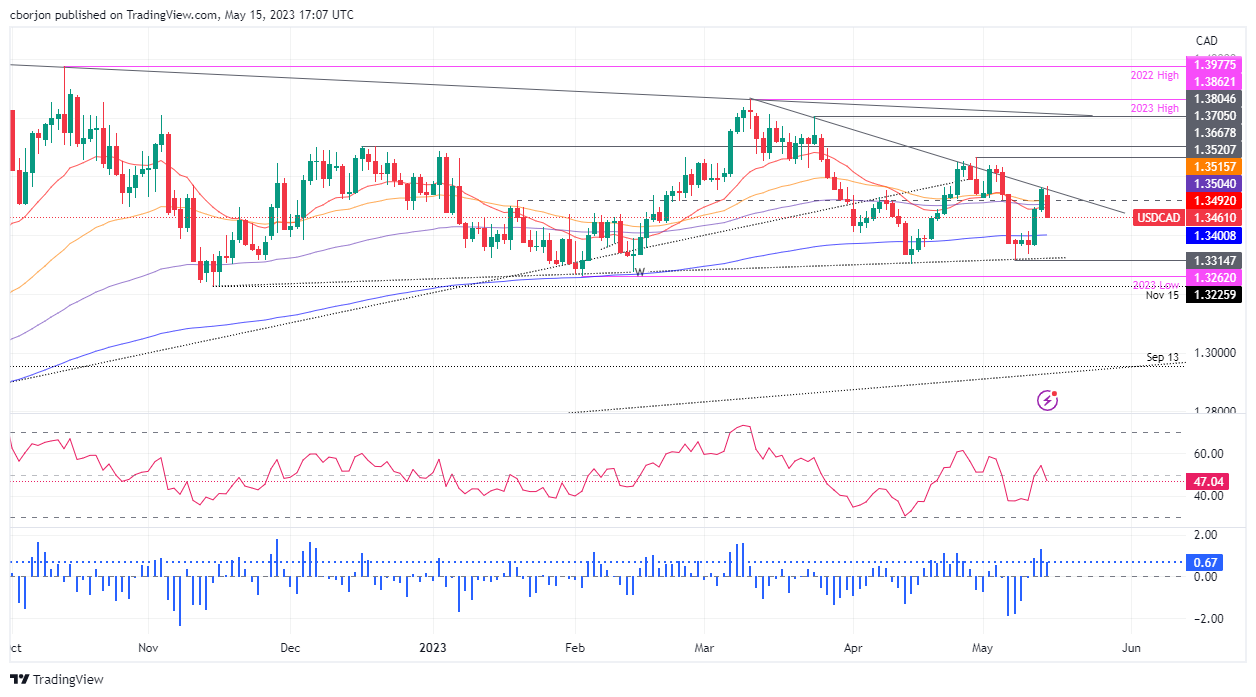
After piercing a downslope resistance trendline at around 1.3550-70, the USD/CAD has retraced and traded below the May 12 daily low of 1.3477, conquering on its way south, the 50, 100, and 20-day Exponential Moving Averages (EMAs). Despite that, the USD/CAD remains neutrally biased as the 200-day EMA continues to act as support at around 1.3400. if USD/CAD extends its losses past the latter, the May 8 daily low of 1.3314 will be exposed. A breach of the latter, the USD/CAD would continue to test the YTD lows of 1.3262.
Author

Christian Borjon Valencia
FXStreet
Markets analyst, news editor, and trading instructor with over 14 years of experience across FX, commodities, US equity indices, and global macro markets.