US500 retests key support as CPI and geopolitical risks loom

The US500 broke above 7,625 on August 4, clearing a resistance level that had prevented price from moving higher following the strong recovery from 6,358 in late March. The market tested 7,625 at least three times, with sellers defending the level on each occasion until the breakout in early August.
The same level was tested as support on September 2, with buyers pushing the index from around 7,630 to 7,764.50 before the recovery lost momentum.
Price has now declined to test the 7,635 support region again following further escalation in the US-Iran conflict. The United States struck five Iranian tankers earlier this week, while Iran claimed it attacked several ship near the Strait of Hormuz in retaliation. These developments have pushed WTI crude above $96 per barrel and Brent above $100, increasing concerns about inflation and the wider economic effect of the conflict.
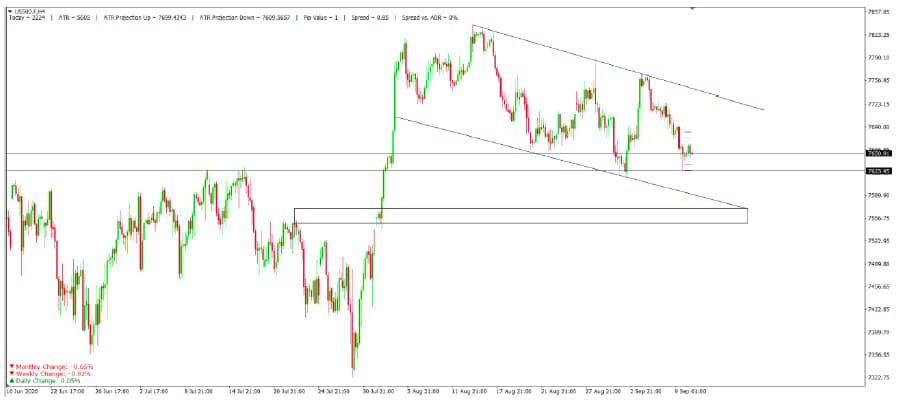
The 7,625 region is holding for now, but the support could eventually give way if the negative market conditions persist.
Price has traded within a descending channel since August 13, rising from the lower boundary of the channel and falling whenever it approaches the upper boundary. Sellers are currently in control after pushing the index down from 7,764.50.
A sustained break below 7,625 would expose the lower boundary of the channel and the next support region around 7,580. A break below both levels would strengthen the case for a medium-term decline, although that remains to be seen.
Current fundamentals
The US Consumer Price Index report could give sellers another reason to push prices lower, but this would depend on an upside surprise in inflation and a further increase in expectations for the Federal Reserve to raise interest rates, not only in September but potentially again later in the year.
According to CME FedWatch, the market currently assigns a 62.4% probability to a 25-basis-point rate hike in September, while the probability of the Federal Reserve leaving rates unchanged stands at 37.6%.
A stronger-than-expected CPI report, higher rate-hike expectations, continued escalation in the US-Iran conflict and elevated Treasury yields could provide enough support for sellers to break below 7,625 and potentially 7,580.
In the event of a lower-than-expected CPI print and reduced expectations for further rate hikes, buyers could temporarily stall the decline and push the index higher from the available support levels. However, the US500 is expected to remain on edge as the US-Iran conflict continues to weigh heavily on market sentiment.
The key event to watch remains the US CPI report. Headline monthly inflation is expected to rise by 0.4%, while core inflation is expected at 0.2%.
Headline inflation could attract greater attention than usual because the increase in oil prices has renewed concerns about energy-driven inflation. However, the core reading will remain important in determining whether price pressures are spreading more broadly across the economy.
Judging by the recent trend, this could be another release that produces only a temporary market reaction if the figures come in close to expectations. Attention would then turn towards the Federal Reserve’s interest-rate decision on Wednesday, September 16.
If that happens, the technical structure, movements in US Treasury yields and developments in the US-Iran conflict would remain the main driving forces for the US500. For now, 7,625 is the first support level to watch, followed by 7,580. A sustained break below both levels would confirm that sellers have taken firmer control of the market.
Author

Olalekan Akinola
Independent Analyst
Olalekan Akinola is a financial-markets analyst and writer with five years of experience covering forex, commodities, and global macroeconomic developments.