Jobs opened the door for the Fed — inflation decides whether it walks through
The latest US jobs report did not end the debate over the Federal Reserve’s (Fed) next move. It may have done something more subtle: it gave policymakers permission to keep their options open.
After months of softer labour market signals, August delivered a stronger-than-expected rebound. Indeed, Nonfarm Payrolls (NFP) showed the US economy added 162K jobs last month, nearly tripling expectations, while the Unemployment Rate held steady at 4.1%. In addition, June and July also saw a combined 55K jobs added, making the report harder to dismiss as a one-off statistical bounce.
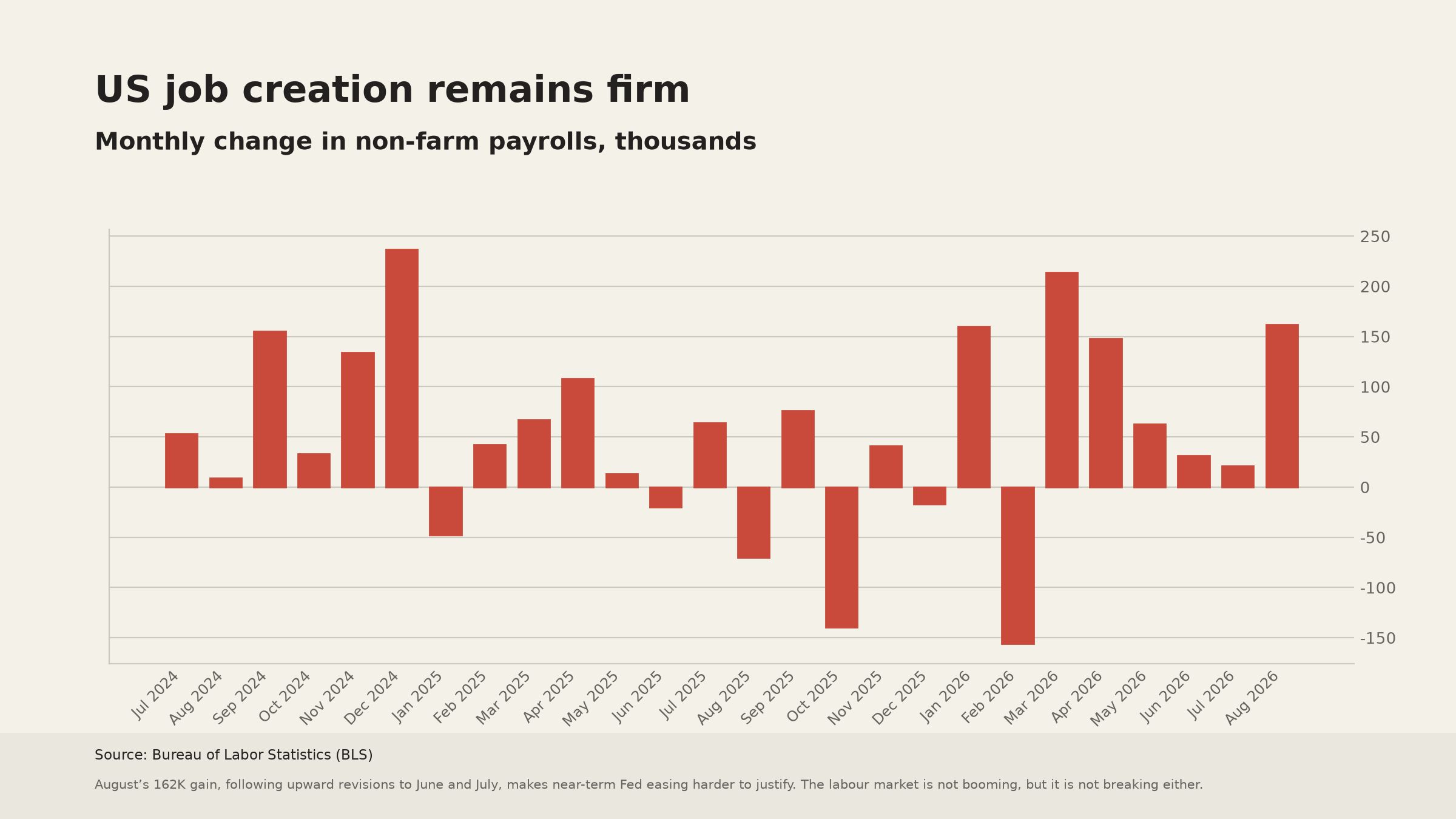
That matters for the Fed because a resilient labour market weakens the case for near-term rate cuts. If the economy is still creating jobs, unemployment is not rising and labour-force participation is improving, policymakers have less reason to rush toward easing. The report does not automatically force another rate hike, but it reduces the urgency to provide relief.
A firm labour market, but not a wage scare
The more interesting part, however, is that the jobs report was not uniformly hawkish. Wage growth remained contained, with Average Hourly Earnings rising 0.3% from a month earlier and 3.1% over the last 12 months. That was enough to show workers are still seeing pay gains, but not enough to revive fears of a wage-price spiral. In other words, the labour market looked solid, but not dangerously overheated.
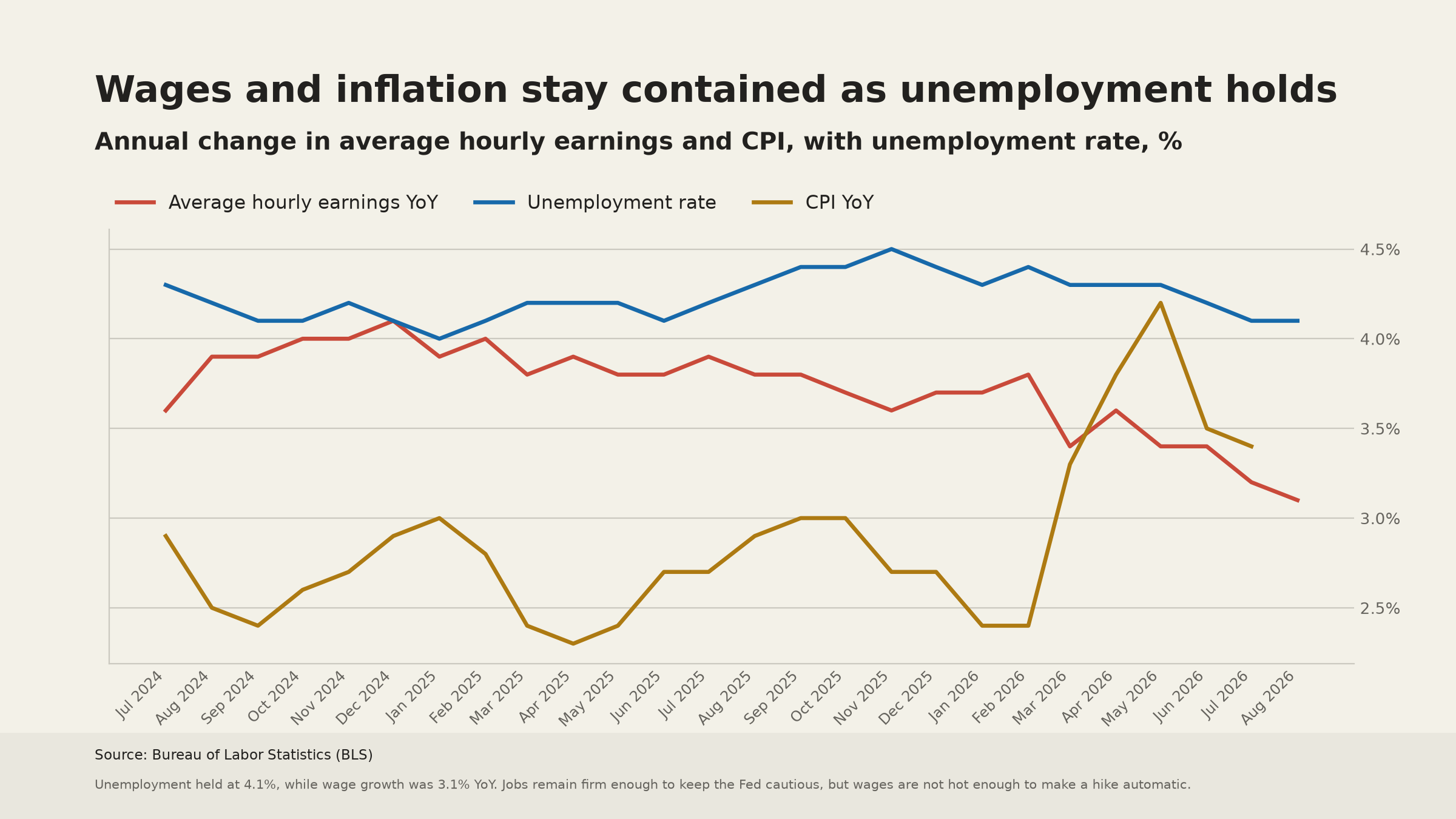
That leaves the Fed in a familiar but uncomfortable position. Employment is no longer weak enough to justify cuts, but wages are not hot enough to make a hike inevitable. The decisive variable is now inflation.
The US Producer Price Index (PPI) gets released on Thursday during the American session, while the all-important Consumer Price Index (CPI) arrives on Friday.
Markets lean hawkish, but the call is not settled
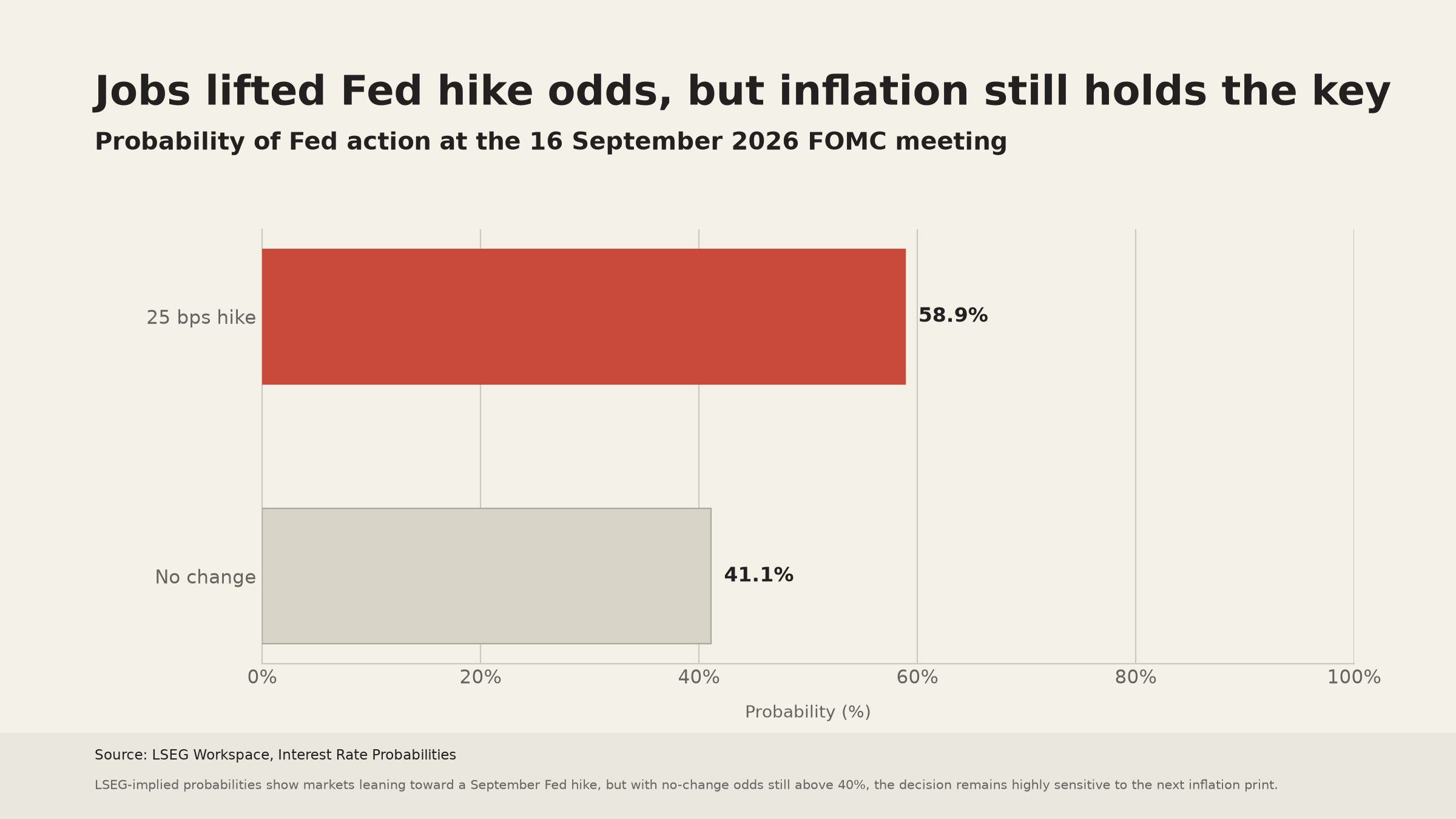
Markets appear to have reached the same conclusion: rate-hike expectations rose after the payrolls release, with futures pricing assigning a higher probability to a Fed move at the September 15-16 meeting. Treasury yields also moved higher after the report, while Gold came under pressure as investors reassessed the likelihood of tighter-for-longer policy.
Inflation now owns the Fed decision
But this is precisely why the upcoming inflation figures matter so much. A strong jobs report gives the Fed cover to stay restrictive. It does not tell the Fed whether policy is restrictive enough. That answer will come from prices, not payrolls.
The timing is important. Investors are now looking to the next US inflation data to decide whether September becomes a live hike meeting or another pause dressed in hawkish language. A firmer CPI print for August would strengthen the case for action, especially if energy prices and supply-side pressures continue to feed into headline inflation. A softer print, by contrast, could allow the Fed to argue that patience remains the better option.
That distinction is crucial: the jobs report gave the Fed an opportunity, but inflation will determine whether it takes it.
The Dollar may not get a clean Fed boost
For the US Dollar (USD), the message is also less straightforward than usual. Strong payrolls and higher Fed-hike odds would normally offer clear support to the Greenback. Yet the US Dollar’s response has been uneven, partly because other central banks are also leaning more hawkishly.
The Bank of Japan (BoJ) remains under pressure to tighten, while the European Central Bank (ECB) is also being watched closely as inflation risks persist. That reduces the policy divergence impulse that would usually amplify a strong US jobs report.
The bond market may do some of the Fed’s work
The bond market might, therefore, be the cleaner transmission channel. If inflation remains sticky and the labour market refuses to crack, Treasury yields may have room to remain elevated. That would reinforce tighter financial conditions even without an immediate Fed hike. In that sense, the Fed may not need to do much for policy to tighten; markets can do some of the work themselves.
There is also a more nuanced message beneath the headline payroll gain. Job creation was supported by areas such as leisure and hospitality, local government education, construction and healthcare, while some white-collar sectors, including information and finance, remained under pressure. That suggests the labour market is still resilient in aggregate but increasingly uneven beneath the surface.
That matters because the Fed does not set policy for one sector. It sets policy for the whole economy. A labour market that is strong enough at the headline level but uneven below the surface gives officials a narrow path to walk. Tighten too much and the weaker parts of the economy may deteriorate quickly. Do too little and inflation expectations could become harder to control.
Payrolls opened the door, but CPI gets the final vote
For now, the latest jobs report has tilted the debate in a hawkish direction. It has made rate cuts harder to justify, increased the chance of another hike and reminded markets that the US “exceptionalism” remains well and sound.
But it has not settled the question.
The next move from the Fed will depend less on whether Americans are still finding jobs and more on whether inflation is still finding ways to surprise.
Payrolls gave policymakers room to act.
The CPI will tell them whether they need to use it.
Author

Pablo Piovano
FXStreet
Born and bred in Argentina, Pablo has been carrying on with his passion for FX markets and trading since his first college years.