XRP dips below $1.40 despite growing ETF demand
- XRP ticks lower and trades below $1.40, aligning with the broader cryptocurrency market's fragile outlook.
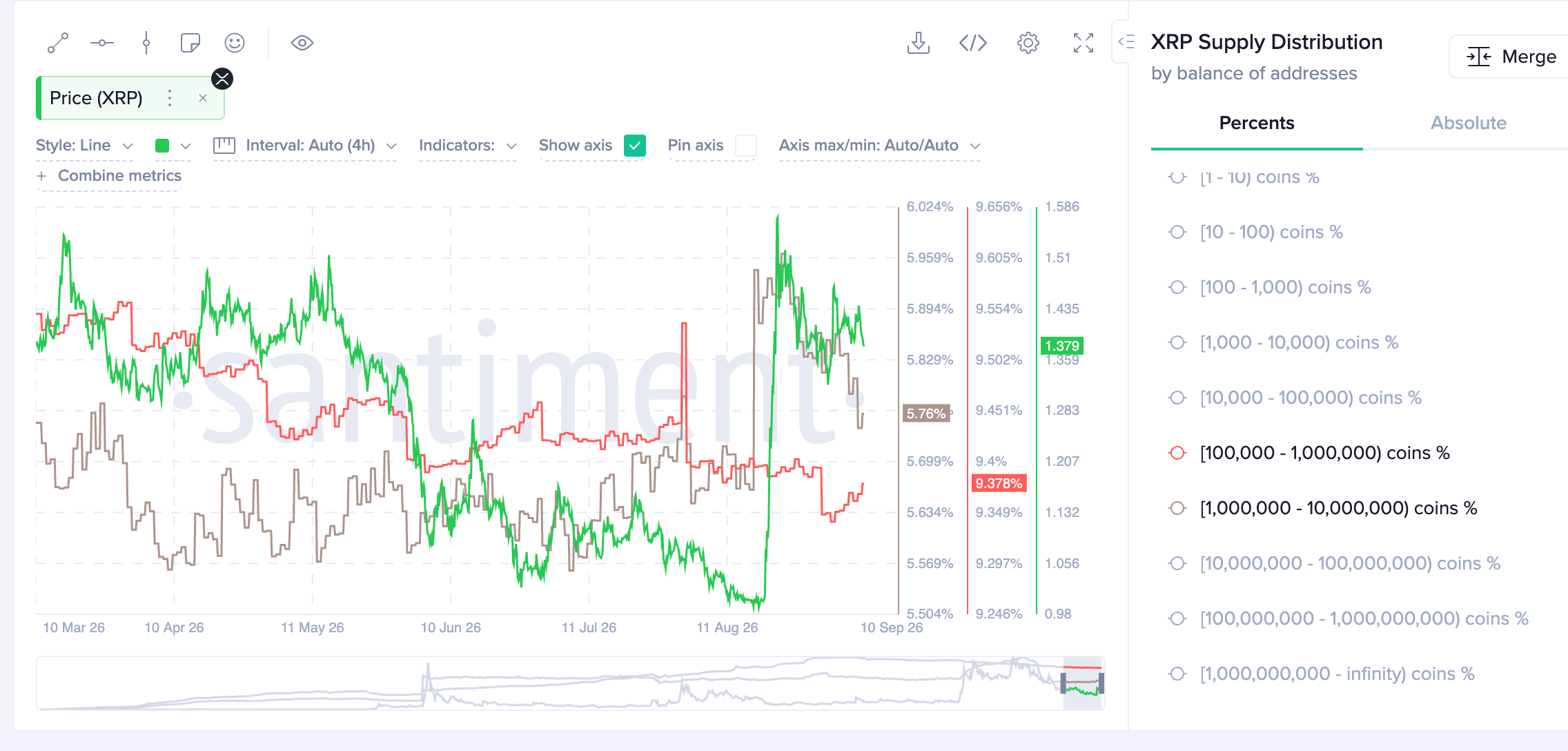
- Large-volume investors increase exposure as XRP wobbles, while addresses holding between 100K and 1M tokens account for 9.4% of the total supply.
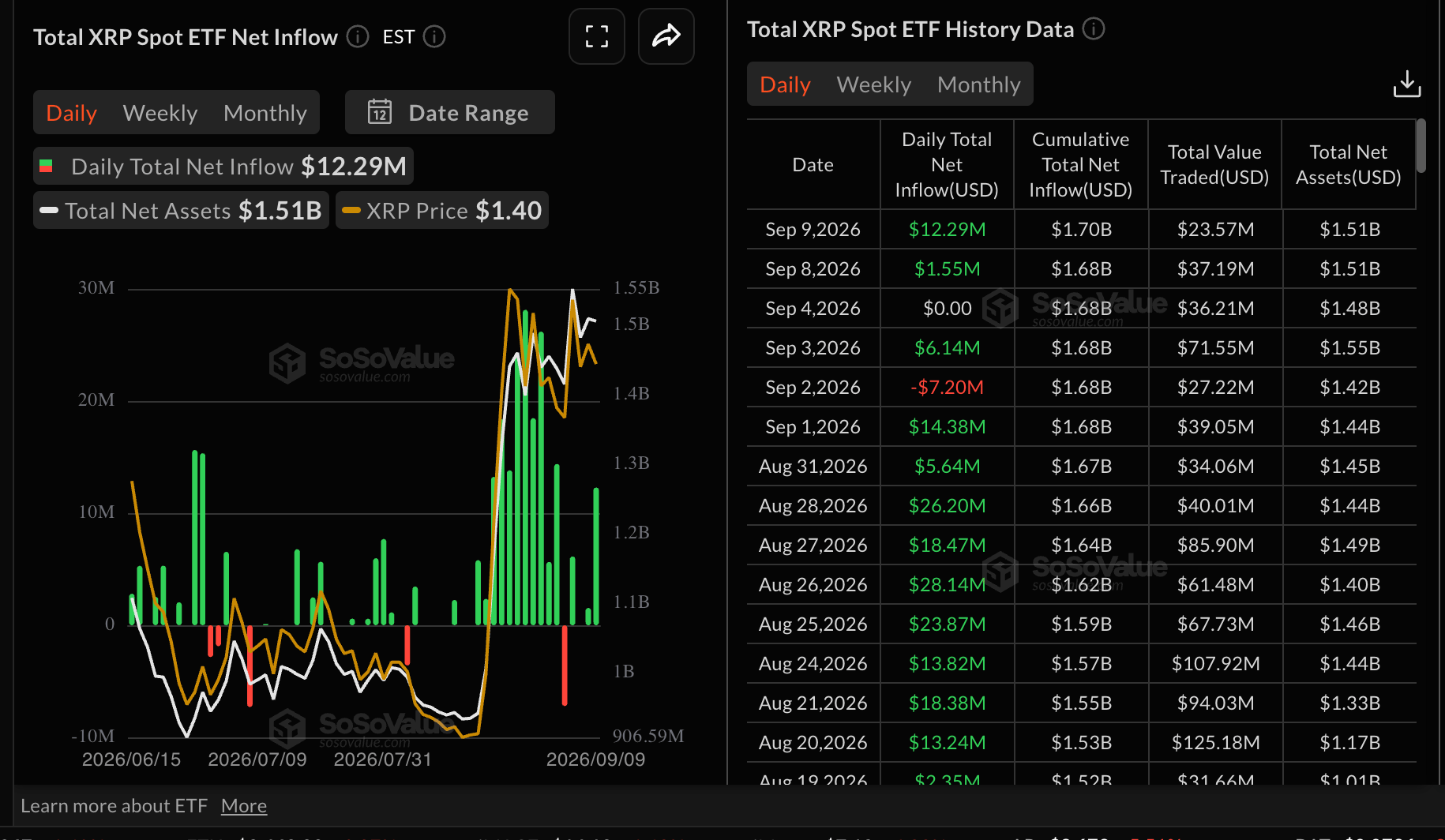
- XRP institutional demand through US-listed ETFs rises, with inflows reaching $12 million on Wednesday.

Ripple (XRP) falls for the second straight day, trading at $1.37 on Thursday. The broader cryptocurrency market remains fragile as investors weigh the impact of geopolitical tensions in the Middle East, which triggered persistent increases in Crude Oil prices while restricting shipping through the Straight of Hormuz and the Red Sea.
Attention has also shifted toward the release of the Consumer Price Index (CPI) report by the United States (US) Bureau of Labor Statistics (BLS) on Friday, which could shape the Federal Reserve’s (Fed) monetary policy decision next Wednesday.
The crypto market remains highly sensitive to shifts in US macroeconomic expectations. A higher-than-expected CPI report would indicate that inflation is a concern in the world’s largest economy, raising the odds that the central bank will hike interest rates. On the other hand, a softer-than-expected CPI report would reinforce the case for leaving rates unchanged, or for easing monetary policy.
“With the FOMC approaching, Thursday’s PPI and Friday’s CPI releases are key volatility catalysts, while the September 15 Senate cloture vote on the CLARITY Act adds a crypto-specific risk event,” a K33 Research report states.
XRP records growing capital inflows
Interest in XRP has stayed relatively intact since the rally to $1.70 in August. This is reflected in the increase in supply held by wallets with between 100,000 and 1 million XRP. This cohort accounted for roughly 9.4% of the total circulating supply on Thursday, up from about 9.3% on September 3. Despite the cohort with between 1 million and 10 million XRP selling to realize gains after the surge from $1.00 to $1.70, the current outlook appears to have stabilized at 5.8% of the total supply. Sustained demand for XRP is needed to strengthen the tailwind and open the door to stronger breakout attempts.
Institutional demand for US-listed spot Exchange-Traded Funds (ETFs) is also steady, as it increased to roughly $12 million on Wednesday, from $1.5 million the previous day. Cumulative inflows are gradually growing, averaging $1.7 billion, with net assets under management at $1.5 billion.
Technical Analysis: XRP eyes 200-day EMA support
XRP trades above $1.37, maintaining a constructive near-term bias despite an ongoing retreat from the August peak of $1.70. Meanwhile, the token holds above the key Exponential Moving Averages (EMAs), with the 200-day EMA offering immediate dynamic support around $1.36.
The Relative Strength Index (RSI) hovers in the mid-50s, hinting at balanced but slightly positive momentum, while the Moving Average Convergence Divergence (MACD) has slipped into negative territory, suggesting the recent pullback remains corrective rather than a full trend reversal as long as price stays above the main EMAs.
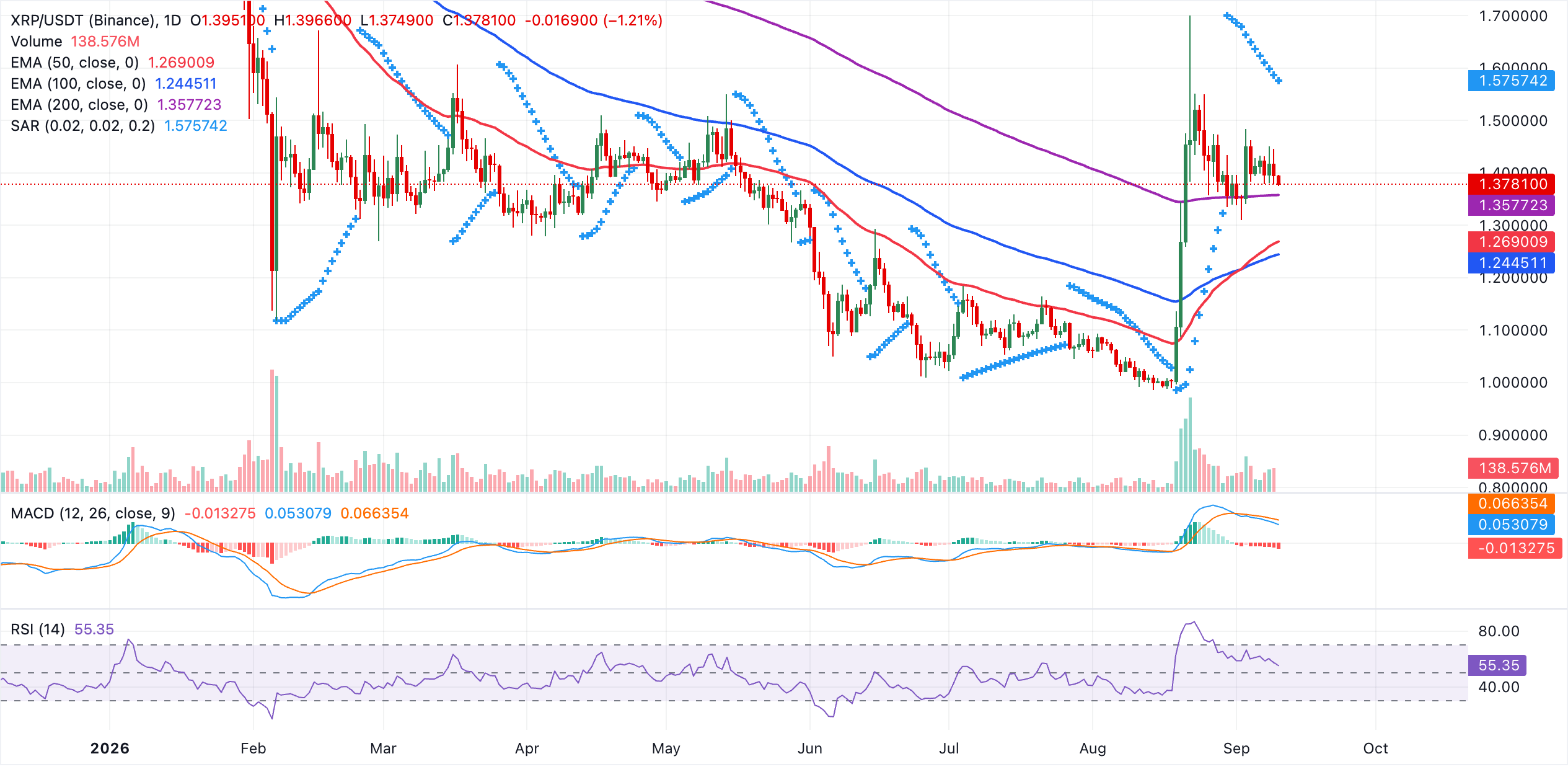
Initial support emerges at the 200-day EMA near $1.36, ahead of a deeper cushion from the 50-day EMA around $1.27 and the 100-day EMA close to $1.24, where buyers would be expected to reappear if the correction deepens. On the topside, the nearest hurdle is supply at $1.40, followed by the Parabolic SAR at approximately $1.58. A daily close above this level would reopen the upside and strengthen the bullish case, while failure to clear it could keep XRP consolidating within the current range above the EMA cluster.
(The technical analysis of this story was written with the help of an AI tool. Know more.)
Cryptocurrency metrics FAQs
The developer or creator of each cryptocurrency decides on the total number of tokens that can be minted or issued. Only a certain number of these assets can be minted by mining, staking or other mechanisms. This is defined by the algorithm of the underlying blockchain technology. On the other hand, circulating supply can also be decreased via actions such as burning tokens, or mistakenly sending assets to addresses of other incompatible blockchains.
Market capitalization is the result of multiplying the circulating supply of a certain asset by the asset’s current market value.
Trading volume refers to the total number of tokens for a specific asset that has been transacted or exchanged between buyers and sellers within set trading hours, for example, 24 hours. It is used to gauge market sentiment, this metric combines all volumes on centralized exchanges and decentralized exchanges. Increasing trading volume often denotes the demand for a certain asset as more people are buying and selling the cryptocurrency.
Funding rates are a concept designed to encourage traders to take positions and ensure perpetual contract prices match spot markets. It defines a mechanism by exchanges to ensure that future prices and index prices periodic payments regularly converge. When the funding rate is positive, the price of the perpetual contract is higher than the mark price. This means traders who are bullish and have opened long positions pay traders who are in short positions. On the other hand, a negative funding rate means perpetual prices are below the mark price, and hence traders with short positions pay traders who have opened long positions.
Author

John Isige
FXStreet
John Isige is a seasoned cryptocurrency journalist and markets analyst committed to delivering high-quality, actionable insights tailored to traders, investors, and crypto enthusiasts. He enjoys deep dives into emerging Web3 tren