US Dollar testing key support after FOMC minutes
- FOMC minutes, US CPI events are weighing on the US Dollar.
- US Dollar bears are in the market and eye a break of temporary support.
- Bulls look for commitments for a correction from support.

At 101.469 DXY, the US Dollar is being pressured on Wednesday following the Consumer Price Index (CPI) that increased in March at a slower-than-expected pace and minute from the FOMC´s March 21-22 meeting whereby the rate hike was widely viewed as dovish. DXY has dropped from a high of 102.15 to a low of 101.449 on the day so far.
The FOMC minutes showed that the staff at the Committee are forecasting a mild recession later in 2023 but also noted that wage growth was still well-above rates consistent with the 2% inflation target.
Key quotes from the minutes:
"Given their assessment of the potential economic effects of the recent banking-sector developments, the staff’s projection at the time of the March meeting included a mild recession starting later this year, with a recovery over the subsequent two years."
"In assessing the economic outlook, participants noted that since they met in February, data on inflation, employment, and economic activity generally came in stronger than expected. They also noted, however, that the developments in the banking sector that had occurred late in the intermeeting period affected their views of the economic and policy outlook and the uncertainty surrounding that outlook."
"Participants agreed that the labor market remained very tight."
"Some participants noted that given persistently high inflation and the strength of the recent economic data, they would have considered a 50 basis point increase in the target range to have been appropriate at this meeting in the absence of the recent developments in the banking sector. However, due to the potential for banking-sector developments to tighten financial conditions and to weigh on economic activity and inflation, they judged it prudent to increase the target range by a smaller increment at this meeting."
"Members concurred that the U.S. banking system is sound and resilient. They also agreed that recent developments were likely to result in tighter credit conditions for households and businesses and to weigh on economic activity, hiring, and inflation, but that the extent of these effects was uncertain. Members also concurred that they remained highly attentive to inflation risks."
US CPI core stays hot
As for the inflation data, the report showed the prices urban consumers pay for a basket of goods and services increased by 0.1% from the previous month and 5.0% year-on-year, landing below consensus expectations of 0.2% and 5.2%, respectively.
But the core measure came in hot. This measure strips out volatile food and energy prices and was posting a month-on-month gain of 0.4%, and 5.6% on an annual basis, 10 basis points hotter than the February print.
Nevertheless, Fed funds futures traders are pricing in 69% probability that the Fed will raise rates by an additional 25 basis points at its May 2-3 meeting, down from around 76% before the data. This is sending the US Dollar lower on the day and into technical support as follows:
US Dollar technical analysis
Daily chart
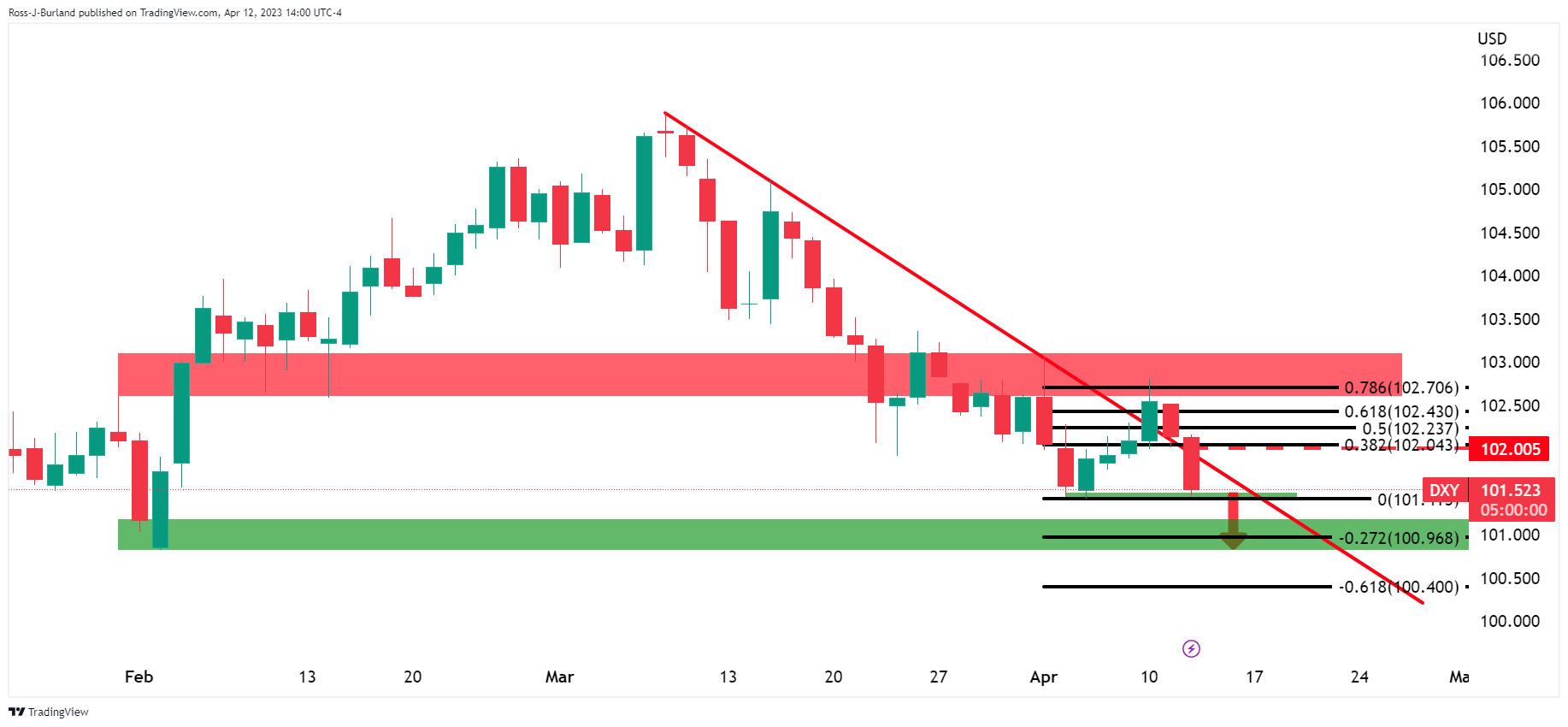
The bias is to the downside while the index is on the front side of the bearish trend and considering the strong daily bearish impulse from the 78.6% Fibonacci retracement level.
H1 chart

However, there are prospects of a correction on the lower time frames from the support area as illustrated above.
Author

Ross J Burland
FXStreet
Ross J Burland, born in England, UK, is a sportsman at heart. He played Rugby and Judo for his county, Kent and the South East of England Rugby team.
















